


Road bike tours - All information on planning, preparation and routes
Nowadays, more and more people are becoming enthusiastic about the Racing bike ride. Many of them are regularly on the lookout for new routes and the associated challenges. However, regardless of whether you have already undertaken road bike tours several times or are dedicating yourself to this endeavour for the first time: To ensure that everything runs smoothly and safely, it is important to bear a few key points in mind. After all, a successful road bike tour begins long before the first pedal stroke.



However, it is also clear that the road bike scene has changed considerably over the course of time. What used to be (apparently) exclusively the Professionals has now become far more open. As a result, many people now feel encouraged to make the "leap" from classic sportive cycling to road cycling.
The following sections show exactly what to look out for and which routes and regions are particularly suitable for both experienced cycling enthusiasts and beginners. However, TOUR does not start with this guide at the actual road bike tours, popular routes and tips for the road, but earlier. After all, comprehensive tour planning also includes making the right preparations. This tip should not only be followed by beginners, but by Road cyclists should be taken to heart. After all, every route presents a special challenge that needs to be mastered. If you are optimally prepared, you can enjoy your personalised route even more.
Which road bike is best suited to which route?
This is a question that every road cyclist has to deal with sooner or later.
Questions that can help narrow down the available choices a little more include:
- What kind of routes are you mainly going to ride on? Especially if there are not only the main roads but also many side roads, it may be that the route leads through rather uneven terrain. The road bike should of course be adapted to this.
- How sporty do I want to be on the road? And what do I already know about the planned length of my route?
- Is it about riding a "little racing bike" in your free time or perhaps even preparing for a competition? Racing bikes that are used in connection with competitionsare characterised not only by one or two "extras", but usually also by a lower weight and a high degree of rigidity.
Of course, you should also always bear in mind that there are Different racing bikes each of which is suitable for different routes. Classic racing bikes, for example, are ideal for fast and long rides. If you plan to ride off-road from time to time, you should opt for one of the all-road or off-road bikes. Gravel bike models decide. And when it comes to taking part in a competition, it is advisable to opt for a model with a convincing Aerodynamics to set. This can then also be used in a triathlon, for example. Last but not least, there are also road bike models that can be used on a wide variety of surfaces. They are considered to be particularly flexible and theoretically offer the rider the opportunity to spontaneously decide on new routes every day.
How much the "basic equipment" costs here depends primarily on the brand, model and equipment. TOUR advises you to compare the various options - from road bike models to GPS trackers - in order to find the equipment that best suits your needs.
What is the best way to prepare for a road bike tour?
The racing bike has been bought! Nice! Now it's time to plan your first tour. But what does the perfect preparation actually look like? Which route do you have in mind? Which routes are interesting? And do you want to stay in your own country or are you more drawn to international destinations?
Basically, no matter how motivated you are, meticulous planning not only ensures that your bike can cope well with the upcoming effort, but also that your body can. Planning a road bike tour can be a lot of fun - especially if you are not working under time pressure. However, don't just compare the different routes with each other, but also take a look at your Equipment.
The following tips will help!
Tip no. 1: The training
If you want to tackle a (longer) road bike tour, you also have to train... preferably several times a week and over long distances. However, in this context it is also important not to neglect strength training. After all, an extensive tour not only requires stamina, but also muscles... especially if you have to cover a lot of metres in altitude to reach your destination.
The leg muscles can be wonderfully challenged with calf raises, leg extensions and squats. However, the upper body should not be forgotten in this context either. After all, muscles in the torso can ultimately ensure that back pain is prevented in the best possible way. The stability provided by targeted muscle development in the upper body generally also ensures greater speed, as the strength in the legs can be better utilised due to the calm position of the upper body. TOUR advises you to focus on a challenging build-up training programme that supports both fitness and strength, especially if you want to cover a relatively high number of metres in altitude.
Tip no. 2: Targeted training of individual areas
One thing is certain: it makes a big difference whether you ride with classic wide tyres or thin road bike tyres over a longer period of time. To ensure a high level of safety, it is therefore important to practise special situations such as fast braking. Depending on the selected road bike region, this can be particularly important. A large, empty car park is best suited for these exercises.
By the way: This type of preparation is not only recommended for beginners. Experienced road bike users are also well advised to keep doing this type of session. "It is also a great way to practise riding straight ahead, negotiating tight bends and clipping in.
Tip no. 3: Prepare the road bike
Not only the rider, but also their bike should be in perfect condition on the "big day". It is particularly important to check all the details before long tours. This includes, among other things:
- the functioning of the brakes
- the chain
- the lighting
- the general driving experience
- the air pressure of the tyres
- switching
This ensures that any nasty surprises, such as an insufficiently lubricated chain, can be prevented in the best possible way in the middle of the route. Ideally, the road bike should first be checked about a week before setting off and then again before the "big day". The first check ensures that any "construction sites" can be rectified in good time.
Tip no. 4: Preparation for minor repairs
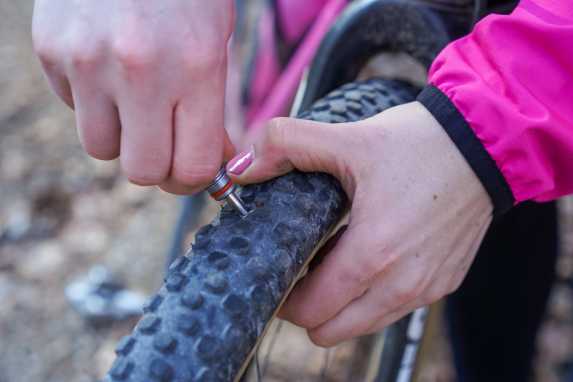
Almost every road cyclist knows that, despite all the preparation and extensive tour planning, it can happen that the bike is damaged on the side of the route. repaired must be done. Anyone who knows what to do here is naturally at an advantage. For a passionate racing cyclist who wants to be as prepared as possible for all incidents, this should not be a problem,
- re-inflate your tyres (and know how high the tyre pressure should be)
- Tighten screws
- pull in a spare hose
The better prepared you are, the less likely it is that you will have to cancel your tour. Of course, it is ideal if you not only know how to fix a problem, but also if you have the right emergency equipment with you. This is especially true if you are not only travelling on main roads, but also on secondary roads or off-road and it is likely to take a little longer for help to arrive in an emergency.
Tip no. 5: Plan overnight stays and stops meticulously
This is a point that many road cyclists cannot really get to grips with, but which is all the more important. At the latest when the road bike tour in question is no longer "just" a one-day tour, it is important to plan with stopovers (and accordingly also with hotels and stages).
Especially in summer, it would be wrong to rely per se on the fact that, with a bit of luck, a room will spontaneously be available in a nearby residence. It is therefore all the more important to familiarise yourself not only with the local conditions, but also with your own fitness level. With a little experience, you can quickly work out roughly how many kilometres you can cover per day. (Additional tip: always plan a small buffer here and don't calculate too tightly - especially if you have a lot of mountains).
Are you in the process of planning your first road bike tour? Should you Beginner it is advisable to plan shorter sections. This will give you and your body the opportunity to get used to the new feeling of "travelling". It is also important not to overexert yourself. Remember: the way back still needs to be mastered. You don't want to have to worry about the physical challenges on the way home? Consider using a different means of transport for the return journey - for example, by train or bus.
What should road cyclists consider in terms of equipment and clothing?
The good news is that the equipment that a road cyclist should have with them on a tour is generally not very demanding in terms of the space it takes up. Most items and equipment can be easily stowed in a medium-sized rucksack or a bag on the bike.
If you are travelling for longer, you should pay particular attention to the following gadgets and Tools can set:
- a mini tool
- one Allen key set
- a spare hose
- Water
- (depending on the weather forecast) a rain jacket
- a small bicycle pump
- a mending kit.
However, to ensure that the comfort factor doesn't suffer during a road bike tour, you also need the right Clothing. Cycling shorts are a particularly important item of clothing in this context. These should always be worn with a comfortable seat cushion be equipped. It is advisable to test the comfort beforehand - on a shorter tour.
Many road cyclists also appreciate it when their top has several small additional pockets. These can be used to stow keys, bars and smartphones, among other things. Last but not least, the outfit is rounded off with comfortable, close-fitting road cycling shoes. These should always provide good, secure contact with the pedals. Perfectly equipped in this way, you can then usually enjoy the respective road bike route a little more.
How should I eat before and during a road bike tour?
Especially on longer road bike tours, it is important to provide the body with the nutrients it needs (and has sweated out) via a suitable Nutrition again. After all, the metres in altitude, physically demanding stretches and steep passes need to be balanced out. If you take the time to stop off at a restaurant, you should look out for potatoes and rice on the menu. Potatoes provide an increased protein intake, while rice is generally considered easy to digest and does not put too much strain on the stomach.
Among other things, however, a diet rich in nutrients and vitamins should generally be prioritised. Vegetables such as peppers, beetroot, apples and bananas are recommended.
Before finally setting off on the route, it is advisable to fortify yourself with a large breakfast, for example. However, it is of course important not to eat too much, as otherwise you are more likely to get side stitches. Some riders also complain of nausea in connection with a full stomach before sport. Here, too, it is best to find out what is good for you first by doing shorter tours and preparing for them.
Which route is the most beautiful for road bike tours?
As many metres in altitude as possible or would you prefer a route with a long, comparatively flat stretch? Smooth roads on the best tarmac or gravel tracks? The list of options when it comes to road bike tours is long. Whether in Germany, France, Italy, Austria, Switzerland, Spain or Europe as a whole, or in relation to long-distance destinations: If you want to plan a road bike tour, you will be confronted with different routes in different countries.
But which route is actually the most beautiful? This is - understandably - a question that cannot be answered in a standardised way. Rather, each country or region is characterised by its own individual routes. It is always best to bear in mind that the way back does not necessarily have to be the same as the way out. Many road cyclists, for example, decide to cycle first and then take the train back home a few days later. Of course, the reverse is also possible.
Additional tip: TOUR advises you to first mark important waypoints along the route and then think about the best way to link them together. This allows you to experience the different regions a little more vividly.
Germany
Many road bike tours in Germany are characterised by a comparatively high altitude difference. It is not only in classic road bike regions, such as the Eifel and Sauerland, that there are always uphill and downhill sections. The area around Freiburg, Lake Constance and the city of Tübingen are also particularly popular - both with beginners and advanced racing cyclists. Those who opt for the "ambitious routes" here should bring plenty of strength and fitness with them. In addition, the probability of being "surprised" by bad (or at least mixed) weather is higher than in maritime regions. TOUR therefore recommends carrying light and easy-to-store rainwear, especially when travelling longer distances.
France
What could be more tempting than France Riding a road bike? After all, the pros will be showing Tour de France It is also worth noting again and again how wonderfully cycling can be combined with impressive views. Many racing cyclists start in Switzerland and then cycle long distances through the country - until they finally arrive in Monaco or Marseille, for example. France offers both comparatively flat routes and real mountain pass challenges. The Alpes Maritimes region is particularly mountainous.
Italy
Road bike riding in Italy is the perfect place to combine sport with a special maritime lifestyle. The long borders to the sea allow you to feel a pleasant breeze kilometre after kilometre. However, some routes - for example on the Alpe-Adria Cycle Path - are rather gravelled. For some tours, we therefore recommend a Gravelbike. It is therefore important to prepare in advance for the somewhat rougher roads. In general, road cycling in Italy is a wonderful opportunity to get to know the landscape and to use various waypoints to experience the road cycling route in a new way time and time again. TOUR also advises you to look at tour suggestions that combine sport and sightseeing. Italy in particular offers some wonderful opportunities for this. Particularly popular in this context are the numerous mountain passes that the country has to offer and which are often part of the Giro d'Italia are. But here, too, it is important to take a closer look. This is because some routes in Italy are primarily aimed at road cyclists who already have a lot of experience.
Austria
Also in Austria nobody has to miss out on their "mountain stages" when road cycling. Whether in Lower Austria or Carinthia: No one has to miss out on scenic variety here. Popular routes include the Katzentürl circuit and the Nockalm road. Anyone who regularly rides a road bike in Austria will not only appreciate the unique panoramas, but also the (mostly) well-developed road network. Those who fancy lush meadows and the odd ambitious climb should include Styria in their search for a suitable road bike route. One thing is certain: there are more than enough tour suggestions - especially in Austria. If you want to plan a road bike tour, you are often spoilt for choice.
Switzerland
The Switzerland is of course not just a racing bike region. The conditions in terms of stages and metres in altitude - both on the main and secondary roads - are similar in Switzerland to those in Austria. However, riders who love shorter laps, such as circular routes around lakes and the like, also get their money's worth here. Lake Zurich is a popular destination in this regard. At around 75 kilometres, the circuit is often also suitable for ambitious beginners. Caution! Some road bike routes in Switzerland may not be too long, but there are often many sections with comparatively loose surfaces.
Spain
In Spain it is possible to cycle in the mountains as well as on the coast. There are always plenty of highlights to discover along the roads and paths - both in the major cities and in the villages. The region in and around Andalusia is particularly popular when it comes to optimising tour planning.
In this context, it is of course also particularly "practical" that it is possible to be out and about on a road bike all year round in many parts of Spain. The weather is usually pleasant and not too cold in most places, even in winter. That's why German cyclists also count Balearic island of Mallorca is one of the most popular road bike destinations. If you want to be a little more flexible in terms of difficulty levels, you should choose a road bike route from Malaga. Various routes with different levels of difficulty start from here.
Long-distance destinations
When it comes to planning road bike tours, a particular trend has been observed for some time now. In particular, riders who have already gained years of experience - especially in the area of longer routes within Europe - are often increasingly drawn towards Long-distance destinations. Cycling in the USA for once? Or maybe even in Asia? One thing is certain: There are not only passes in Europe that are worth conquering.
Planning a road bike tour in other, more remote areas is not all that different from planning a route in a nearby road bike region. What's more, many airlines are now characterised by their comprehensive and uncomplicated services when it comes to transporting equipment from A to B. So if you fancy a new road bike region - far away from what you already know - you should think outside the box and perhaps "internationalise" your tour planning a little.


