Roller trainers: indoor cycling when it's not suitable outside
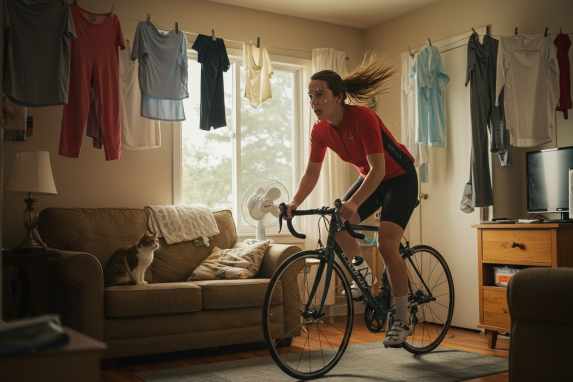
With a good roller trainer, the saying "There's no place like home" can be put to good use again. After all, you are probably one of those cyclists who prefer their Racing bike prefer to ride outside, with the wind in your face and a real feel for the road. But sometimes there are storms, darkness, slippery snow, lack of time and other adverse circumstances where a roller trainer is a top alternative to keep you going in bad weather and during the cold season. train to be able to.



What types of indoor cycling are there?
From exercise bikes to roller trainers: there are many different products that you can use to create a cycling feeling indoors. The reasons for using one or the other are just as varied. TOUR gives you an overview of which training devices are available for a successful training programme. Indoor training on the market - above all the roller trainer.
Exercise bike: Exercise bikes or home trainers are cardio fitness machines with minimal basic equipment. They are stationary bikes with a flywheel mass of at least five kilograms and a maximum power output of 150 watts, which would only elicit a tired smile from a real racing cyclist. They are generally simple and inexpensive training devices for everyday use. An exercise bike trains endurance and strengthens the cardiovascular system. However, exact training specifications and the tracking of physiological data are not provided.
Ergometer: The ergometer is also a stationary bike, but represents a real upgrade compared to the exercise bike. An ergometer can be used to determine your exact performance level. Individual training programmes can be defined and completed by recording the pulse, distance, exertion and recovery phases. The accuracy requirements for ergometers are significantly higher than for exercise bikes. The pedalling resistance must be precisely adjustable and the watt measurement must be calibrated. And with outputs of around 400 watts, the sporting demands have also increased. However, the sitting position remains relatively relaxed, as with an exercise bike. If you were to compare an ergometer with a road bike, it would be more of a touring bike than a sporty racing bike. Nevertheless, due to its measurement accuracy and range of functions, it is also a popular training device in professional sport. It is also often used in medicine and especially in rehabilitation. Recumbent ergometers are a special type of ergometer that are particularly easy on the joints and are ideal for older and physically handicapped people.
Spinning wheels: While home trainers and ergometers focus on health aspects, spinning bikes are all about pure power training and hardcore fitness. The riding experience and the sitting position are designed for sportiness. The workouts usually take place in a group, where participants cheer each other on to loud music. A heavy flywheel disc is used for strength training to the point of total exhaustion. The spinning bike is also a stationary bike. The training is repeated in hard intervals, the intensity can be adjusted using touch or rotary controls and there is no idling. A trainer (in the gym) usually sets the pace. When athletes do spinning alone and not in a group, it is also referred to as indoor cycling.
Roller trainer: The roller trainer is not a stationary bike, but a training device that allows you to use your own racing bike for exercise in your own four walls. There are three basic versions: the trainer with direct drive, the roller trainer with pressure roller and the free roller. The great advantage of roller trainers is that you can use your bike with the geometry that has been specially adjusted for you and do not have to change or get used to it. Another practical advantage compared to a stationary bike is that most roller trainers can be folded up to save space if you prefer to use your road bike outdoors.
What is a free roll?
With the free roll, the bike is placed on a frame with three loose, movable rollers. The rear wheel is placed on two rollers that are close together and the front wheel is placed on the third roller alone. You have to balance the ride yourself on the free wheel. After a familiarisation phase, however, you will quickly notice how balance and coordination are trained. Even the classic cradle kick is possible on such a training roller. The riding experience on the free roller is realistically similar to cycling on the road, but also requires greater concentration. Product features that you should definitely look out for in a free roller are the brake for simulating off-road resistance and the roller's bearings. A training roller that swings in the direction of travel can, for example, absorb impulses from the racing bike and rider.
What is a roller trainer with pressure roller?
With this type of model, the rear wheel is firmly clamped into a frame and fixed so that you can concentrate fully on pedalling during training. The roller trainer is clamped to the quick release. Most roller trainers are supplied with a special quick release for this purpose. To compensate for the gradient caused by the rear wheel being "jacked up", a front wheel support is usually also included with the roller trainer. This is also used to keep the bike on track and keep it level. To generate pedalling resistance, a braking system is required for the rear wheel. This usually consists of a pressure roller that is clamped to the tyre via a lever. The small roller is connected to a flywheel, which runs more smoothly the larger it is. The best power transmission is achieved with treadless tyres. If the roller trainer is used intensively and frequently, you should consider using a rubber compound for the tyre that is optimised for this purpose. The quality of the braking system and the adjustment options for the rolling resistance are also decisive purchase criteria for the roller trainer with pressure roller. Of course, the riding experience does not come close to the road feeling, it is relatively static. If you attach more importance to authenticity, you can opt for wobble platforms, which are designed to replicate outdoor road conditions more realistically.
What is a roller trainer with direct drive?
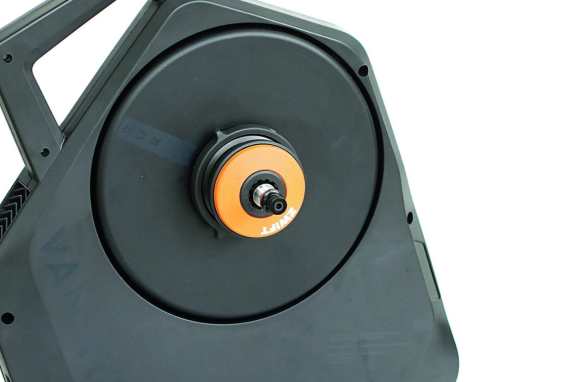
With this type of roller trainer, the rear wheel is replaced by a direct drive. A sprocket is clamped to the chain so that the power can be transferred directly to the sprocket set of the roller trainer without loss. This protects the actual rear tyre as it is not used. The resistance can be adjusted in different ways. Simple mechanical adjustment systems use a separate control element that you can clamp to the handlebars. A cable pull system then offers you the option of adjusting the manual magnetic resistance on the roller trainer in individual stages. However, there are also electronic systems where you can control the resistance levels via a PC, app or tablet with the appropriate software. In some cases, this can also be done according to specifications such as your heart rate or the terrain characteristics in virtual worlds. To make the ride feel more realistic, some manufacturers use a system with flexible feet that allows slight sideways movements.
What is a smart roller trainer?
Smart roller trainers are equipped with sensors and offer the option of interaction. Smart roller trainers exude a touch of artificial intelligence because their control system reacts to changes in the boundary conditions. The fact that smart roller trainers are also used in real sporting competitions increases the demands on measurement capability and accuracy. After all, it would be unfair if someone won an e-cycling race simply because they were able to conquer the same hills with less power. Of course, there are different levels of smartness for smart roller trainers. In the simplest case, only the frequency of the rear wheel is transferred to the virtual world and everything else, such as pedalling power and the resulting speed, is merely calculated. As the brake is not linked to the virtual terrain, the rider can "cheat" because they do not have to adjust the resistance of the brake unit on a digital hill. A holistic smart trainer, on the other hand, relates everything to each other. The digital hill and the condition of the virtual road determine the braking resistance. If you climb, you have to sweat and change gear. In principle, all three types of roller trainers can be used as smart trainers. However, if you are travelling on the free roller, you should already have a certain level of safety. If you are training or racing in virtual waves, virtual and real reality can sometimes mix. As soon as you enter a bend on a downhill run on Zwift, there is a real risk of falling off the roller.
What should I look out for when buying a roller trainer?
From the braking system to the volume, there are a number of product features that you should scrutinise when buying a roller trainer.
- This starts with the aforementioned quality of the Brake resistance system. Which system is used and how precisely can the resistance levels be set? Does the rear wheel slip when pedalling hard?
- If you are interested in a Smarttrainer, then you need to know the whole Interfaces in view. Which data is actually measured and transferred to the virtual world, and which is only calculated? Which platforms and apps is your roller trainer compatible with? Which parameters can be used as control parameters for your training? Can you use a heart rate monitor to record your health data and transmit training data?
- Which Range of functions do you need? Do you simply want to define training programmes yourself or do you want to load "real" routes via GPS track and ride them in detail? Do you need a roller trainer with animation to be able to race?
- How smoothly the Flywheel for trainers with direct drive?
- How realistic is that Driving experience be? Is a static ride without pedalling enough for you or should it be as dynamic as on a real road?
- What about the Noise development off? The noise level of the roller trainer can be an issue, especially in a rented flat. Roller trainers are often louder than normal ergometers. The coarser the tyre tread, the louder the rolling noise on trainers with a pressure roller. To avoid noise and vibrations, you can place the trainer on a thin foam mat or carpet.
- The robustness and Stability of the roller trainer are also important features.
What advantages does a roller trainer offer?
The biggest advantage is training on your own road bike. The settings of the Saddlesthe Handlebarsthe Gear shift and much more corresponds exactly to what you know from the road. This sets roller trainers apart from all stationary bikes. What's more, you have less preparation and follow-up work. You are at home and can get started straight away. At the same time, you can do without things like cycling goggles, rain jacket, bike locks and other ballast. On the free roller, however, you should still wear a cycle helmet, at least at the beginning. If you don't need the roller trainer for a long time in summer, you can fold it up and store it away to save space. The disadvantages are, of course, the static riding experience on trainers with a press-on roller or direct drive. The abrasion of the tyre casing is also usually much more pronounced. If the rear wheel is placed in front of a white wall, worn rubber can accumulate there. A smooth tyre casing for training purposes and a protective cover for sensitive walls are recommended.
Which manufacturers of roller trainers are there?
Well-known manufacturers of roller trainers are Elite, Tacx, Wahoo, JetBlack and Saris, which also stand for the highest quality training equipment. There are also suppliers such as Zwift, Decathlon and Xplova. At TOUR you will find various test reports on roller trainers from a wide range of manufacturers.
Roller trainer test
Over the past few years, TOUR has tested almost all the well-known roller trainers on the market. Here you will find a large Comparison test. These include the Elite Nero model as a very realistic version of a free roller. In the test, the Tacx Antares T1000 proved to be an affordable free trainer for beginners. The Tacx Boost Bundle and the Wahoo Kickr Snap were able to position themselves as affordable models for getting into interactivity. In the area of real smart trainers, TOUR put the JetBlack Volt and the Elite Suito, among others, through their paces. Among the high-end smart trainers, the Saris H3, the Zwift Hub and the Tacx Neo 2T Smart were scrutinised as part of the large comparison test.
Individual test reports can be found on the Wahoo Kickr V5, to the Wahoo Kickr Rollr and to the Tacx Flux S Smart.
What do roller trainers cost?
There is a wide range of prices for roller trainers. The simplest roller trainers are available for less than 100 euros. However, you should treat these with caution. More sophisticated models cost several hundred euros. For a real smart trainer, you need to calculate with at least 500 euros, while high-end training devices are priced in the four-digit range. If you have the opportunity to do a test training session, be sure to take advantage of it.
Is the bike roller worth it?
Yes, the training roller is worth it. Even in the high-end version, smart roller trainers are significantly cheaper than good racing bikes and generally also cheaper than indoor bikes. They are therefore an excellent training alternative. With a bike roller, you can get through the winter without putting on rolls of flab elsewhere on your body. Of course, even the best simulation and the most sophisticated animation of a virtual world cannot achieve the real feeling on the road.