


Vuelta a España: Cycling highlight in late summer
The Vuelta a España is the third major national professional cycling tour of the year and usually takes place in August or September. The Tour of Spain impresses riders and spectators with its hilly profile and some difficult mountain stages. TOUR explains everything you need to know about the Vuelta and keeps you up to date with the latest news about the cycling event.


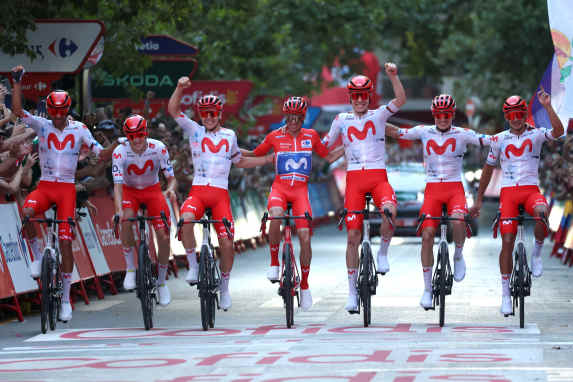

Vuelta a España: Tour of Spain on hilly terrain
The Vuelta a España (Spanish for Tour of Spain) ranks alongside the Tour de France and the Giro d'Italia is one of the three biggest cycling races in the world - the Grand Tours. Since the 1990s, it has been held after the other two competitions in August and September, marking the end of the major road races. It is usually followed by the Cycling World Championships, which usually take place in mid-September.

The Vuelta Ciclista a España (usually abbreviated to Vuelta or La Vuelta) was first held in 1935, making it the youngest of the Grand Tours. The three-week tour usually comprises 21 stages and two rest days. The challenging course leads across Spain with alternating routes. Like the Giro d'Italia and the Tour de France, the Tour of Spain often starts outside the country. In some cases, the route also makes individual detours to other countries, such as Germany, France or Andorra. Traditionally, the Vuelta ends in the Spanish capital Madrid.
Since 2005, the Vuelta has been part of the UCI Pro Tour, a series of major road cycling races organised by the International Cycling Union. The successor series has been the UCI World Tour since 2011.
Tour of Spain: The perfect route for climbers
The Vuelta is characterised by its hilly stages and impressive surroundings. It usually covers a distance of 3300 to 3500 kilometres, divided into 21 stages. The riders often climb up to 5000 metres in altitude in just one day. Due to its few flat stages, which often end with a shorter mountain finish, the Vuelta is considered the most mountainous Grand Tour. As a result, strong climbers are usually the top favourites.
However, if you want to be at the front of the race and take a stage win or even the overall victory, you also need to be a good time trialist: The Tour of Spain often starts with a time trial right at the beginning - either as a team or individually. Another time trial follows in the second half of the tour. In addition, there are usually two, sometimes even three rest stages, for example if there is a transfer between two countries.
The majority of the stages take place on the coast in the south of the Iberian peninsula or on the high mountains in the centre of the country. The riders often also complete some flat stages in the north-west north of Portugal. The trademark of the Vuelta is the Alto de Angliru climb in Asturias, where the riders have to overcome a steep ramp with a gradient of up to 24 per cent. This climb is one of the most difficult in all of cycling.

Other hard-fought and exciting stages include the mountain finishes at the Puerto de las Peñas Blancas, the Sierra de la Pandera or the Hoya de la Mora in the Sierra Nevada. The Vuelta often makes a stopover in Andorra on the border with France for some stages. Some steep mountain stages and passes await the cyclists here.
Vuelta a España 2022: The 78th edition of the Tour of Spain
The 78th edition of the Vuelta begins on 26 August 2023 with a team time trial in Barcelona and ends after three weeks on 17 September in Madrid. Highlights of the route are the arrivals on the Col du Tourmalet and the Angliru, which are well-known from the Tour France.
The rankings and jerseys of the Vuelta
Who can wear which jersey at the Vuelta has been changed several times in the past. Not only have the jersey colours changed, but also the rules. Today, the Tour of Spain is held in accordance with the regulations of the UCI and the special regulations of the organiser, the company Unipublic. The organiser can make changes to its specifications for the race from year to year.

Overall ranking
The overall leader has worn the red jersey (maillot rojo) since 2010 (75th anniversary of the Vuelta). In the past, the jersey was gold or yellow for many years, but also white, orange and white with red chest stripes. For the overall classification, the times of all the stages ridden are added together - minus the time credits that the first three finishers receive at the finish and at intermediate sprints. The professional cyclist who takes the shortest time to complete the entire course wins the overall classification.
Scoring
As in the Tour de France, the points classification jersey is green in the Vuelta. The points are awarded to the top 15 or top 3 at the intermediate sprints and finishes. In the event of a tie, the number of stage wins and then the number of intermediate sprints won will determine who wears the green jersey (maillot verde).
In 2021, points were awarded according to the profile of the route for the first time - as in the Giro and the Tour de France. As a result, the riders were able to score more points on the flat stages than on a mountain finish. This means that the sprinters have a better chance of winning the green jersey, while the climbers dominate the white jersey in the mountain classification.
Mountain classification
The rider who leads the mountain classification wears the best climber's jersey (maillot lunares). As in the Tour de France, this is white, but with blue rather than red dots. As in the other two national tours, the summits of the Vuelta are divided into four categories. Depending on the level of difficulty, the first three or five riders on the climbs receive different amounts of points for their placing.
Young talent ranking
Since 2019, the best young rider has worn a white jersey (maillot blanco), as in the other two Grand Tours. Like the leader of the overall standings, he is determined by adding up the times of the daily stages of all riders under the age of 25.
There is also a team classification and a competition for the most combative rider. Until 2018, the Vuelta had a special feature in cycling with only a few interruptions: the combined classification. It honoured the most versatile professional cyclist. The results of the overall, mountain and points classification were added together for this. The rider with the lowest total led this combined classification.
Past winners of the Tour of Spain
The Spaniard Roberto Heras (2000, 2003, 2004, 2005) has won the most overall victories in the Tour of Spain. The Swiss rider Tony Rominger (1992-1994), the Spanish professional cyclist Alberto Contador (2008, 2012, 2014) and the Slovenian Primož Roglič (2019-2021) have three victories each. The 78th edition of the Vuelta will show whether Roglič can draw level with Heras.
The Spaniard Delio Rodríguez has the most stage wins. He holds the record with 39 victories. In general, the Spaniards dominate the results of their home tour: they have won the Vuelta a total of 33 times and also achieved many stage victories.
List of Vuelta winners over the last ten years
- 2022 Remco Evenepoel (Belgium)
- 2021 Primož Roglič (Slovenia)
- 2020 Primož Roglič (Slovenia)
- 2019 Primož Roglič (Slovenia)
- 2018 Simon Yates (Great Britain)
- 2017 Christopher Froome (Great Britain)
- 2016 Nairo Quintana (Colombia)
- 2015 Fabio Aru (Italy)
- 2014 Alberto Contador (Spain)
- 2013 Christopher Horner (USA)
- 2012 Alberto Contador (Spain)
History of the Vuelta a España
Inspired by the Italian and French national tours, the Vuelta a España was held for the first time in 1935. 50 riders took part in the race, which consisted of 14 stages. The winner was the Belgian Gustaf Deloor. Even then, the route was more than 3000 kilometres long. The Belgian cyclist also won the Vuelta a year later. In the following years, the Tour of Spain only took place very irregularly. This was due to the Spanish Civil War and the Second World War, as well as the resulting economic problems in the country.
The Tour of Spain has been held annually since 1955 - with more and more participants and spectators. Initially, the organiser scheduled the race in the spring. However, this led to overlaps with the other Grand Tours, so the Vuelta was moved to August/September in the mid-1990s. Unipublic has been the organiser of the tour since 1979 and has been working with the Amaury Sport Organization (A.S.O.) since 2014.
In 2020, the Vuelta was postponed to 20 October due to the COVID-19 pandemic. This resulted in an overlap with the Giro d'Italia, which took place from 3 to 25 October. The riders therefore had to decide which Grand Tour they would take part in. For the first time since 1985, the tour only comprised 18 stages instead of 21 and did not start in Utrecht in the Netherlands as planned. The route to neighbouring Portugal was also omitted due to the pandemic.


