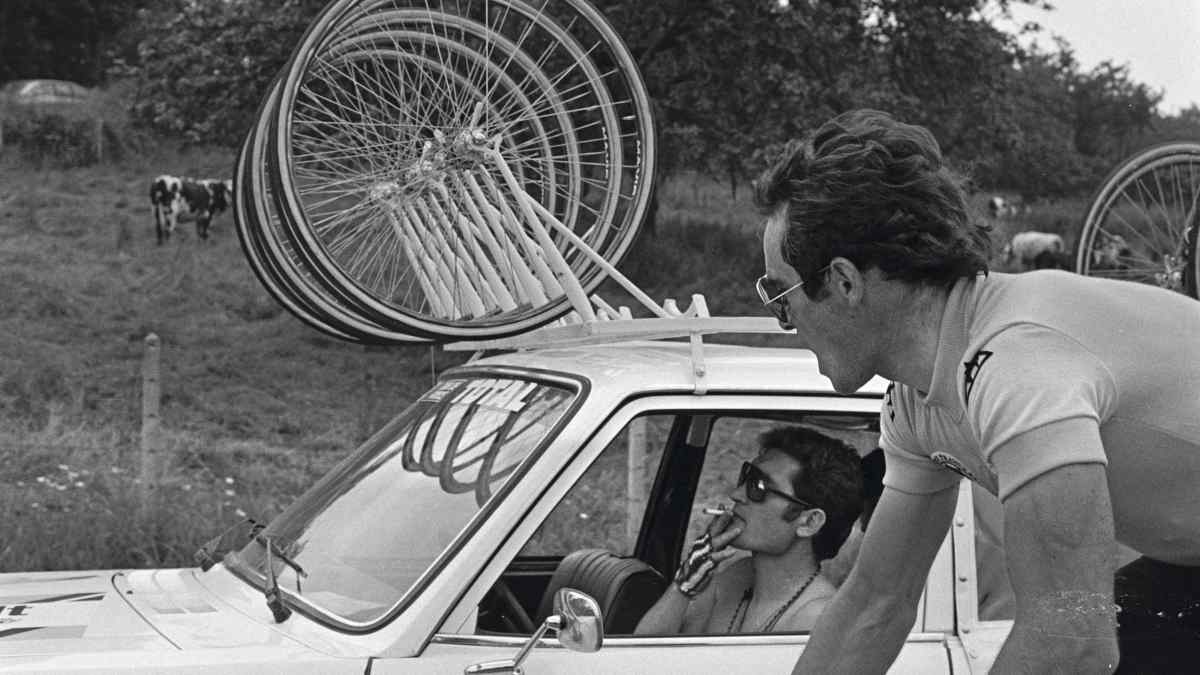
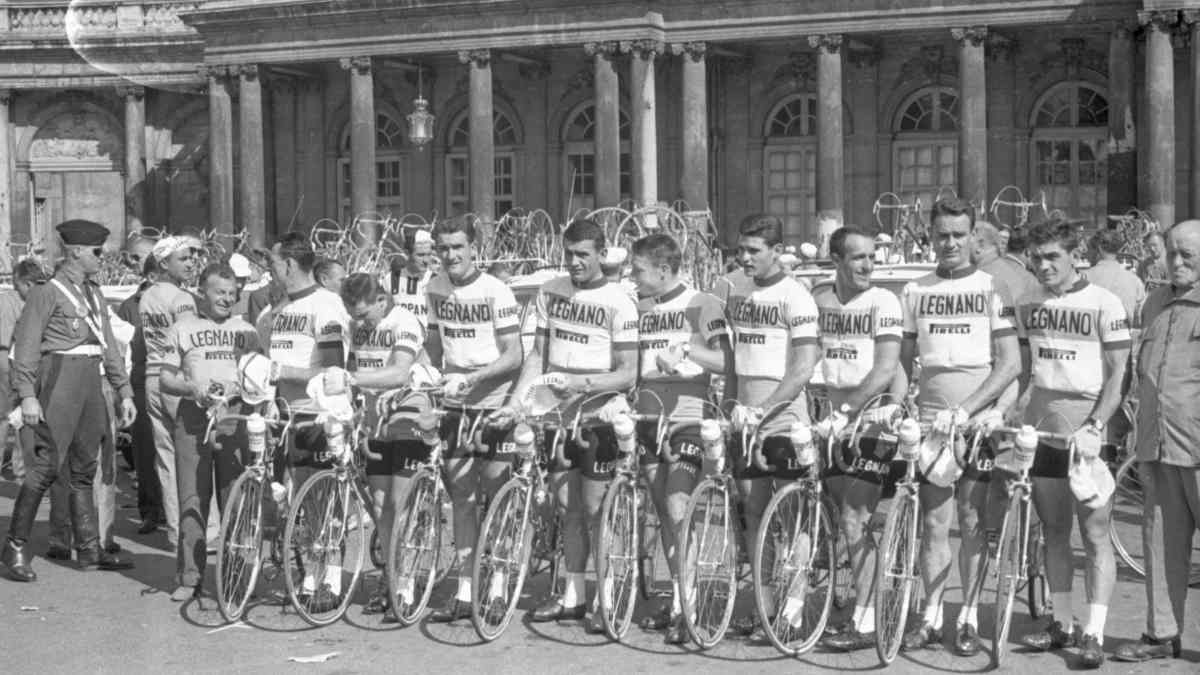
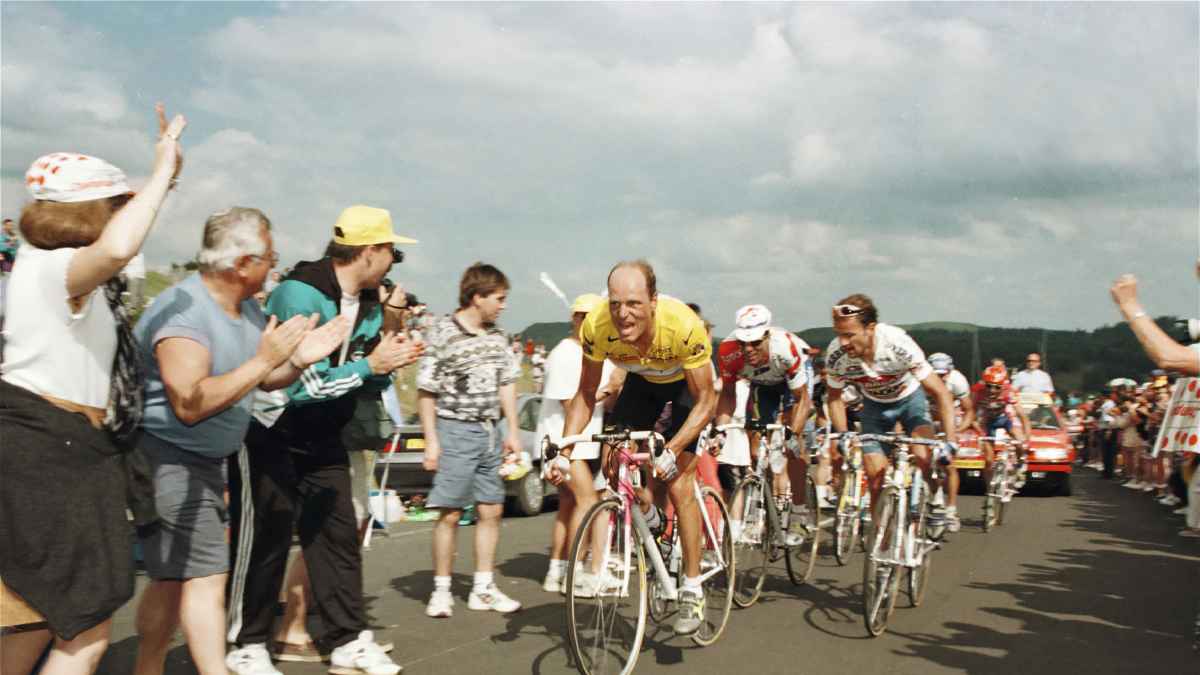
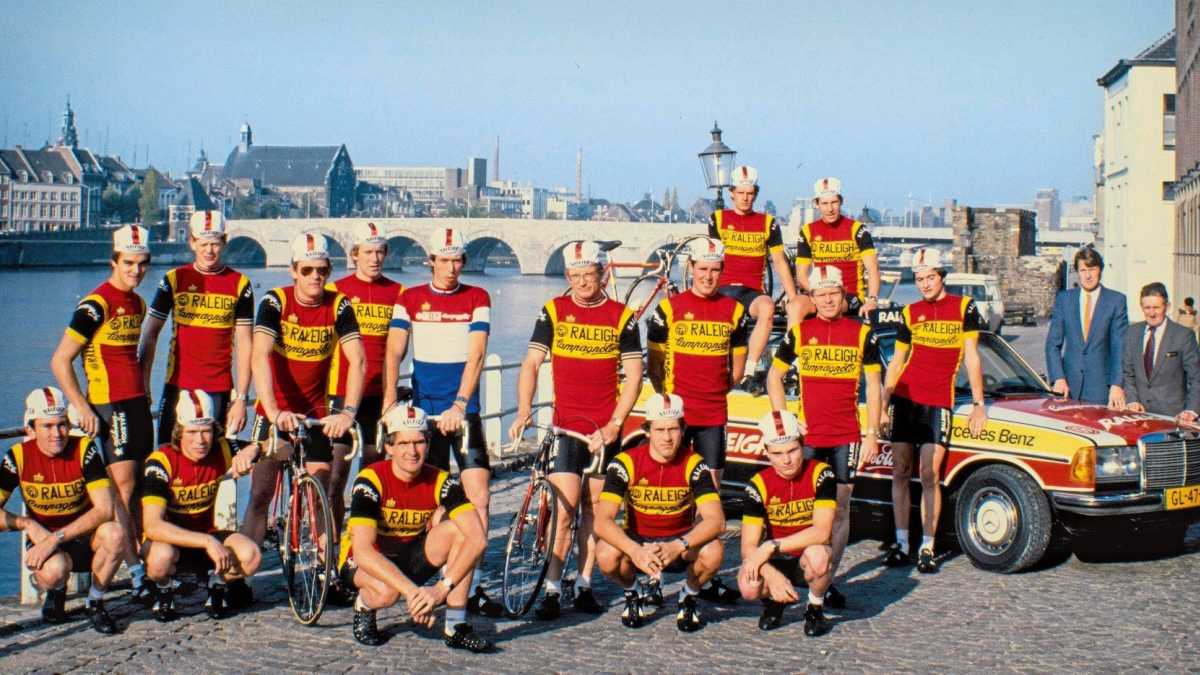
Belgium’s best: Between 1959 and 1979, there was hardly a top Belgian cyclist who did not wear the Flandria jersey. The only exception: Eddy Merckx. It might well have been too chaotic for him in that team. Many of his compatriots, on the other hand, helped Flandria to numerous successes. The team was regarded as young and carefree, but also difficult to manage. Behind the scenes, a family-run business influenced the team’s fortunes – not always for the better.
The history of its origins
From the province of West Flanders to the wider world: over several generations, the company Flandria developed into a successful manufacturer of bicycles, mopeds, lawnmowers and motorbikes. In addition to its headquarters in the municipality of Zedelgem, further sites were established in the Netherlands, Portugal and France. From 1959 onwards, the company’s involvement in cycling proved instrumental in raising its profile. Leon Vandaele was the key figure in this. The young sprinter had fallen out of favour with Team Faema. In 1958, he had committed the affront of defying the team hierarchy at Paris–Roubaix and finishing ahead of team captain Rik Van Looy. Flandria’s managing director, Aimé Claeys, subsequently met with Vandaele and decided to set up a team centred around the Belgian from 1959 onwards.
The greatest victory
In Flandria’s case, it is a winning streak: the Belgian Freddy Maertens finally established himself among the world’s elite in 1976. As a strong all-rounder with a powerful sprint, he claimed eight stage victories in that year’s Tour de France. Together with Charles Pélissier and Eddy Merckx, he still holds the record to this day. Maertens could even have achieved more victories; after all, he finished second four times in that Tour. He was unrivalled in the battle for the Green Jersey. He also wore the Yellow Jersey for eight days.
Maertens was hailed by the press from an early stage as the next Eddy Merckx. However, Maertens needed guidance, which is why Flandria appointed Guillaume Driessens as their new team manager for the 1976 season. Initially, Maertens benefited from this partnership. In September 1976, he also won the Road World Championships.
However, Driessens subjected his protégé to increasing pressure to perform, which did Maertens no favours. At the 1977 Giro d’Italia, he suffered a serious crash during a sprint finish and sustained a complicated wrist fracture. In the captain’s absence, the team saw Michel Pollentier go from strength to strength; he claimed the pink jersey after the 17th stage and went on to win the race. Driessens, always looking for the bright side of sport, had found a new favourite in Pollentier. He dropped Maertens.
The Boss
Aimé Claeys handed over the management of the team to his son Pol at an early stage; following Aimé’s death in 1972, Pol took over the entire company. Pol Claeys was regarded as an enterprising businessman. In cycling, however, he lacked foresight. He viewed his riders as employees with business obligations, and regarded frequent appearances at regional fairground races as an integral part of the racing calendar. Even top riders such as Maertens were no exception to this. “Freddy rode 230 races a year. And all of that without any planning – actually, it was very amateurish,” journalist Robert Janssens is quoted as saying in the book *Het verhaal van Flandria* about the team’s history.
When it came to sponsorship negotiations, however, Pol Claeys was in his element. From 1970 onwards, he brought the US corporation Mars on board, which was looking for an advertising partner for the launch of its chocolate bar in Belgium. In 1973, Claeys signed an agreement with the components manufacturer Shimano to enable the Japanese firm to enter the world of cycling. Shimano’s components for Flandria: the first generation of Dura-Ace.
However, the team’s sporting successes were primarily down to the riders’ abilities, not the team structure. Support, equipment and planning – all of these fell short of the standards set by other teams. Maertens is said to have frequently painted Italian frames red and white at the factory so that they looked like Flandria bikes.
The team dynamic also suffered from too many riders’ egos. From 1969 onwards, the squad included stars such as Eric Leman, the brothers Roger and Eric De Vlaeminck, Walter Godefroot and Jean-Pierre Monseré. “You can’t even imagine how much squabbling there was between all these riders. These men simply didn’t want to ride for one another,” says Janssens, describing the situation.
The man who should have instilled structure and order within the team was Albéric “Briek” Schotte. As a racing driver, he embodied the Flemish virtues of hard work and perseverance. As team manager, however, Schotte came across as a doting grandfather who always turned a blind eye. The team lacked authority. The chaotic overall organisation of the team made the work even more difficult. Claeys regularly signed new amateur riders from the region – mostly without Schotte’s knowledge. Squads of more than 50, and in some cases even 60, riders were not uncommon, even though many of them only competed in fairground races. In 1976, Driessens replaced Schotte as team manager.
The most influential riders
Freddy Maertens
As a successful amateur, Maertens had already been offered a lucrative contract by the Italian professional team SCIC in 1972. At the same time, his mother had fallen seriously ill, which threatened the future of the family laundry business. This is where Pol Claeys stepped in: he offered his help – but on the condition that Maertens signed for Flandria. The Belgian possessed immense talent. His CV boasts 15 Tour de France stage wins, three Green Jerseys and two world championship titles. However, he lacked the unshakeable mental fortitude of an Eddy Merckx or a Rik Van Looy. He also had no knack for managing money. Even during his career, he ran up debts through loss-making investment deals. The newspapers pounced on his private life and his slumps in form. After several team changes and years without success, Maertens ended his career in 1987.
Jean-Pierre Monseré
When the Belgian made his professional debut in 1969, even Eddy Merckx’s dominance seemed under threat. At the very least, the Belgian newspapers were unanimous in their belief that Monseré would become one of cycling’s all-time greats. The young man from Roeselare possessed the necessary self-confidence and relished public events and the company of celebrities. In his first year as a professional, he won the Tour of Lombardy; a year later, the Road World Championships. In a three-man leading group, Felice Gimondi is said to have tried to buy the title from him. Monseré refused and won the sprint. In March 1971, he collided with a car during a fairground race in Belgium. He succumbed to his injuries – aged 22 and whilst wearing the world champion’s jersey.
Michel Pollentier
Pollentier represented an atypical breed of Flemish cyclists. For him, climbing had nothing to do with talent, but rather with the ability to endure suffering. It was only on the recommendation of a friend that he joined Flandria in 1973. At first, he was overshadowed by his friend Freddy Maertens, before winning the Giro d’Italia in 1977 ahead of Francesco Moser. His style was unusual: Pollentier always sat on the very tip of the saddle, almost crouched, yet kept up with the best. In 1978, he looked set to win the Tour when he took the overall lead after the 16th stage at Alpe d’Huez. However, during the subsequent urine test, he was caught attempting to tamper with the sample. The race organisers expelled him from the race. He retired in 1984.
The biggest controversy
A wall. Running right across the factory grounds. From 1956 onwards, it symbolised the low point in the relationship between the brothers Aimé and Remi Claeys. They had inherited the Flandria company from their father, but had fallen out over the future direction of the family business. Neither wanted anything more to do with the other – and vice versa.
In 1957, they split the company: Aimé continued to run the business as A. Claeys-Flandria, whilst Remi founded the Superia brand. The fact that the brothers also became competitors in the cycling world with their respective companies from 1964 onwards further exacerbated the tensions.
That year, Remi Claeys joined the Belgian racing team Solo as a sponsor through Superia, in order to facilitate the signing of the Belgian classics star Rik Van Looy. Van Looy was still riding for Flandria in 1962, but fell out with the team management. Flandria subsequently brought in Van Looy’s long-standing sporting director, Guillaume Driessens, who from then on was notable primarily for his verbal attacks on Van Looy.
On the sporting front, a bitter rivalry developed, with neither team willing to give the other an inch – particularly as many of Van Looy’s former teammates were now riding for Flandria. With Van Looy in the team, Superia-Solo won, amongst other races, Paris–Roubaix in 1965, but withdrew from cycling two years later.
The End
In 1979, the team lost Pollentier, its sporting figurehead, whilst Maertens was now merely a shadow of his former self. And Claeys had other concerns. His company was facing increasing financial difficulties, with sales of bicycles and mopeds plummeting. Claeys had lost his enthusiasm for cycling anyway. In August 1979, the management decided to disband the racing team. A year later, Flandria was sold.
The trophy cabinet
- Giro d’Italia 1977 (Michel Pollentier)
- Vuelta a España 1977 (Freddy Maertens)
- Tour of Flanders 1962 (Rik Van Looy), 1963 (Noël Foré), 1968 (Walter Godefroot), 1970 (Eric Leman), 1971 (Evert Dolman)
- Paris–Roubaix 1962 (Rik Van Looy), 1964 (Peter Post), 1969 (Walter Godefroot), 1976 (Marc Demeyer)
- Liège–Bastogne–Liège 1962 (Jozef Planckaert), 1964 (Willy Bocklant), 1967 (Walter Godefroot), 1970 (Roger De Vlaeminck)
- Tour of Lombardy 1969 (Jean-Pierre Monseré)