Whenever the road led uphill, they would push their way to the front: the riders in their yellow and blue jerseys bearing the letters ‘KAS’ on their chests. In the 1960s, the Spanish cycling team from the Basque Country was particularly feared for its climbers, including Juan Manuel Fuente and Julio Jiménez. However, when the team’s sponsor sought to conquer the Belgian market with its products, the team’s success story came to an end.
The history of KAS
KAS-brand soft drinks can still be found in almost every Spanish supermarket today. Yet the company’s founder, Roman Knörr, originally had very different plans in 1870: the German emigrant wanted to establish himself as a brewer in the Basque Country. However, he achieved only moderate success in this endeavour. It was only with the lemonades and the business acumen of Luis Knörr, Roman’s grandson, that KAS achieved nationwide recognition from the 1950s onwards.
Knörr was also interested in cycling. It so happened that the regional Basque team, Boxing Ciclo Club, was looking for a sponsor to enable it to compete more effectively at national level. During Spain’s economic boom, Knörr saw cycling as a lucrative advertising opportunity. In 1958, KAS came on board as a co-sponsor; a year later, the team was racing entirely under the company’s name and auspices.
The greatest success
Spain’s national tour, the Vuelta a España, was a prestigious race in the 1960s, particularly within Spain itself. As the Vuelta was the first of the three major stage races to take place back then, in April and May, its dates often clashed with the season planning of the top riders, who were focused on the higher-ranked Giro d’Italia and Tour de France. This did not change until 1995, when the race was moved to September.

In Spain itself, the Vuelta was, of course, fiercely contested even back then, particularly by the Spanish teams, led by KAS. Their first overall victory did not come until 1966, but it was all the more impressive for that: three KAS riders stood on the podium, with Francisco Gabica as the winner. Three further KAS professionals followed in fifth, sixth and seventh places. Added to this were six stage wins and victory in the mountains classification.
What set the overall winner, Gabica, apart from many Basque cyclists of that era was that, as well as being a strong climber, he was also regarded as a good time-trialist. In the final week of the race, he took the leader’s jersey after a time trial and ultimately won the tour with a 39-second lead over his team-mate Eusebio Vélez. Juan Manuel Fuente’s overall victory in 1972 was no less dominant: KAS placed six riders in the top ten and won the points, mountains and team classifications.
The Boss
Distinctive facial features, coupled with the build of a boxer – this was the picture painted of Dalmacio Langarica by the Spanish press. His nickname: ‘The Colossus of Bizkaia’ – a reference to his Basque homeland. Langarica certainly did not lack presence as a racing cyclist. He achieved his greatest success in 1946 with overall victory in the Vuelta a España. However, his role as team manager of the Spanish national team brought him far greater prestige. Under his leadership, Federico Bahamontes secured Spain’s first Tour de France victory in 1959.
From 1961, Langarica took charge of the KAS team and ran it along Italian lines – with good infrastructure and equipment, as well as organised trips in the team coach, which was still unusual at the time. Unlike Italian teams, however, there was no standout leader. Langarica saw cycling as a team effort: whoever attacked received full support. Although the KAS riders made their mark on numerous mountain stages and secured many stage wins and classification jerseys, this approach revealed strategic weaknesses when it came to the general classification of major stage races. But Langarica saw greater appeal in the team classification than in individual performances anyway. In 1965, 1966, 1974 and 1976, the team was, amongst other things, named the best team at the Tour de France. By 1979, however, KAS had never won a major classic.
Langarica was regarded as rather conservative and as someone who punished any hint of arrogance. What really set him apart, however, was his support for a number of local talents who went on to become professionals at KAS. A large proportion of them came from the Basque Country. Riders who were not from Spain, on the other hand, were a rarity in the squad.
In 1972, Langarica stepped down as team manager and subsequently acted as an adviser. The working relationship between him and KAS finally came to an end in 1978 at the labour court in Bilbao, after he had been dismissed. When the company returned to cycling in 1985, Langarica was once again set to take on the role of sporting director. However, he died of a heart attack a few days before the team presentation, aged 65.
The most influential riders
José Manuel Fuente
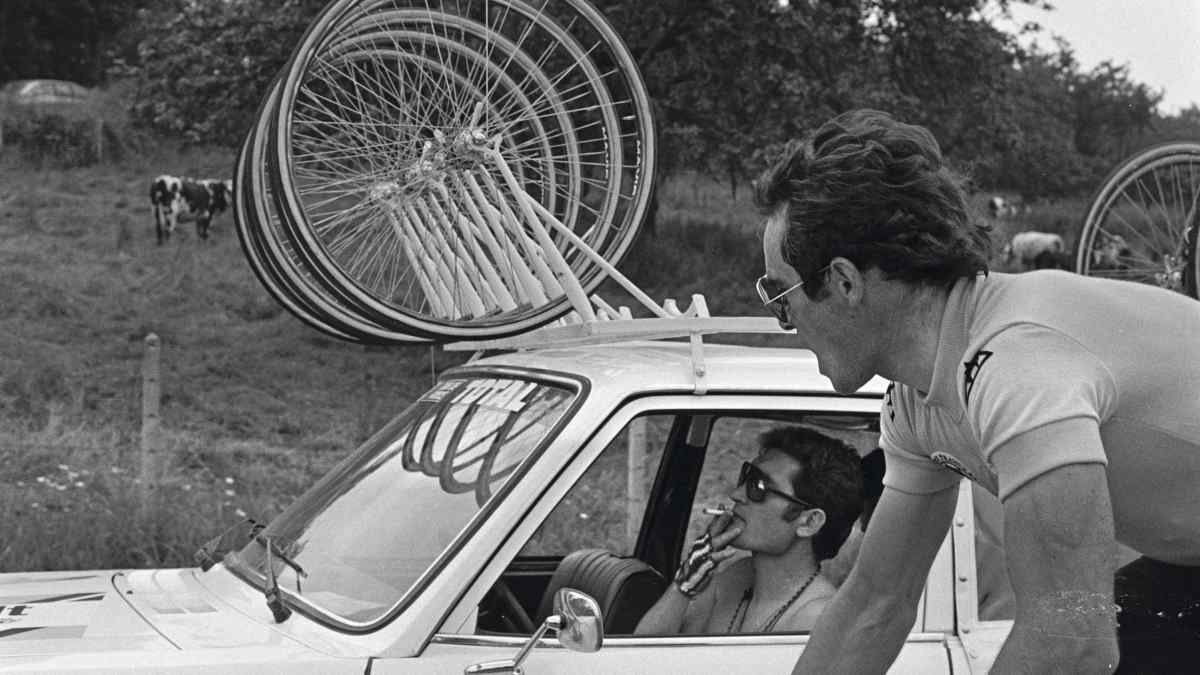
Eddy Merckx never made any secret of it: the rider he feared most during his heyday was José Manuel Fuente. Even Merckx was powerless against the Spaniard’s explosive surges in the mountains. What often worked in Merckx’s favour, however, was that Fuente lacked patience and tactical acumen. His attacks were often spectacular, but so were his collapses. Yet Fuente’s riding style was almost impossible to rein in. He was regarded as headstrong, and at times even rebellious. This certainly made him a difficult character within the KAS team. He was also notorious for his heavy cigarette consumption. His successes, however, afforded him a certain degree of freedom: he won the Vuelta a España twice and finished third on the Tour de France podium in 1973. From 1975 onwards, Fuente suffered from kidney problems, which forced him to bring his career to a premature end at the age of 31. In 1996, he died at the age of 50 from the long-term effects of his kidney disease.
Julio Jiménez
Jiménez was often right at the heart of major cycling events, both iconic and dramatic. When Jacques Anquetil and Raymond Poulidor engaged in their legendary neck-and-neck battle for the Yellow Jersey at the Puy de Dôme during the 1964 Tour, it almost went unnoticed that Jiménez had won the stage ahead of them. Three years later, on Mont Ventoux, Jiménez was one of the last riders to accompany Tom Simpson when he fell from his bike and died at the scene. Jiménez did not turn professional until he was 24, having previously worked in his cousin’s watch shop. Reporters with a penchant for embellishment subsequently gave him the nickname ‘The Watchmaker of Ávila’. As a proven climber, Jiménez won the mountains classification in the Vuelta in both 1964 and 1965, and that of the Tour in 1965, whilst riding for KAS. However, when he asked for a pay rise, Langarica turned him down. Jiménez subsequently moved to Jacques Anquetil’s team. He went on to win the Tour’s mountains classification twice more. Jiménez died in 2022 at the age of 87.
Domingo Perurena
The Spaniard still holds two records to this day: with 158 victories, he is regarded as the most successful road cyclist from the Basque Country. He also wore the leader’s jersey in the Vuelta a España for 31 days, without ever winning the race. He came close in 1975: he went into the final time trial as the overall leader, but still lost the tour by 14 seconds to his compatriot Agustín Tamames. Perurena later admitted that he could never forget the oppressive silence of the spectators as he crossed the finish line. He possessed sprinting abilities that were unusually good for a Basque, which enabled him to win twelve stages and the Vuelta’s points classification twice. He was, nevertheless, a decent climber. In 1974, he celebrated his greatest success outside Spain by winning the mountains classification at the Tour de France. He died in 2023 at the age of 79.
The biggest controversy
Thanks to KAS, the Basque Country established itself as the centre of Spanish cycling in the 1960s. In 1966, Fagor even emerged as a second professional team from the region. The household appliance manufacturer’s headquarters were located just a few kilometres from KAS. However, the two never got on well. Time and again, Fagor lured top performers such as Francisco Gabica, Eusebio Vélez and José Antonio Momeñe away from KAS with lucrative contracts. Furthermore, there was a long-standing feud between the two team managers, Langarica and Pedro Matxain of Fagor, which dated back to their time as racing cyclists.
This rivalry spilled over into the teams: as soon as a Fagor professional took to the start line, a rider from KAS would follow – and vice versa, particularly in races in Spain. It was not unusual for riders from the other team to be held up by the rival team’s car. At the 1969 Vuelta a España, Langarica is even said to have tried to force Matxain’s car off the road with his own vehicle when Matxain, drafting behind team captain Luis Ocaña, was attempting to return to the front of the race. During that Vuelta, the mutual animosity reached its peak, as both teams were solely focused on preventing the other from winning. Ultimately, the Frenchman Roger Pingeon of the Peugeot team emerged as the beneficiary of this feud.
The End
For the 1979 season, the company KAS decided to use the racing team for promotional purposes on the Belgian market. The Spanish core of the team was disbanded and a Belgian team licence was acquired. KAS invested in Belgian stars such as Lucien Van Impe as its new figureheads. This turned out to be a serious mistake, as a rift developed within the team between the Spaniards and the Belgians. Major success failed to materialise, and the venture also fell short of financial expectations. In October 1979, the company announced the dissolution of the racing team.
In 1985, KAS returned to professional cycling once more – initially as a co-sponsor of the Skil team, and a year later as the main sponsor. The sporting philosophy was now different, however: everyone was behind Sean Kelly, the undisputed team captain. The Irishman won Milan–San Remo, Paris–Roubaix and, in 1988, the Vuelta a España for KAS. Following Knörr’s death in 1988, the company’s focus shifted, and KAS withdrew from cycling for good at the end of that year.
The trophy cabinet
Vuelta a España 1966 (Francisco Gabica), 1971, 1974 (José Manuel Fuente), 1976 (José Pesarrodona)