


The time trial went as expected, with a commanding victory for Remco Evenepoel. His time of 32:19 set the the time of 33:28 we predicted by more than a minute.
Evenepoel got off to a very fast start and reached the top of the climb with the best split time (and an average speed of 37!). This is remarkable given that his core strength lies in the balance between power and aerodynamics. The fact that he rode faster uphill than Tadej Pogacar may, to a certain extent, have been down to superior aerodynamics, but this is not as significant on climbs as it is on the flat or on descents. This suggests that, relative to his weight, Evenepoel put in a similar performance to Pogacar.
This ties in with the fact that, shortly after crossing the finish line, Evenepoel mentioned that he had pedalled at unusually high wattages at the start – more than he had planned.
We had calculated the uphill power output at 432 watts for a rider weight of 66 kilograms (race-ready, including clothing) (6.54 W/kg); Remco Evenepoel is likely to have exceeded this figure. That said, we do not know either his exact weight or his precise cwA value.
Before the Tour, a video circulated featuring his former coach, Dan Lorang, who spoke of a threshold of 425 watts during a test on a mountain. This would tie in well with the estimated power output in the simulation. However, Evenepoel has presumably pushed himself even harder. This would suggest that he was able to increase his performance slightly beyond the training data.
Crash in slow motion – Pogacar displays superb bike control
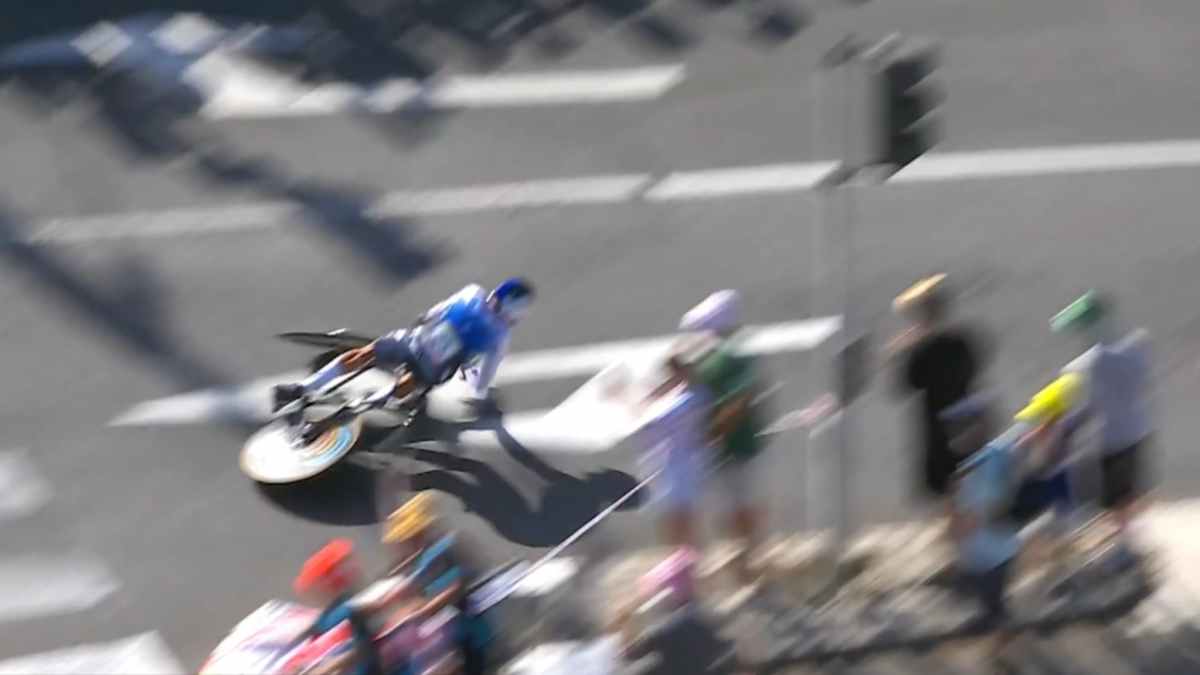
Florian Lipowitz crashed in a fast right-hand bend six kilometres from the finish and was forced to withdraw with a broken collarbone. Tadej Pogacar, however, also nearly crashed in the same bend. Lipowitz’s crash was presumably caused by a correction to his line at the apex of the bend (approaching it too fast or misjudging the bend’s radius). The The uneven surface and the zebra crossing may have played a part. What is striking, in any case, is that Lipowitz skidded off the track whilst leaning only slightly; this strongly suggests that a steering manoeuvre was the cause. The additional steering forces presumably caused the front tyre to lose grip, a situation that usually leads to a crash. Pogacar was also going too fast, but slid across both wheels towards the edge of the bend. In slow motion, you can see how Pogacar saved the situation with subtle steering movements around the neutral position and a bold turn of the handlebars just before the kerb. It’s clear: his riding skills helped to avoid a crash.
The role of the rubber compound
Did the Conti tyres help Pogacar stay in control? We know from our grip tests (on a wet circular track)…that the Conti tyre hocks before it slips, meaning it behaves in a forgiving manner at the limit. This ties in with observations made during the race. The rear wheel slipped, but didn’t lose traction completely. However, in TOUR’s latest grip test (2023), the Specialized rubber compound also demonstrated controllable slippage at the limit of grip.

Robert Kühnen
Editor
