


2026 Tour de France: Why the Yellow Jersey becomes a handicap in the time trial
Robert Kühnen
· 21.07.2026

The world’s best cyclists will be competing in the Tour de France until 26 July. Victory and defeat on the roads of France are decided not only by the riders’ legs, but also by their equipment. The TOUR Tech Briefing for Stage 16.
Stage 16 is a 26-kilometre time trial. Right from the start, the route climbs for 9.7 kilometres to the Côte de Larringes, a second-category climb.
As with any hilly time trial, the question arises: which bike is better – a dedicated time trial bike or a classic road bike with an aero attachment?

In our view, the time trial bike has a clear advantage, as the gradient is gentle. The speed uphill is between 30 and 35 km/h – these are speeds that are relevant in terms of aerodynamics.
A wheel-change strategy is not a viable option, as the uphill section runs straight ahead and is the opposite of a technical climb. The climb can therefore be tackled comfortably in the aero position on a time trial bike.

The descent on a time trial bike is more challenging, as it features a number of bends that cannot be taken at full speed. Nevertheless, we believe the time trial bike has a clear advantage here, as it allows for greater speed between the braking points.
Number of the day: Five Aero-Watts = ten seconds saved
To highlight the impact of materials, we are once again simulating various bike configurations to investigate the influence of weight and aerodynamic optimisation on the course. Are disc wheels the way to go, or should the bike be as light as possible at the start?
According to our calculations, this means one kilogram excess weight eight seconds longer journey time. Five watts Aerodynamic advantage (based on 45 km/h) results in a time advantage of 10 seconds. It follows from this that aerodynamic optimisation takes precedence over lightweight construction. However, the aim is to find the sweet spot between aerodynamic performance and lightweight construction.
Aero gains of five watts can be achieved in many areas. The greatest impact comes from the optimal riding position and the way the aero handlebars, helmet, body and clothing are tailored to the rider’s physique. The aim is to make the rider’s ‘blunt’ body more aerodynamic through the interplay of many details. We cannot achieve a teardrop shape, but we can still achieve a significant improvement on the classic road bike position.
When everything is in the right position, as with time trial world champion Remco Evenepoel, the handlebars, arms, helmeted head and torso merge into a single unit that offers significantly less resistance to the airflow than a fragmented body, where the handlebars, arms, head and upper body are each surrounded by the airflow individually.
Clothing also plays a role here. The aerodynamic suit can be fine-tuned by adjusting the surface roughness of the fabric. Roughened sections act in a similar way to the dimples on a golf ball; they deliberately keep the airflow in contact with the body for slightly longer, which reduces drag. The effect can be highly customised by adjusting the roughness to suit the speed range and the circumference of the arms and legs. As a rule of thumb: the slimmer the body and the slower the ride, the more roughness is needed to control the airflow.. Two riders of different builds therefore need different fabrics to get the most out of a particular situation.
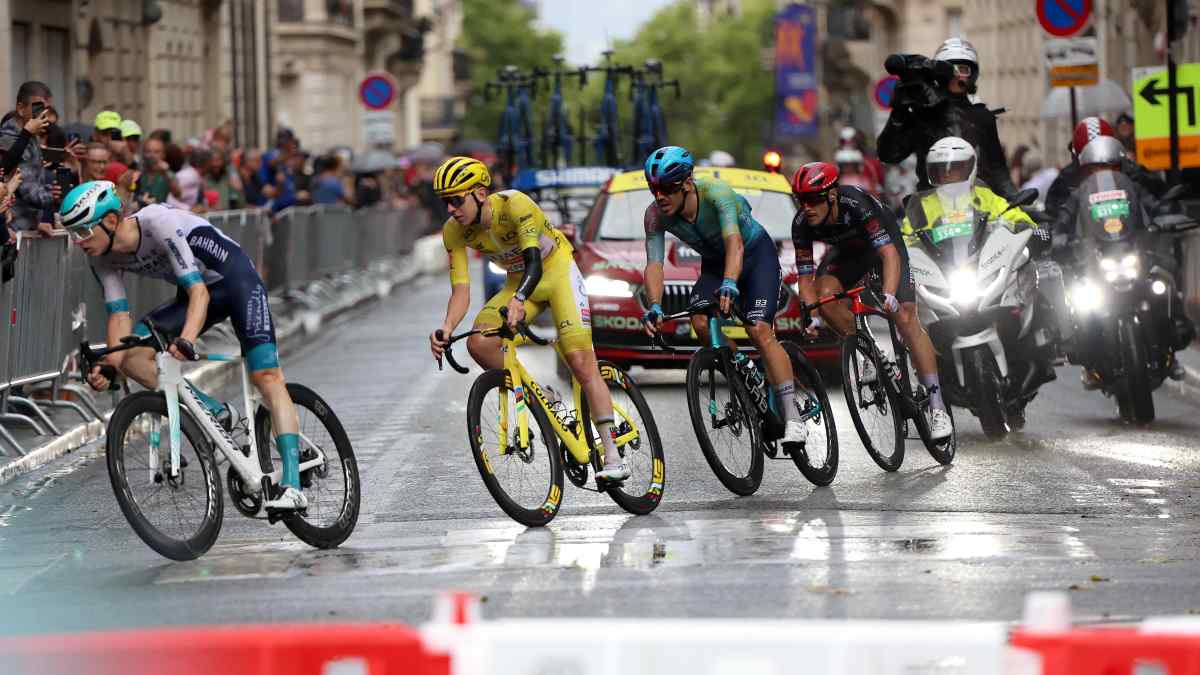
That is also why starting in the yellow jersey (or any other classification jersey) is a disadvantage, as the suit cannot then be fine-tuned to the same extent.
The expected average speed is very high, despite the mountain classification. We believe the most likely combination is TT4, which would result in a calculated average speed of 47.7 km/h.
Following his recent climbing performance on Stage 15 and given his outstanding time-trialling abilities, Remco Evenepoel is the favourite for the time trial.
An overview of the (almost) full line-up*:

The table shows the simulated ride times for various bike configurations. It illustrates, by way of example, the effect of aerodynamic optimisation (the ‘Aero-Power’ column) compared with weight. As the route involves a longer uphill section, the aim is to find the sweet spot between aerodynamic performance and weight.
* Simulation calculations
Based on our own wind tunnel tests, we carry out simulation calculations for the Tour de France tech briefing. How TOUR tests: Aero road bike test in the wind tunnel.
We are investigating which wheels can offer a technical advantage in which situations. The variables we can influence in the simulation include wheel weight, rider weight, the inertia of the wheels, the drag coefficient, the rolling resistance coefficient and the efficiency of the drivetrain.
To model ride times, we use realistic power outputs and weights for the riders, combine these with our wind tunnel data, and have the riders race virtually along selected sections of the route, which we extract from the official route data; the derived elevation profiles are key to this. The modelling also includes bends, which we can brake for realistically, and adjustable power profiles for different types of riders. This allows us to distinguish between hill climbs and proper final sprints. Taken together, this makes the simulation very realistic. What we cannot replicate are dynamic handling effects such as the individual behaviour of the wheels on different surfaces.
The journey times calculated for the sections of the route that are decisive for the race highlight the influence of the wheels – provided that the riders always behave in the same way in a given scenario.

Robert Kühnen
Editor