


The German stage race starts on 19 August 2026, with a prologue. Each of the 18 participating teams fields six riders. The total route covers 741.5 kilometres and passes through Hesse, Baden-Württemberg and Rhineland-Palatinate, as well as a very small section of Bavaria.
Route profile and climbs
The riders will tackle a total of 10,900 metres of climbing over the five days of the Deutschland Tour. The longest climb is the 5.2-kilometre ascent to the Kalmit, with an average gradient of 7.5 per cent. At 616 metres above sea level, the mountain marks the highest point of the route. The steepest section is on the Juxkopf, with an average gradient of 14.4 per cent over a distance of 1.1 kilometres. Now that’s a proper climb!
Venues and organisation of the Deutschland Tour
Bad Orb, Schwäbisch Hall, Offenbach an der Queich, Herxheim and Bad Dürkheim will host the race for the first time in 2026 as stage venues for the Deutschland Tour. Heilbronn is the only city to return as a host. The organisers will deploy 2,300 stewards and marshals to secure the route. Up to ten acoustic warning systems per stage will ensure the riders’ safety. The barriers comprise 16,700 metres of mesh fencing and 225 bales of straw in the towns and along the cross-country route.
Ratings and media reach
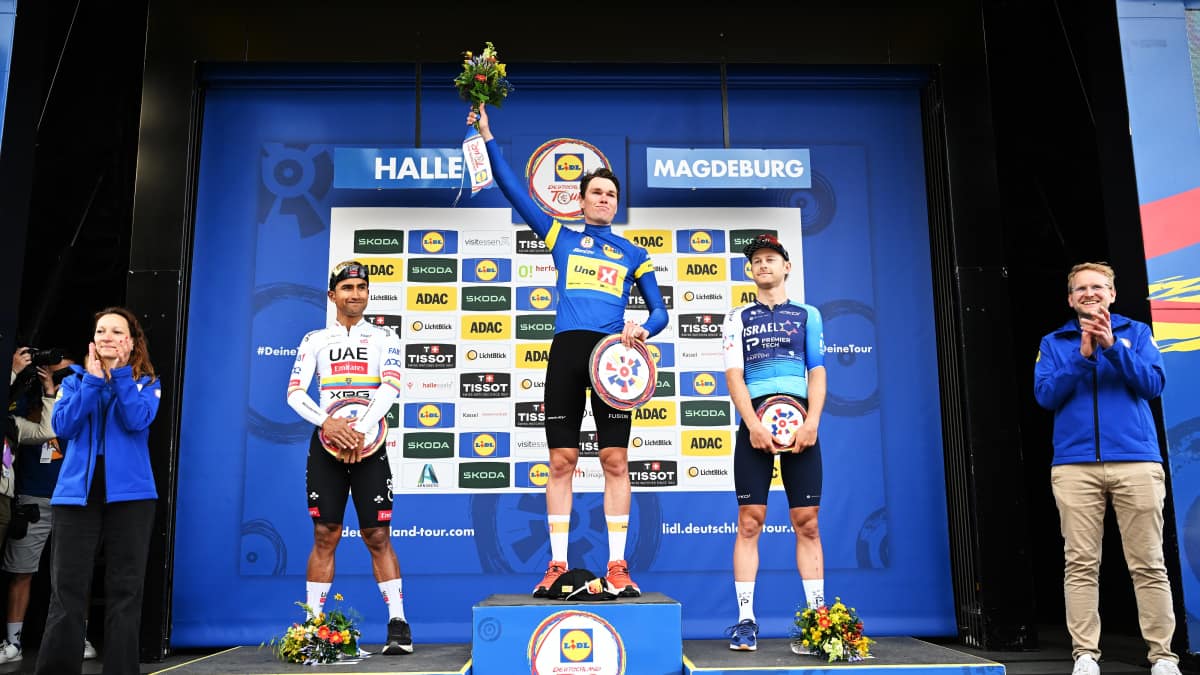
Seven different jerseys will be awarded during the Deutschland Tour: the Lidl General Classification, the Škoda Sprint Classification, the Mountains Classification, the Lichtblick jersey for the best young rider, the Community Jersey, the Rose Award for the most combative rider, and the Lotto Team Classification. 72 broadcasters from 190 countries will be covering the race. ARD, ZDF, Eurosport and L’Équipe will be showing live coverage. The By August 2026, the digital reach had grown to 61,874 fans, an increase of six per cent on the previous year. 250,000 spectators watched the 2025 event from the track itself.

Leon Weidner
Editor
