


The Lidl Germany Tour is celebrating its 40th anniversary this year and runs from Wednesday to Sunday from Bad Orb to Heilbronn, passing through Hesse, Bavaria, Baden-Württemberg and Rhineland-Palatinate. The route is varied and features a number of challenging climbs.
That is precisely what makes the Deutschland Tour so interesting: it allows a wide variety of riders to compete for the overall victory. Last year, Søren Wærenskjold – a sprinter – even won the tour, ahead of the two classics specialists, Jhonatan Narváez and Riley Sheehan.
This year, however, things are likely to be tougher for the fast riders. The riders will have to tackle a lot of elevation gain over the five days, so it’s unlikely that a sprinter will be standing at the very top of the podium in the end.
Key points at a glance
- Date: 19 to 23 August
- Distance: 741.5 kilometres
- Start: Bad Orb, Objective: Heilbronn
- Profile: a prologue, four hilly stages
- UCI category: ProSeries
- Premiere: 1911, 40th edition
The route of the 2026 Lidl Deutschland Tour


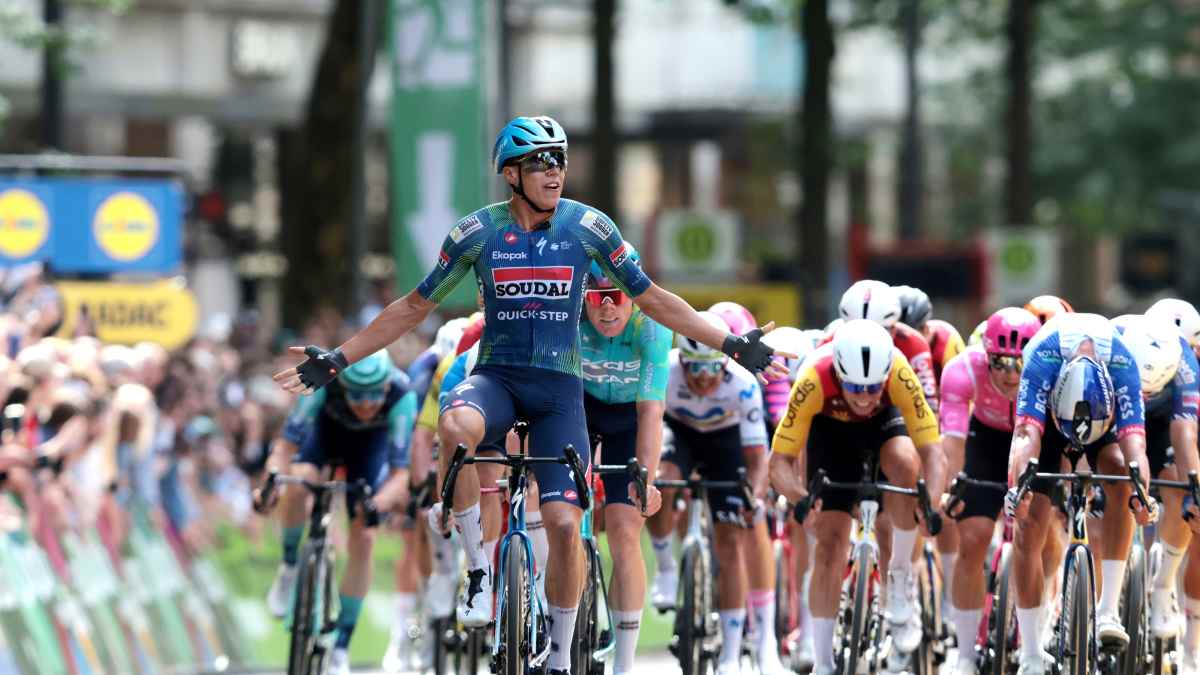
At just 2.6 kilometres, the prologue is certainly not a long start to the Tour of Germany. However, it’s hardly flat. The route climbs from the very start, reaching its highest point just shy of the 1-kilometre mark, from where it descends to the finish. The short prologues suit the sprinters and strong classics riders, and a winner of this calibre is to be expected once again this time.
An opportunity for the sprinters
As short as the opening stage of the German tour is, the professionals will have to spend just as long in the saddle on the first proper day of racing. Over 215 kilometres, with constant ups and downs. The final two kilometres take the peloton uphill once more, with an average gradient of over 3 per cent. Riders with good staying power are likely to sense an opportunity here after a long day. The second stage, by contrast, is fairly flat. After tackling a few undulations in the first half, it’s the sprinters’ turn. With hardly any elevation gain left to come, anything other than a bunch sprint would be a surprise.
The queen stage to Bad Dürkheim
Five categorised climbs, culminating in Bad Dürkheim. This is the queen stage of this year’s Tour of Germany. The biggest challenge is the Kalmit, which the riders will tackle twice. At 5.2 kilometres with a 7.5 per cent gradient, it’s certainly no walk in the park. The Annaberg, too, which must be tackled twice shortly before the finish, is no walk in the park. Although it isn’t long, with a gradient of 6.2 per cent, this could be where the day’s winner is decided. If not, a group will form here from which the eventual winner will emerge.
Final in Heilbronn
The final stage to Heilbronn, at 156 kilometres, is rather short. However, changes are certainly possible here too. The climb to the Jägerhaus, in Heilbronn’s Stadtwald forest towards the Waldheide, features sections with gradients of over 8 per cent, has an average gradient of 5.3 per cent and leads 2.2 kilometres uphill to the Jägerhaus. On the two laps immediately outside Heilbronn, this climb is tackled three times. The final mountain classification is 12 kilometres from the finish line – a section that lends itself to a solo breakaway.
These are the favourites for the Tour of Germany
Thanks to the undulating profile and the relatively open route, a whole host of riders are in contention for the overall victory this year. The only certainty is that there will be a new winner. The team of defending champion Søren Wærenskjold, Uno-X Mobility, will not be on the start line in 2026, which means last year’s winner will be unable to defend his title.
Jhonatan Narváez, on the other hand, is one of the most promising contenders. The Ecuadorian finished second in the 2025 Deutschland Tour and has already demonstrated his class on several occasions this season. The slightly tougher course profile should suit him, although he too will need to get through the long climbs on the third stage unscathed. Although his team-mate Adam Yates boasts the greatest stage race successes in the field, an overall victory would probably require a particularly gruelling race.
Lidl-Trek, too, arrives with several strong contenders in the mix. Giulio Ciccone is at home on terrain similar to that of the classics and is likely to be among the strongest riders on the selective stages. Mathias Vacek, on the other hand, like Yates, has what it takes for the longer climbs. From a German perspective, hopes are also pinned on Max Walscheid, even if the high number of metres of climbing is likely to limit his chances of victory.
The German national team’s performance is also set to be exciting. For all top German riders whose teams are not taking part in the Deutschland Tour, it offers an additional opportunity to compete. With Jonas Rutsch and Georg Zimmermann, two riders have already been confirmed who should find the course suits them well. Whilst an overall victory for the national team would be a surprise, it cannot be ruled out entirely given the open nature of the route.
*At the time of publication of this article, the start list has not yet been finalised.
Germany Tour 2026: TV broadcast & live stream
The Lidl Deutschland Tour will be broadcast live on ARD and ZDF in 2026. The final stages will be shown, with the two channels sharing the coverage of the stages between them. A live stream of the prologue, which is not being shown on TV, can be found on the Hessischer Rundfunk and Sportschau websites. The Sportschau website also offers a live stream for each stage. In addition, a paid live stream is available for the prologue and all four stages on discovery+.
| Stage | TV channel | Start of broadcast |
| Stage 1 | ARD | 2.05 pm |
| Stage 2 | ZDF | 3.35 pm |
| Stage 3 | ARD | 3.35 pm |
| Stage 4 | ZDF | 3.32 pm |

Leon Weidner
Editor