


Team Netcompany INEOS has built up a clear identity in recent years: aerodynamic perfection, scientific meticulousness and an exceptional depth of specialised knowledge in time trials. This culture not only pays off for proven specialists like Filippo Ganna, but has long since spread to the overall class riders, who have to defend every second in three-week tours.
Ganna's Giro victory as a lesson for the whole team
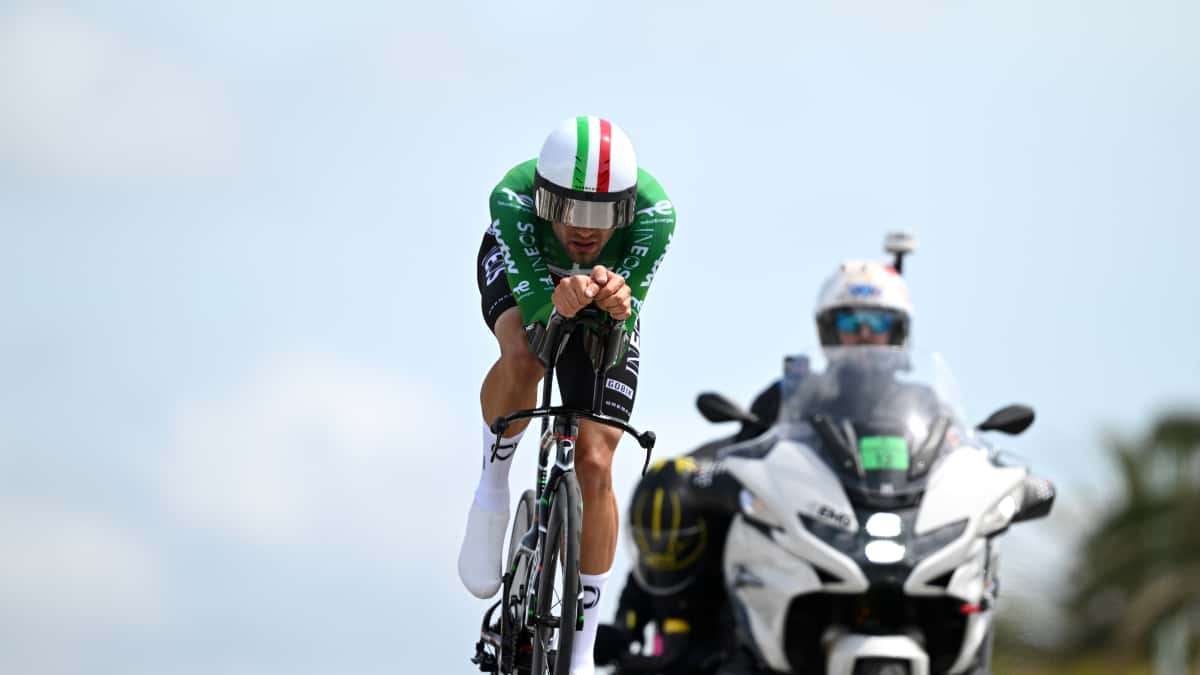
The 10th stage of the Giro d'Italia, a flat time trial, was once again impressive proof of Filippo Ganna's dominance. With his mixture of raw power, perfect aero position and countless hours in the wind tunnel, he prevailed against the competition and took a commanding stage win.
But this success is more than just a personal triumph. It shows how deeply the time trial culture is anchored in the team. Ganna is not just a winning rider - he is a rolling laboratory. His tests, his material feedback and his obsession with detail flow directly into the work of the engineers and performance coaches. Riders who are not primarily considered time trial specialists also benefit from this. The team's GC captains, traditionally riders who have to perform consistently over three weeks, gain access to the same insights: optimised positions, more efficient power transmission, more precise pacing strategies.
Why GC riders thrive on time trial expertise
In a Grand Tour, the overall classification is not only decided in the mountains. Time trials are often the quiet royal stages, unspectacular to the eye, but brutally honest for the legs and the watts produced. It is precisely here that differences are noticeable that are barely visible on TV, but in total cost minutes. The riding position, suit, helmet, wheels and even the smallest details on the cockpit and bottle setup determine how much speed per watt actually reaches the road.
Equally important is pacing, which can determine victory or defeat in GC like a science. If you open too hard, you pay twice in the end. If you start too conservatively, you give away free seconds. The best time trialists hit their performance curve as precisely as if it had been mapped out. Added to this is the choice of material, from the helmet to the tyre width. Air pressure, tyre and rim combinations, gear ratios and rolling resistance must match the track, the asphalt and the conditions. Over the years, Netcompany INEOS has built up an infrastructure that systematically optimises precisely these factors. The GC drivers do not have to acquire this knowledge themselves, they inherit it.
Tour de France: The opening time trial as a key stage
At the Grand Départ of the Tour de France in Barcelona, this knowledge could prove decisive. The special format - in which the time of each rider counts - makes the time trial even more tactical and valuable than in the Giro.
For the GC riders, this means that a strong team with strong time trial DNA can give them a lead on the first day that will be hard to catch up on over three weeks. Especially in a Tour de France, where every second counts, the expertise of Ganna and the other specialists could make the difference. Since last year, the team finally has hope again for the overall classification of the grand tours. With Kévin Vauquelin, Oscar Onley and Thymen Arensman, there are three riders who deliver consistent performances. Their time trial expertise could play a decisive role here.

Leon Weidner
Editor
