


The Race Across America is a legend in the ultracycling scene. For more than four decades, solo riders and teams have been cycling non-stop across the USA. The route has been modified since 1982 – but the core idea remains the same: to cycle from west to east, right across the USA. Around 3,000 miles/4,900 kilometres, 13 states and approximately 50,000 metres of elevation gain are the key features of RAAM. In a complete surprise, the organisers have now cancelled all races. This also affects the shorter routes, the Race Across the West and the Race Across the East. The cancellation is attributed to a planned reorganisation of the race.
Participation figures are falling
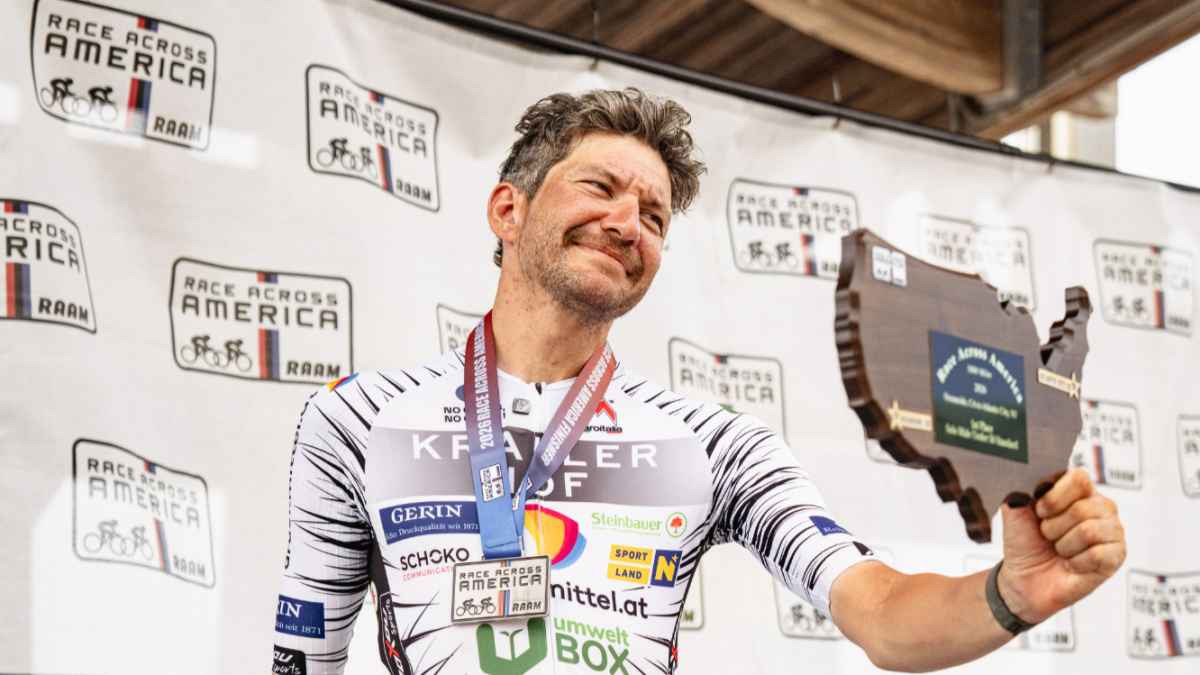
If one takes a critical look at the RAAM, the number of participants has fallen year on year, whilst races such as the Transcontinental Race in Europe have come more into the spotlight. In 2026, only 17 male riders and one female rider lined up in the solo category at the Race Across America. In addition, only one two-person team, two four-person teams and two eight-person teams took to the course. This meant that only 52 riders were registered for the full distance in 2026. A further 27 riders took part in the shorter stages. The number of entrants has thus reached an all-time low: in 2025 there were still 80, and in 2024 there were still 96 participants. In the event’s heyday, over 300 entrants were registered. Even though ultracycling naturally attracts small fields, the figures have recently been astonishingly low. By way of comparison: 367 participants took to the course at the 2026 Transcontinental.

Race Across America Statement
The official statement from the organisers, translated into German:
A message to the Race Across America (RAAM) community
After careful consideration, we have decided to suspend Race Across America – including RAAM, RAW and RAE – for the 2027 calendar year, as well as our other events: the 2026 and 2027 editions of The 508, and the 2027 editions of the Longhorn 500 and Stampede 200.
RAAM has a history stretching back more than 40 years and has welcomed riders from all over the world. We believe that now is the right time to pause and conduct a thorough review of our events – from the races themselves and their formats to the overall experience for participants – and to explore how they can evolve for the future.
Our aim is not simply to attract new riders to RAAM and our other events, but also to create experiences that encourage them to return and help ultra-cycling to continue growing in the long term.
We believe it is important to take the time needed to determine the right long-term course of action, rather than setting expectations for a 2027 timetable before this work has been completed.
Our intention is to use this time to determine the best way forward for RAAM and our other events, with the clear aim of bringing RAAM back in an improved form and delivering an event and experience worthy of its reputation as ‘the toughest cycle race in the world’. The timing and format of this return will depend on the outcome of this review and on the establishment of a clear, sustainable model that preserves RAAM’s legacy whilst laying a strong foundation for its future.
We know how much these events mean to the riders, support crews, volunteers, partners and host communities, who are the heart and soul of RAAM. Precisely because this community and this legacy deserve to be preserved and honoured, we believe that the right approach is to take the time to do this properly.
We are very grateful to you for your loyalty and passion, which are at the heart of every decision we make.
History of the Race Across America
It all began in 1982. Four individual cyclists set off from the Santa Monica Pier in Los Angeles to the Empire State Building in New York City. National television broadcast the spectacle live – and the race immediately captured the imagination of a wide audience. A new sport was born. Today, the Race Across America starts in Oceanside, Southern California, at the foot of one of the state’s longest piers, and finishes on the famous Boardwalk in Atlantic City, New Jersey.
The route runs from west to east and is unique worldwide in its combination of distance, terrain and weather. Three major mountain ranges – the Sierra Nevada, the Rocky Mountains and the Appalachians – must be crossed. Four of America’s longest rivers – the Colorado, the Mississippi, the Missouri and the Ohio – are crossed. In addition, the riders pass through iconic landscapes such as the Mojave and Sonora deserts, Monument Valley and the Great Plains.
Solo riders have a maximum of 12 days to complete the 3,000 miles. Most finish in around 11 days, with the fastest completing the course in under 8 days. Teams of 2, 4 or 8 riders have a maximum of 9 days – the best reach the finish line in just over 5 days. In 1992, relay teams were admitted to the Race Across America for the first time – a milestone in the race’s history. The team classification quickly became the most popular and fastest-growing segment of the RAAM. Whilst solo riders must qualify, in principle any fit cyclist can put together a team and take part.
Note: In an earlier version, we mistakenly gave the elevation figures in feet – that is around 175,000.

Kristian Bauer
Editor