


Mountain Passes 2026: Col du Galibier car-free – free access to the ‘Roof of the Tour de France’
Gitta Beimfohr
· 19.06.2026


This year, the approaches to the famous Col du Galibier will be closed to cars and motorbikes for three days. Cyclists will then be able to really put their foot down on its winding tarmac roads from 9 am to 12 noon. Those who can’t wait can head up there on 29 June, although only the southern ramp will be open this Monday.
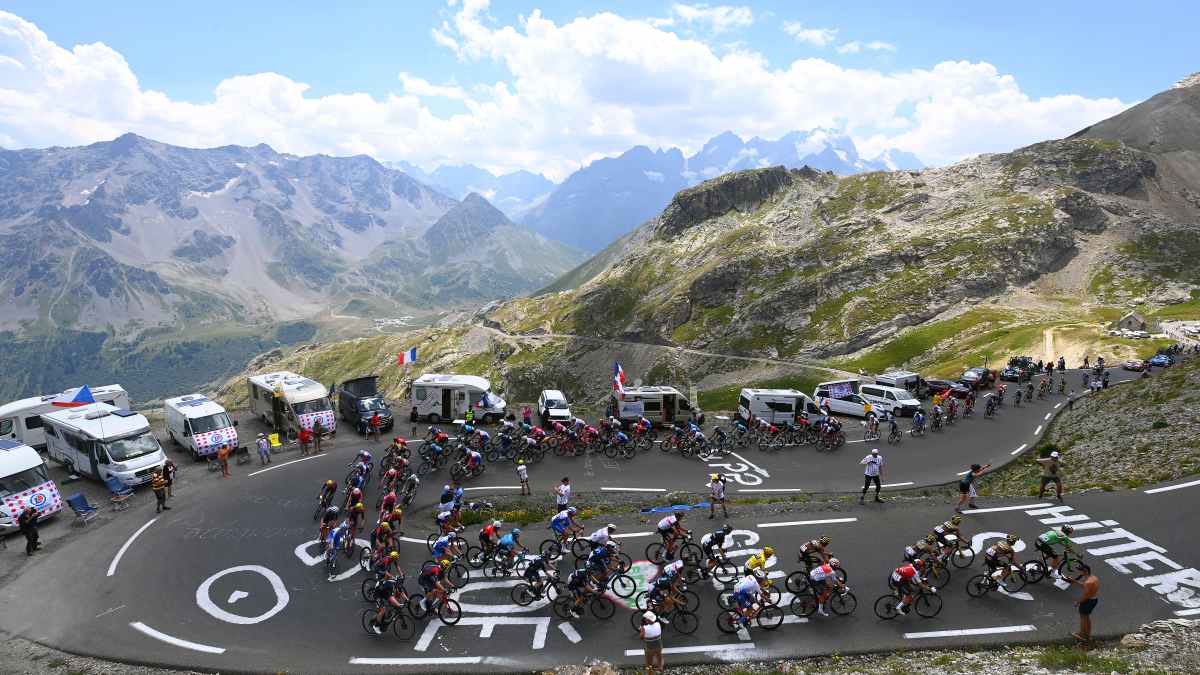
However, you won’t be alone at the starting point, the Col du Lautaret, on the day, as there are already too many Tour de France fans eagerly awaiting this day. After all, the Col du Galibier was the first Alpine pass that Henri Desgrange included in the Tour de France in 1911. Until then, the highest peaks in the Tour de France had been in the Pyrenees and the Vosges. Until 1937, the Col du Galibier, at an altitude of 2,643 metres, held the title of ‘Roof of the Tour de France’, before being replaced a year later by the Col de l’Iseran (2,770 m).
Col du Galibier – the queen stage on 25 July
Once again this year, the Galibier is part of the Tour de France, featuring in the queen stage on 25 July 2026. Anyone wishing to watch this spectacular event up close should make sure they’ve secured a spot by the roadside early in the morning on 25 July. This date also combines perfectly with one of the cycle days when the roads are closed to motor traffic:
- 29 June: the south ramp only, from 9 am to 12 noon
- 16 July: South and North access roads from 9 am to 12 noon
- 4 August: South and North access roads from 9 am to 12 noon
A Classic: The Northern Approach, 1911
The real ascent is, of course, the one from the north, as this is the route that Tour de France founder Henri Desgrange chose as the first Alpine stage back in 1911. It starts in Valloire and is initially a pleasant ride towards the Col du Galibier. But where the road had to be wound in hairpin bends through the rock faces, the gradient becomes steeper. For four kilometres, you really have to dig deep here, with an average gradient of 8.5 per cent and the air growing thinner, before the final stretch towards the summit comes into view and, on a clear day, the view opens up to Mont Blanc, the Écrins massif and the Meije Glacier.
- Start: Valloire
- Distance: 18.2 kilometres
- Ascent: 1239 metres
- Average gradient: 7 per cent
- Maximum gradient: 9.5 per cent (1 km)
Kürzer: The southern approach to the Galibier
The fifth-highest continuously tarmac-surfaced mountain pass in the Alps also has a significantly shorter southern side. The ascent begins at the Col du Lautaret (2,057 m) and then winds its way up to the Galibier over just 8.6 kilometres. The average gradient here is 7 per cent, but particularly on the final kilometre – where the wind may be blowing across the tarmac – there are even 9.5 per cent gradients to contend with towards the end. And: it goes without saying that you have to cycle to the starting point. So that adds another 20 kilometres or so from Briançon up to the Col du Lautaret.
- Start: Col du Lautaret (or Briançon)
- Distance: 8.6 kilometres
- Uphill: 585 metres of elevation gain
- Average gradient: 7 per cent
- Maximum gradient: 9.5 kilometres
Commemorative plaque in honour of Henri Desgranges
Don’t miss: the memorial stone to Tour de France founder Henri Desgrange at the southern entrance to the Scheiteltunnel at the top of the Galibier Pass. Incidentally, in his honour, the “Souvenir Henri Desgrange” is contested at every Tour de France in addition to the standard mountain classification: the rider who is the first to reach the highest pass of the Tour de France (it does not have to be the Galibier) receives a special prize of 5,000 euros.

Gitta Beimfohr
Editor
