


Ridley Kanzo Fast 2.0: The aero gravel pioneer is set to become much wider and more modern
Jens Klötzer
· 27.08.2026


Drawing on aerodynamic insights from the speedy Noah Fast, Ridley has launched the second generation of its Kanzo Fast race gravel bike. The biggest advance, however, lies less in aerodynamics than in extreme tyre clearance and a new geometry concept
When Ridley unveiled the first Kanzo Fast in 2020, it was one of the first race gravel bikes to be designed with a consistent focus on aerodynamics. However, even back then, the Belgian manufacturer was not alone in this concept: 3T had already combined wide tyres with pronounced aero profiles in the Exploro, whilst Cervélo had unveiled the sporty Áspero in 2019. Ridley, however, implemented the concept particularly thoroughly – with a flat frame, an integrated aero cockpit and a design clearly tailored to fast gravel racing.
It is also worth noting how long the first Kanzo Fast remained on the market: there are almost exactly six years between the two generations. In an industry where model cycles are sometimes short, this is unusual. A TOUR wind tunnel comparison showed that Ridley was not under any great time pressure: With identical wheels and 40-millimetre tyres, the old Kanzo Fast required around seven watts less than the 3T Exploro, which is also aerodynamically optimised. The previous model was therefore already exceptionally fast in aerodynamic terms.

A new platform rather than a gradual facelift
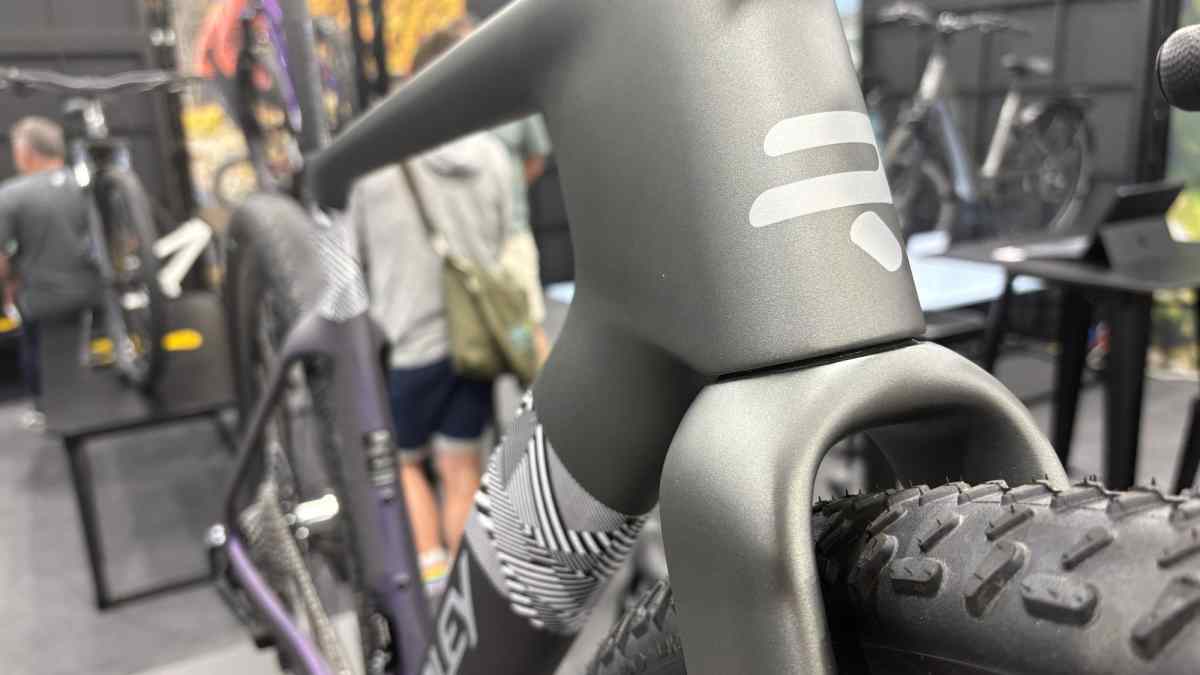
Visually, the Kanzo Fast 2.0 remains true to its design heritage, whilst adapting to the brand’s new design language. The wide down tube, the elongated head tube and the deep tube profiles are clearly reminiscent of Ridley’s latest aero road bike, the Noah Fast. The shape of the down tube is designed to control airflow in conjunction with two water bottles; cables and wires are routed entirely within the frame.
Technically speaking, however, the 2.0 is not merely a revamp. The tyre clearance has increased significantly from 42 to 58 millimetres, the frame is said to be 150 grams lighter, and the geometry has been completely re-engineered. Added to this are a frame storage compartment, concealed mountings for a top-tube bag and a specially developed mudguard option.
This is Ridley’s response to developments in gravel racing: the courses are becoming more technical, whilst average speeds remain high. A modern race gravel bike therefore no longer needs simply to be light and aerodynamic, but must also perform well with large-volume tyres. The fact that the bike also features details suitable for touring, such as mudguards and a storage compartment, is, however, quite exceptional.
58 millimetres of tyre clearance: who can beat that?
The most striking improvement is the maximum tyre width of 58 millimetres. This is roughly equivalent to a 29 × 2.3-inch mountain bike tyre and significantly exceeds the 42 millimetres of its predecessor. Ridley is therefore no longer positioning the Kanzo Fast solely for fast, firm gravel tracks, but also for rough and technically demanding race courses.
Wider tyres can reduce rolling resistance on poor road surfaces, provide greater traction and more effectively isolate the rider from bumps. At the same time, their contact patch increases. Ridley’s own measurements put the aerodynamic disadvantage of a 55-millimetre tyre compared to a 38-millimetre model at 36 km/h at six watts. Whether the wider tyre is faster overall therefore depends heavily on the surface, pressure, carcass and tread pattern.
Furthermore, the maximum clearance should not be confused with a blanket recommendation for 58-millimetre tyres. On fast, smooth tracks, 40-millimetre tyres may still be the better choice. The generous frame clearance then provides additional headroom for mud. On rough terrain, however, the optimum is likely to shift increasingly towards 50 to 55 millimetres.
Aerodynamics: Two watts on the bike, 13 watts across the entire system
Ridley reports a two-watt advantage over the old Kanzo Fast in the riderless test. The measurements were taken using identical Skiron wheels, 38-millimetre-wide Vittoria Terreno Dry tyres, two water bottles and an airspeed of 36 km/h. This is a small improvement, but a plausible one given the already very fast predecessor.
The manufacturer’s figure, which includes the rider, is significantly higher: the Kanzo Fast 2.0 is said to save 13 watts in this scenario. This would be relevant at gravel racing speeds. However, there is no information as to whether the riding position, clothing and posture were reproduced exactly. It is the rider in particular who accounts for the majority of the aerodynamic drag; even minor changes to handlebar width, arm position or upper body angle can significantly influence the result. It stands to reason that a changed riding position plays a role here.
Modern race geometry
In fact, at first glance, the changes to the new geometry appear quite significant. In size M, the frame’s reach has increased from 385 to 408 millimetres compared to its predecessor, whilst the stack remains virtually unchanged. As a result, the stack-to-reach ratio has fallen from around 1.52 to 1.43. However, the stack-to-reach ratio only reflects the frame itself. On the old Kanzo Fast, the downward-sloping cockpit resulted in a sportier riding position than the geometry figures would suggest. The much longer top tube on the new Kanzo Fast is partly offset by a shorter stem, whilst the seat angle becomes 1.5 degrees steeper. Compared with its predecessor, the Kanzo Fast 2.0 therefore moves the rider further forwards, rather than necessarily placing them much further apart. The rider sits more centrally over the bottom bracket, slightly lower and only moderately more stretched out.
The new Nimbus Pro cockpit features an upper handlebar that is 36 centimetres narrow and a lower handlebar that is 40 centimetres wide, which is likely to explain the aerodynamic advantage.
Weight: 150 grams lighter, but no full details
Ridley promises a frame weight reduced by 150 grams, but does not specify either the absolute frame weight or the weights of the complete bikes in the press release. Ridley stated that the old frame weighed 1,190 grams in size M, which suggests the bike is unlikely to be a lightweight marvel. By way of comparison: BMC states 998 grams for the current Kaius 01 frame and 7.1 kilograms for the top-of-the-range model. Specialised quotes 725 grams for the S-Works Crux frame. The Kanzo Fast 2.0 is therefore likely to continue to prioritise aerodynamics, stiffness and tyre clearance – rather than uncompromising lightweight construction. According to Ridley, a pre-production Force XPLR bike showcased at Eurobike was said to weigh around 8.1 kilogrammes. Whether this figure applies to the now-announced production model remains to be seen.
Storage compartment, top tube bag and mudguards
A new feature is a storage compartment in the down tube. Two padded pockets can hold items such as a inner tube, tools and a CO₂ cartridge. Unlike some rival designs, the opening is not situated directly beneath the bottle cage and is therefore designed to remain easily accessible even when a bottle is fitted.
The top tube features concealed threads for attaching a bolted-on bag. In addition, there is a mudguard system developed in collaboration with Curana. This makes the Kanzo Fast more suitable for everyday use without compromising its fundamental racing character.
Nevertheless, the platform remains considerably more specialised than an adventure gravel bike. There are no additional mounts on the fork, and Ridley limits drivetrain compatibility to electronic 1x systems. Mechanical groupsets and double chainrings are not supported. Instead, chainrings with up to 56 teeth are possible – an unusually high number designed for very fast races and road-like routes.
Positioning: How does the Kanzo Fast 2.0 compare with the competition?
The closest competitor is the BMC Kaius 01, refurbished in 2026. It also combines aero profiles, aggressive racing geometry, additional frame mounts and electronic 1x drivetrains, but offers a maximum of 52 millimetres of tyre clearance. Its geometry, with a 79-millimetre bottom bracket drop and 425-millimetre chainstays, is also strikingly similar to that of the new Ridley.
The Wilier Rave SLR ID2 It follows a similar concept with an aero frame and race-oriented geometry, but is designed to be slightly more moderate, with tyres up to 52 millimetres wide and less extreme frame proportions.
The Trek Checkmate SLR follows a similar concept with its Aero frame, narrow cockpit and IsoSpeed comfort element, but is limited to 45-millimetre-wide tyres. The Canyon Grail CFR It also features aerodynamic profiles and an integrated storage compartment, whilst officially remaining at 42 millimetres.
The Specialized Crux is the polar opposite: it is designed much more with a focus on minimal weight and direct handling than on maximum aerodynamics. Its tyre clearance is 47 millimetres. The 3T RaceMax Like the old Kanzo, it is one of the pioneers of aero design, but with 700C wheels it allows for a maximum tyre width of around 46 millimetres; wider tyres of up to 61 millimetres require smaller 650B wheels.
Ridley’s description of the 58-millimetre tyres as ‘unprecedented’ is therefore a slight exaggeration: there are gravel bikes with tyres of a similar width or even wider. However, within the current group of uncompromisingly aerodynamic 700C race gravel bikes, the Kanzo Fast 2.0 is indeed one of the most generous designs.
Conclusion
The overall design appears impressive: 58-millimetre-wide tyres, a low bottom bracket, a longer frame and short chainstays are designed to combine high speed with control on challenging routes. Added to this are practical features such as a frame storage compartment, a top tube bag and the option of mudguards.
Models and prices
Unfortunately, the new Kanzo Fast range is limited to just four frame sizes. All three spec levels come with SRAM 1x13, and the frame is limited to electronic 1x drivetrains. Complete bikes start at 5,499 euros, whilst the top-of-the-range model costs a whopping 11,699 euros.
- Kanzo Fast 2.0 SRAM Red XPLR 1x13 – 11,699 euros
Gear system: SRAM Red XPLR, electronic, 1x13
Wheels: DT Swiss GRC 1400 Dicut
Tyres: likely to be Vittoria Terreno T30 TLR, 55 mm - Kanzo Fast 2.0 SRAM Force XPLR 1x13 – 6,999 euros
Gear system: SRAM Force XPLR, electronic, 1x13
Wheels: Forza Skiron RS, 50 mm high hookless carbon rims, carbon spokes
Tyres: expected to be Vittoria Terreno T30 TLR, 55 mm - Kanzo Fast 2.0 SRAM Rival XPLR 1x13 – 5,499 euros
Gear system: SRAM Rival XPLR, electronic, 1x13
Wheels: Forza Skiron CG40
Tyres: Vittoria Terreno T30 TLR, 55 mm - Kanzo Fast 2.0 Frameset – 4,499 euros
Frame and fork, Deda Aero seatpost, CeramicSpeed SLT headset bearings and 4ZA Nimbus Pro cockpit
All versions are available in the following sizes XS, S, M and L are available and can be customised in terms of features and paintwork using Ridley’s configurator.

Jens Klötzer
Editor