Data and facts about the Storck Aerfast 5 Pro SRAM Red
| Weight | 6.89 kg |
| Drivetrain | SRAM Red AXS |
| Front brake | SRAM Red |
| Wheelset | DT-SWiss ARC 1100 |
| Front tire | Continental Aero 111 29-622 |
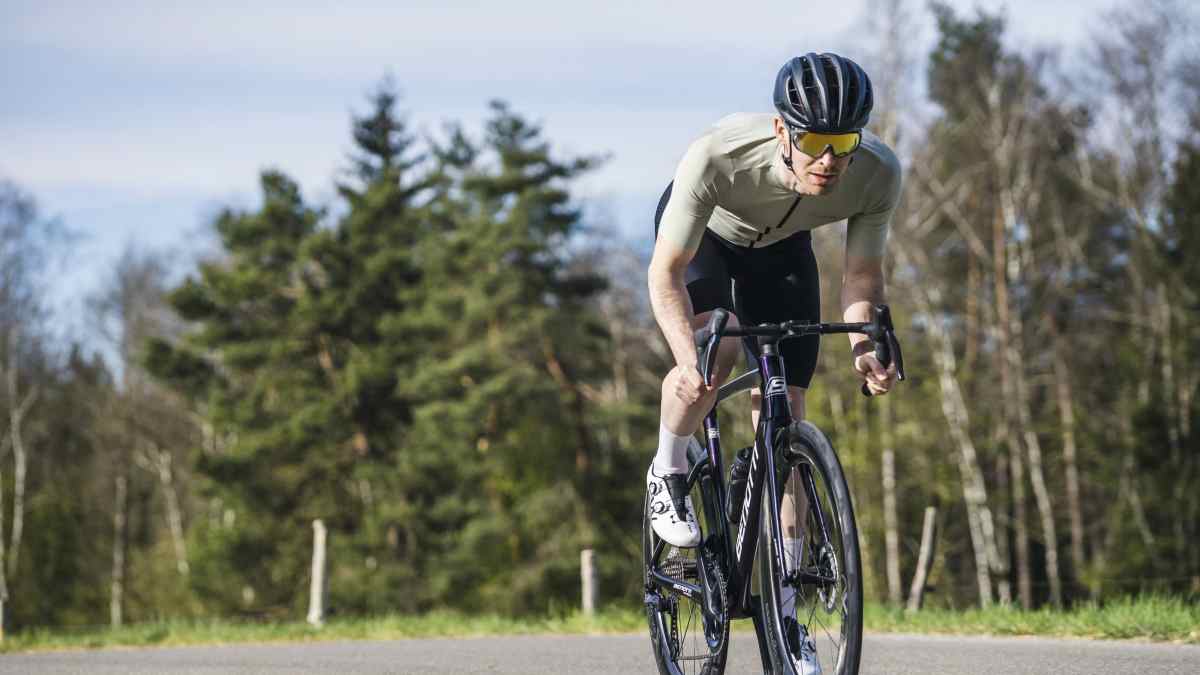
You can't ride slowly on this bike. The saddle at lofty heights, the handlebars just above the road, force the body into such an aggressive position that you can't help but realise the motto emblazoned on the side of the extended lower handlebar ends: "pedal hard", it says. That's exactly what I do. Because the bike sharpens your senses for speed. You can clearly feel the road. The gusty wind too. The front wheel with its 65 millimetre high rim twitches in such a way that it is more of an incentive than a risk to put the spurs to the red racing car. The fact that the bike is still easy to ride despite the high rims is also due to the aero tyres fitted. The tread pockets in the Conti Aero 111 prevent premature stalling and help to reduce front wheel wobble. And so I surrender to the thrill of the road, surfing the asphalt, looking for small berms where car tyres have deformed the ground. Narrow handlebars, firm feedback from the road and surroundings: pure race feeling, the bike runs smoothly.
On the first descent on a wet road, the bike builds up almost too much speed to simply let it run as usual. But just in case, the extremely confident Red brakes are on hand. The visuals play their part in the speed. Before, during and even afterwards, when the bike is back on the hook, it conveys a clear message: speed, speed, speed.
Narrow application range
On the move, the eye is drawn to the slender, shiny red tube. 80 millimetre deep fork blades, the maximum permitted by the UCI, cut through the air. The cockpit matches this: also slim and sleek. The aero optimisation goes right down to the last detail. The curve of the 38 centimetre narrow handlebar is aerodynamically shaped, as are the handlebar ends. It's all easy to grip, the optimisation does not interfere with the ergonomics. The aero chainring of the 1x12 drivetrain matches the idea of the minimalist high-speed machine. Mountain gears? There are none. The single drivetrain (50 to 10-30 teeth) requires muscle and speed tolerance. A bike for criterium racing or for a quick lap around the house. In the lightest 50/30 gear, the chain grinds audibly and the short chainstays take their toll.
But fast driving is much better anyway. The centre of the road is the traditional place for the Aerfast. If a cyclist appears in front of me, I have to overtake him. This can become problematic in the long run, because riding at full throttle all the time, that much is clear, is a real killer. As a second bike, the Aerfast - in this configuration - is therefore more conceivable than as a sole piece of sports equipment: it is not very versatile. If you encounter a serious obstacle such as a vineyard with a double-digit gradient, things get really tough. Not to mention an Alpine pass. The speedster is no fun on bad roads either. But when the tarmac is spotless, it's a pleasure to eat up kilometres at low speed. Other configurations for a more moderate pace and more flexibility are possible, but the 1x12 drivetrain with aero chainring brings out the race genes. The minimalist Alpitude carbon saddle, which also proves to be surprisingly comfortable, is a perfect match. The fact that the shape fits may be a coincidence. But the saddle cover is springy and the generous cut-out reduces pressure in the crotch, which are objective plus points beyond the fit.
Full hardness
The massive aero seatpost, on the other hand, hardly bounces at all, while the low-set seat stays save some frame flex. In practical terms, however, the rear suspension is reduced to the tyre, which is particularly narrow at 25 millimetres. A detail that contributes to the outstanding wind tunnel result (about half a watt), but is a rather disadvantageous compromise in real life. A tubeless setup is ideal for pushing the air pressure limits to the limit. However, if you're not a watt fetishist, you're more likely to opt for a 28 mm tyre at the rear, which offers more clearance and riding dynamics. A 26 millimetre wide Conti Aero 111 is fitted at the front. However, according to our measurements, the 29-millimetre version is aerodynamically equivalent on the DT Swiss ARC 1100 wheels. The combination of these wheels and the tyres puts the Storck right at the top of the aero rankings. With frontal airflow the Stromm Raktt, which we recently voted the fastest bike (TOUR 5/26), a little faster, as the resistance curves show. But under the influence of crosswinds, the Storck delivers an extra dose of speed, which makes it one watt faster.

Numerically, Storck is therefore ahead. The lettering "195" on the back of the seatpost, which was still somewhat optimistic before the test and referred to a measurement without a water bottle, has now become reality. It seems as if Markus Storck had a premonition that he would be able to break the threshold at some point. You should know how to categorise this, that the group of the fastest bikes with values around 200 watts has similar potential. All of these bikes are very fast, and a lucky tyre/rim combination can be the deciding factor in who has the front tyre in a shoot-out. As we showed in TOUR 5/26, it's not the frame alone that makes a bike fast. It's the sum of all the parts. However, Markus Storck leaves nothing to chance here and assembles the parts that harmonise perfectly with each other according to the available measurements. The world champion title is the result of meticulous attention to detail. At Storck, it is the boss himself who crunches the numbers and scrutinises every detail. This sets Storck apart from other bike companies, which have a greater division of labour and may not be quite as consistent in their approach.
Successful diet
Storck has also tweaked the weight. In the last test, the bike weighed 7.29 kilograms. The test bike now weighs just 6.89 kilograms. The 400 gram difference can be explained by the 150 gram lighter wheels and a tuning saddle, which reduces the weight by a further 170 grams. The remaining difference is due to tuning screws and one less spacer. The diet plays a major part in the overall score of 1.7 - which is very good for an aero specialist. Nothing has changed in terms of riding characteristics. The Aerfast is as hard as a rock, the handlebars are the most likely to flex under hard impacts. In the bottom bracket, the bike is very stiff, but also very stable. This distinguishes it from the Stromm Raktt, which is significantly less stable, but also not as hard on the rider. The geometry of the bike is well-balanced and overall it is lively to ride without feeling nervous. The Aerfast.5 Pro is also attractively priced in this configuration: the bike costs € 9,199, undercutting most competitors who usually hang five-figure price tags on their top models. With an Ultegra groupset and Storck's own Aero wheels, the bike is available from € 6,549 and, thanks to the 2x12 drivetrain, is also more versatile than the top model tested.