


Data and facts about the Canyon Aeroad CFR LTD AXS
| Weight | 7.105 kg |
| Drivetrain | SRAM Red XPLR AXS |
| Front brake | SRAM Red |
| Wheelset | DT-Swiss ARC 1100 |
| Front tire | Continental Aero 111 26-622 |
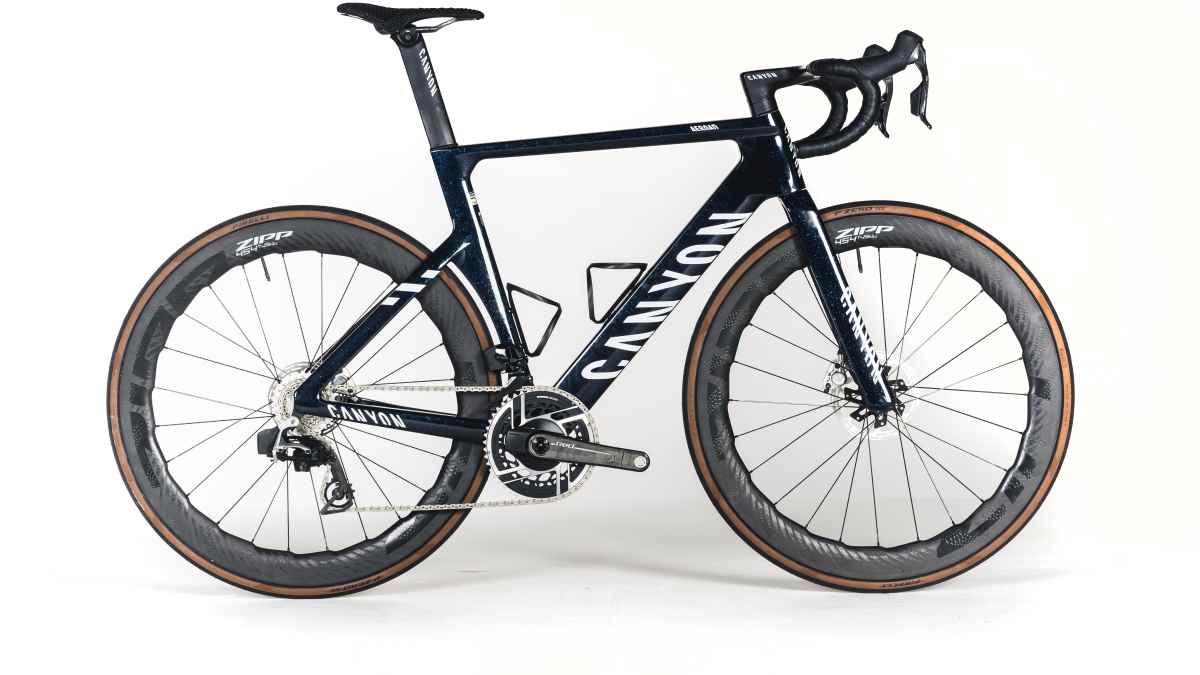
Just in time for the Eurobike trade fair – where Canyon is one of the few exhibitors specialising in road bikes – and shortly before the start of the Tour de France, Canyon has unveiled an update to its flagship Aeroad CFR. Although ‘update’ is perhaps a bit of an overstatement, as nothing has changed about the frame apart from a new mount for a UDH derailleur hanger. The headline news is a spec variant with the additional ‘LTD’ designation, which is tuned for maximum speed. It comes with a new, more aerodynamic handlebar, which was already seen earlier in the season on pro bikes in various races and, from today, can also be fitted to other Aeroad spec variants. The LTD version also comes with a 1x13 drivetrain (SRAM Red AXS), which saves even more watts by doing away with the front derailleur and featuring a closed-face aero chainring. Fast DT Swiss wheels and Continental’s Aero 111 aero tyres, 26 millimetres wide, squeeze every last bit of aerodynamic advantage out of the spec.
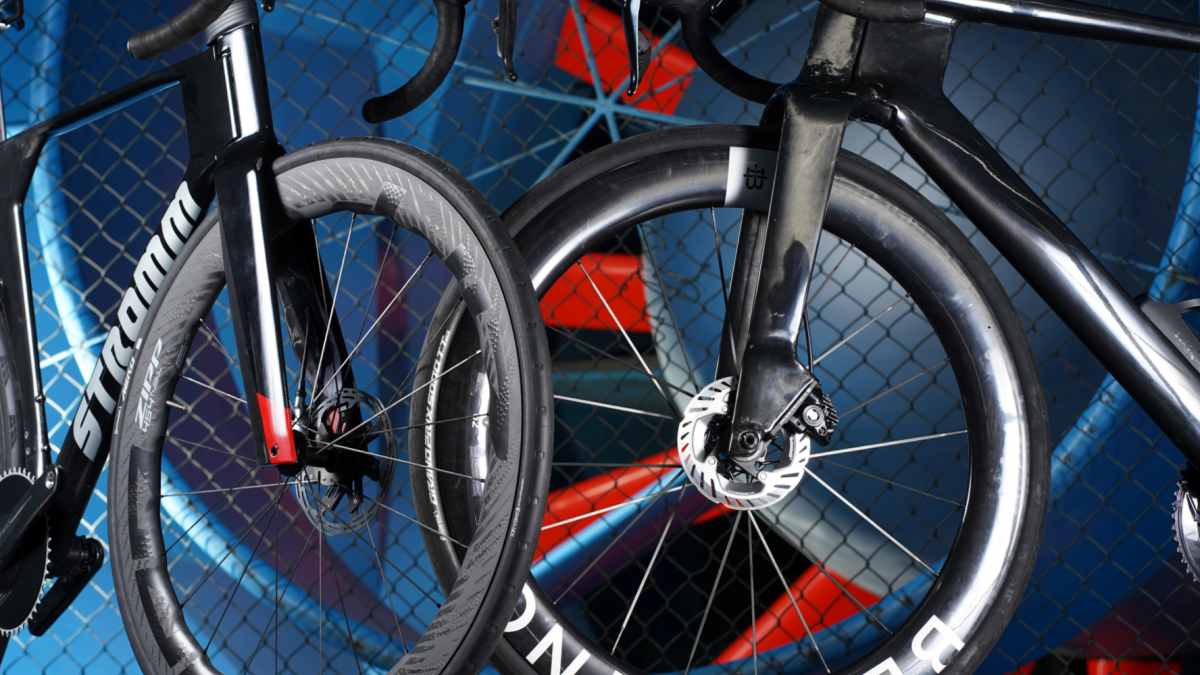
According to Canyon, the new handlebars are said to save two watts of aerodynamic power. The Aeroad CFR, which currently ranks at 204 watts in our aero rankings, is therefore edging close to the 200-watt mark, which only a handful of bikes have managed to beat so far. Based purely on the maths and our experience to date, success should be on the cards with the single-drive system (minus two watts) and the aero tyre (minus 2–3 watts). Our wind tunnel measurements, which we were able to carry out with this version even before the official launch, confirm the result: according to our measurement method and weighting, the display now shows 198 watts.
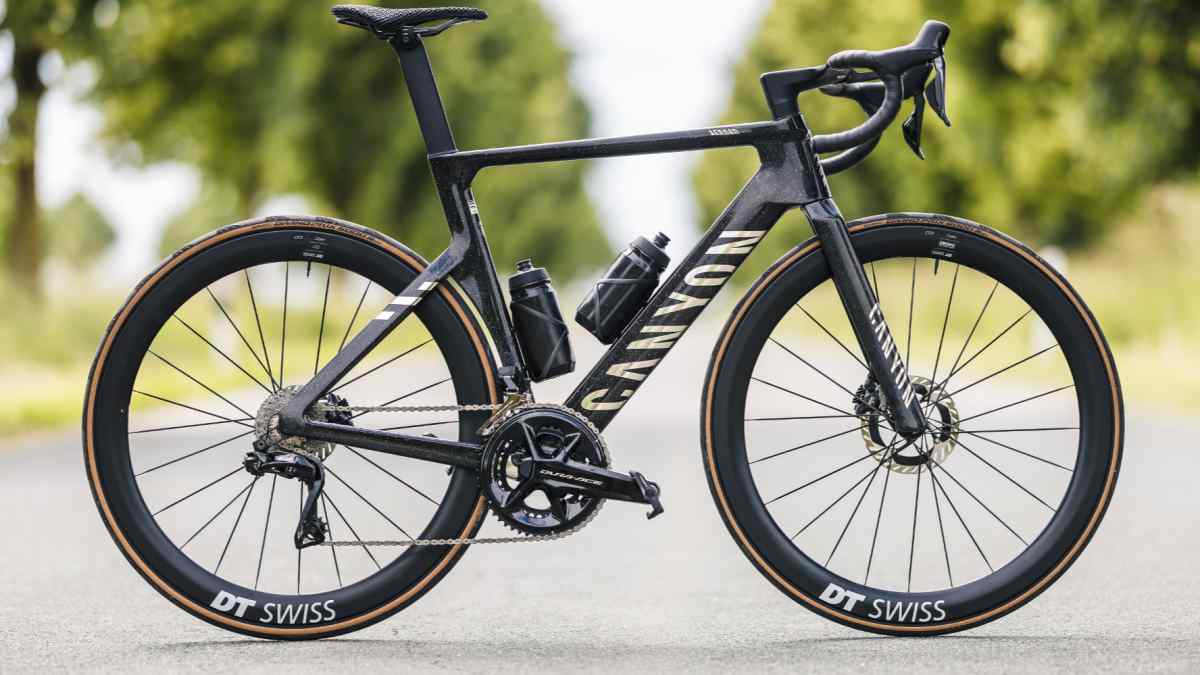
Canyon is promoting the bike as the “fastest bike in the Tour de France”, although this claim should be taken with a pinch of salt: The measured figure applies only to the configuration with the SRAM 1x13 drivetrain; double-chainring set-ups are likely to remain just above the 200-watt mark. Only Movistar would be in a position to implement a comparable setup, as they use SRAM groupset and Conti tyres. However, it is rather unlikely that the rather conservative Spanish team will opt for the single-chainring setup across the board.
New cockpit with an extreme position
On the LTD model, the RACE Bar replaces the previous PACE Bar system. The one-piece V-shaped design weighs 120 grams less than its predecessor, but unlike the standard version, it is no longer adjustable in width; instead, it is available in two different fixed widths. Furthermore, the handlebars shift the grip position 10 millimetres forwards and a full 20 millimetres downwards. Under real-world conditions, Canyon promises a power saving of up to 25 watts thanks to the reduced frontal area. The drops are angled outwards by 14 degrees. According to the manufacturer, torsional stiffness is also higher – for better power transfer during sprints.
With the new handlebars, the riding position on the Aeroad changes from moderately sporty to extremely stretched out. The body’s centre of gravity shifts far forwards, with a lot of weight resting on the front wheel and on the hands. Anyone wishing to spend many hours in this position and enjoy the undeniable aerodynamic benefits should therefore be well-trained. In tight bends, the Aeroad can feel a little unwieldy at times due to the handlebar position, which is set well ahead of the front wheel hub. The faster you go, the more stable the bike feels on the track. At high speeds, the Aeroad rides straight as an arrow. The handlebars also offer advantages when riding out of the saddle and during sprints: even riders who lean far forward over the handlebars during powerful surges are unlikely to bump their knees against the handlebars in the heat of the moment.
A fast LTD variant with some compromises
The new frame uses a UDH (Universal Derailleur Hanger) interface for the rear derailleur. This design feature allows the use of SRAM’s 1x13 drivetrain; the Aeroad CFR LTD is fitted with a Red AXS XPLR. Although essentially a gravel drivetrain, the 50-tooth chainring at least offers sufficient gear range for fit riders and hilly terrain. However, this configuration is definitely not an option for high-altitude mountain riding. It’s not just the large gear steps – particularly in the lower gears – that are annoying. On the Aeroad, too, the drivetrain makes an audible grinding noise when the chain runs askew in the two lowest gears. The setup, which offers a mere two watts of aerodynamic advantage and – due to the large cassette – a weight saving that’s barely worth mentioning, remains a choice for specialists who know exactly what they’re getting into.
In any case, in this configuration, the Aeroad is the antithesis of a long-distance bike: the narrow front tyre and the exceptionally stiff seatpost setup offer little comfort on rough roads by today’s standards; many all-round race bikes, which are only slightly slower, are significantly more comfortable to ride in these conditions. The riding position and gear ratios are also better suited to a quick after-work ride and perhaps criterium races than to epic cycling marathons. As for the total weight, the CFR LTD tips the scales at 7.1 kilograms – exactly the same weight as a model we tested last year fitted with a SRAM Red AXS double drivetrain.
New configurable components
The RACE Cockpit is available in seven stem lengths and two widths; two carbon computer mounts are included. The cockpit can be ordered as an upgrade via the MyCanyon programme; it is compatible with all models featuring the CP0048 PACE Bar System, including the Aeroad CFR/CF SLX, Endurace CFR/CF SLX and Ultimate CFR/CF SLX.
Meanwhile, the classic PACE Bar handlebar is increasingly becoming an integral part of a geometry concept that also extends to other Canyon models. Not only can the width of the handlebar ends be adjusted, but they can also be swapped out, with three options to choose from. The so-called Race Drops replace the Aero Drops with less flare and a lower lower bend for sprints and descents. The Compact Drops focus on ergonomic handling; the effective reach here is 10 millimetres shorter than on the Classic Drops.
The MyCanyon programme now also offers three seatpost options for the Aeroad. In addition to the standard Aero seatpost with a 10-millimetre setback or without any setback, there is also a comfort seatpost with a recess for extra flex, which is familiar from the Endurace unveiled in the spring.
The range is expanded to include carbon wheelsets from Scope. The Scope Artech 6 Aero wheelset features 65-millimetre-high rims with a scaled Aeroscales surface. Pirelli P-Zero SLR TLR tyres are pre-fitted on this version, which weighs 1244 grams. The Scope Artech 4, designed as an all-rounder, features 45-millimetre-high rims with the same surface texture. It comes fitted with Continental GP5000 TT tyres, and the wheelset weighs 1120 grams.
The Aeroad CF SLX can now also be configured via the MyCanyon programme. Crank length, stem length, handlebar drops and cassettes can be selected here.

Jens Klötzer
Editor
