


Road cycling for beginners: The most common mistakes when riding with clipless pedals
Lukas Niebuhr
· 15.06.2026

Many of the mistakes listed here are perfectly normal and can be quickly rectified with a little knowledge and practice. The following points highlight what you should look out for to ensure you ride your road bike more safely, more relaxed and with greater enjoyment.
8 common mistakes when cycling with clipless pedals
1. Not enough practice before the first ride
Many beginners get straight on their bikes outdoors without practising clipping in and out beforehand. In real-world conditions – traffic, traffic lights, hills – the pressure mounts, and suddenly they can’t get the hang of it. A quick practice session on a grassy patch or outside your house helps ease the nerves and builds up a routine.
Better:
- Practise for 10 to 15 minutes in a meadow or near the house
- Click in and out several times in a row
- Don’t set off until the movement has become second nature
2. The cleats are incorrectly adjusted
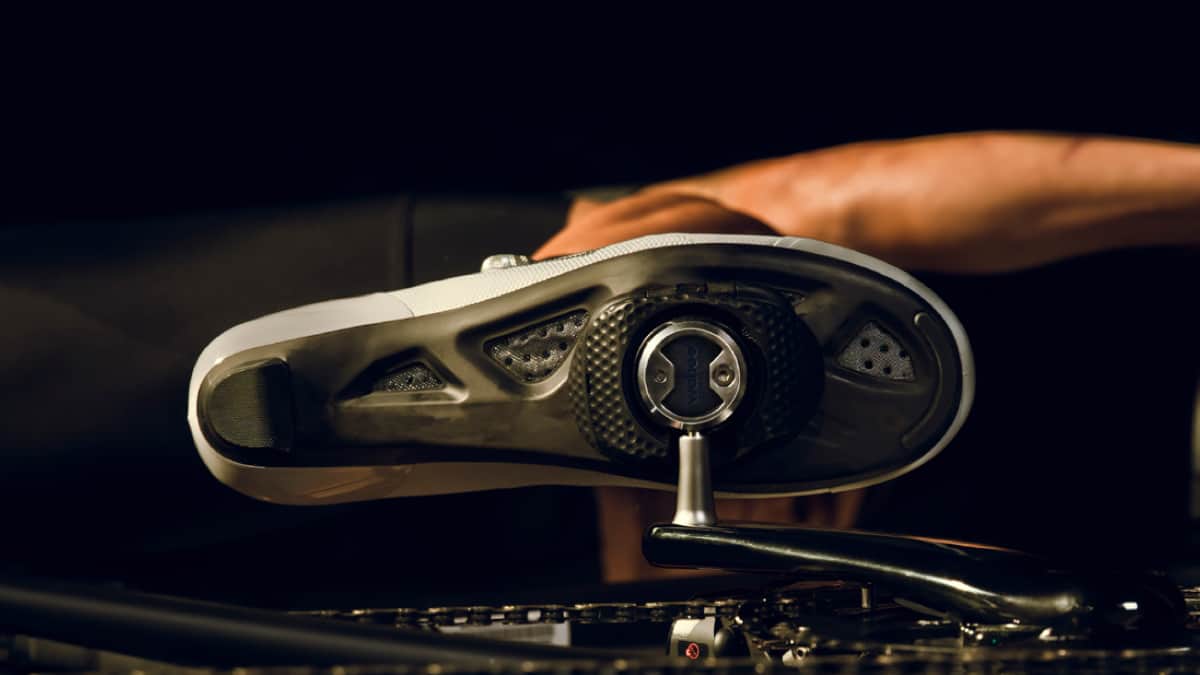
If the cleats do not match the natural position of the foot, knee or hip pain can quickly develop. An incorrect angle or insufficient float (range of motion) can also make cycling feel unstable. Careful alignment ensures comfort, efficiency and long-term health.
Common mistakes:
- Cleats positioned too far inwards/outwards → knees turn inwards or outwards
- Incorrect angle → Foot is positioned unnaturally
- Insufficient float
Better:
- Fit the cleats so that the foot is in its natural position
- For beginners: Cleats with plenty of float (6–9°)
- Use the markings on the shoe to check your position
3. Failing to release the clip in time when stopping
The classic scenario: you’re cycling leisurely towards a set of traffic lights, clip out too late – and tip over whilst stationary. The bike loses its stability at the last moment, something beginners often underestimate. If you clip out in good time, you’ll have enough time to brace yourself safely.
Why this happens: Beginners underestimate how quickly a bike becomes unstable when stationary.
Better:
- Unclip early – at least 5–10 metres before coming to a stop
- Always unclip the same foot first (it’s a habit!)
- When setting off, only engage the clutch once the vehicle is rolling steadily
4. Excessive pedal resistance
Many pedals come factory-set to be quite stiff, which makes unclipping unnecessarily difficult. Especially when you’re just starting out, a slightly looser setting helps to build confidence. Only once you’ve got the hang of the movements is it worth gradually increasing the tension.
Better:
- Set the spring tension on the pedal to the lowest setting
- Only tighten it more firmly later, once you feel confident
5. Incorrect pedalling technique
Clipless pedals are designed to make your pedalling smoother, but many cyclists pedal unevenly and focus, for example, only on the downward stroke. This leads to an uneven riding style and, over time, can put one-sided strain on the muscles. Applying even pressure throughout the entire pedal stroke and maintaining a moderate cadence help to improve your technique.
Common mistakes:
- Uneven load
- Heels point downwards
- Unsteady gait at high frequency
Better:
- Focus on even pressure across the entire circle
- Lift your heels slightly, but don’t overdo it
- Ride at 80–90 rpm to encourage a smooth pedalling motion
6. Fear of falling over – and consequently riding tensely
Anxiety often leads to tense shoulders, stiff arms and an unsteady riding style. If you ride tensely, you react more slowly and lose your balance more easily. A relaxed posture and keeping your eyes on the road create stability and confidence.
Better:
- Look far ahead, not at the pedals
- Keep your shoulders relaxed
- Building trust: Everyone falls over at the start – it’s all part of the process
7. Ill-fitting shoes or shoes that are laced too tightly
Shoes that are too tight or straps that are adjusted incorrectly can cause numbness or pain in the forefoot. This becomes noticeable very quickly, especially on longer rides. A well-fitting shoe with plenty of room and moderate tension ensures comfort and better power transfer.
Better:
- Shoes with plenty of room in the forefoot
- Do not tighten the strap too much
- On longer rides, take a break now and then
8. Changing gears too soon after setting off
Many people try to clip in straight away with their first pedal stroke, which can throw them off balance. Stability is more important than efficiency, especially when setting off. Wait until you’ve made a few steady turns of the pedals, then clip in calmly – this makes getting started much more relaxed.
Better:
- Start by doing just 2 or 3 steady turns of the cranks
- Then click it in gently
- Safety comes before efficiency
Conclusion
Clicker pedals can be a bit of a challenge at first, but with a bit of practice they’ll soon become your best friend on the road bike. Most mistakes are down to a lack of practice, incorrect settings or a lack of confidence – all things you can quickly get to grips with by following a few simple steps.

Lukas Niebuhr
Working student
