


A connected road bike and a titanium bike straight from the printer: Road bike highlights from Eurobike 2026
Jan Timmermann
· 26.06.2026


For years, Eurobike has seen a decline in the number of sports brands attending, and this trend is set to continue in 2026. Other trade fair formats suit manufacturers such as Specialized, Trek and Scott better; these professional equipment suppliers are, in any case, using the Tour de France – which begins in a few days’ time – as a showcase for new products. Of the established brands, only Canyon is sticking with Eurobike. Otherwise, smaller suppliers are using the space to draw attention to themselves. Amidst e-MTBs, cargo bikes and child trailers, our trade fair team searched for news featuring road bike handlebars, and did at least find a few interesting items.
Prototype: Canyon Grail CFR

There had already been speculation about the prototype of Canyon’s new gravel bike at the Traka 2026 gravel race. This very bike was now on display at the Canyon stand at Eurobike. The previously unannounced race gravel bike is a newly developed Canyon Grail CFR. According to information at the stand, the prototype is said to incorporate the aerodynamic insights of the World Tour team. Notable features include the large tube diameters and the clearance for 29 x 2.1-inch Schwalbe gravel tyres – despite the aerodynamically shaped seat tube. The model on display is the race bike ridden by German rider Juri Hollmann. Canyon is keeping the weight and price under wraps for the time being.

Quick build: Canyon Aeroad CFR

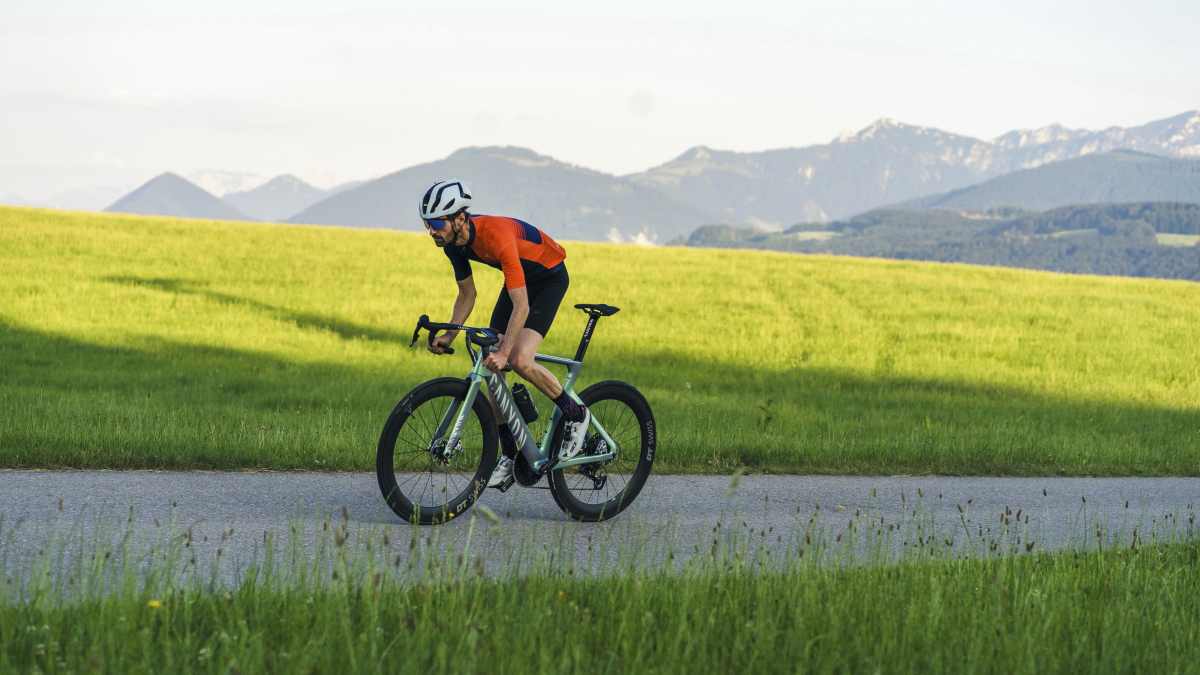
Also on display at the Canyon stand: the Aeroad CFR, which was officially unveiled on Thursday. Admittedly, the changes to the flagship race bike are only minor: a new race handlebar, UDH derailleur hanger, and a spec variant called LTD, which is tuned for maximum speed with a single-chainring drivetrain and aero tyres. The bike is being promoted on the back of our wind tunnel test, in which it dipped below the 200-watt mark. We’ve already had a go on it – click here for the review:
The road bike of the future: Canyon Predict

With the Predict, Canyon is introducing a concept that brings safety technology from the automotive industry to cycling, without compromising the riding experience of a high-end road bike. The system is designed to address the lack of safety improvements for cyclists, as death and injury figures continue to rise in many countries, leaving many people feeling unsafe.
Technically, the Predict Bike utilises multimodal 360° sensor technology comprising a camera, radar and a multidimensional motion sensor in the DT Swiss wheel hub. The AI-based on-device processing analyses the surroundings and ride data in real time, detects hazards, reduces blind spots and operates in a privacy-friendly manner even without an internet connection.
A display in the handlebars and an optional AR helmet are designed to provide early warnings about traffic, group dynamics and challenging terrain – including predictive risk assessment and possible interventions such as automatically lowering the seat post. However, it remains to be seen whether the technology will make the leap from concept to a production-ready system suitable for everyday use.
To complement this, Canyon is unveiling a connected helmet featuring an integrated display, voice control and audio output. It is designed not only to provide protection, but also to serve as an interface for the smart safety system. According to Canyon, the helmet can also process data from other compatible systems, such as power or heart rate sensors. The manufacturer is thus positioning it both as a training device and as part of a comprehensive safety ecosystem for cyclists.
Prototype: New aero gravel bike from Ridley

There isn’t much information available yet, but given the frame’s polished design, a market launch is likely imminent: Ridley showcased a new gravel bike with an aerodynamically shaped frame at the trade fair. Ridley helped pioneer this trend a few years ago with the Kanzo Fast; however, the model now seems somewhat outdated, mainly due to its narrow permitted tyre width. The new bike follows the current trend towards significantly wider tyres; here, it is fitted with 55-millimetre-wide Schwalbe tyres. A storage compartment is also integrated into the down tube. The bike is fitted with a SRAM Force 1x13 drivetrain, although a front derailleur is apparently still planned. When it will be available and how much it will cost: as yet unknown.
3D-printed: TOOT custom road bike made from titanium powder
TOOT specialises in aerodynamically optimised track bikes. However, the design studio on Lake Garda also undertakes exciting custom projects, such as this titanium road bike called Eris. The bike is developed entirely around the rider’s individual needs. The ergonomics of the client, Stefan, were characterised by a long torso. The aim was to build a titanium bike that would be a pleasure to ride both at high speeds and on long rides. 3D-printed parts allow for the precise optimisation of wall thicknesses. This involves fusing titanium powder with pinpoint accuracy using a laser. The cost of Stefan’s TOOT Eris: around 9,000 euros. Only 60 to 70 TOOT bikes are produced each year.

Electric gearbox for sports enthusiasts: Rohloff E14 Solo
With the E14 Solo, Rohloff is returning to its core strengths. Although the hub gear system is electronically controlled, it does away entirely with app connectivity, cloud data and the need to log in. Instead, the focus is on the low-maintenance gear-shifting function. Gear changes are designed to be lightning-fast, even when stationary, and can be controlled via both flat-bar triggers and drop-bar shifters. The system is powered by an elongated battery, which can be mounted either internally or externally on the frame. The bike on display at the trade fair is a super-lightweight Ahead The Superfast gravel bike made from carbon. In typical Rohloff fashion, the individual E14 Solo components can be retrofitted to all Speedhub hubs ever produced. Rohloff immediately won a gold Eurobike Award for the E14 Solo.

9.8kg e-road bike: Origine with Mahle X20
It doesn’t look like an e-bike, but it is one: the lightweight Origine Newton(e) road bike is powered by a Mahle X20 hub motor. The mini drive unit delivers up to 65 Newton metres and 275 watts. The entire drive system weighs just 1.4 kilos, giving the e-road bike a dream weight of 9.83 kilos. This is designed to preserve the bike’s natural handling and authentic pedalling feel. Other road bikes, such as the Ponomaret Eidolon (9.9 kg) or the Wilier Filante Hybrid (10.3 kg), also reflect the industry trend towards integrated lightweight systems.

Conclusion
Eurobike may have shrunk as a trade fair, but the remaining manufacturers show no signs of slowing down. Instead, there are exciting new bikes and parts as far as the eye can see. Technical progress is not limited to any one area. Whether e-bikes, gravel bikes or mountain bikes, whether electronic, mechanical or hydraulic: Eurobike 2026 shows that bikes can get even better. - Jan Timmermann, BIKE editor


Jan Timmermann
Editor