


The 113th edition of the Tour de France will take place from 4 to 26 July 2026, covering 3,320.7 kilometres through Spain and France. 184 riders from 23 teams, each comprising eight riders, will set off from Barcelona. The race comprises 21 stages with a total elevation gain of 53,950 metres.
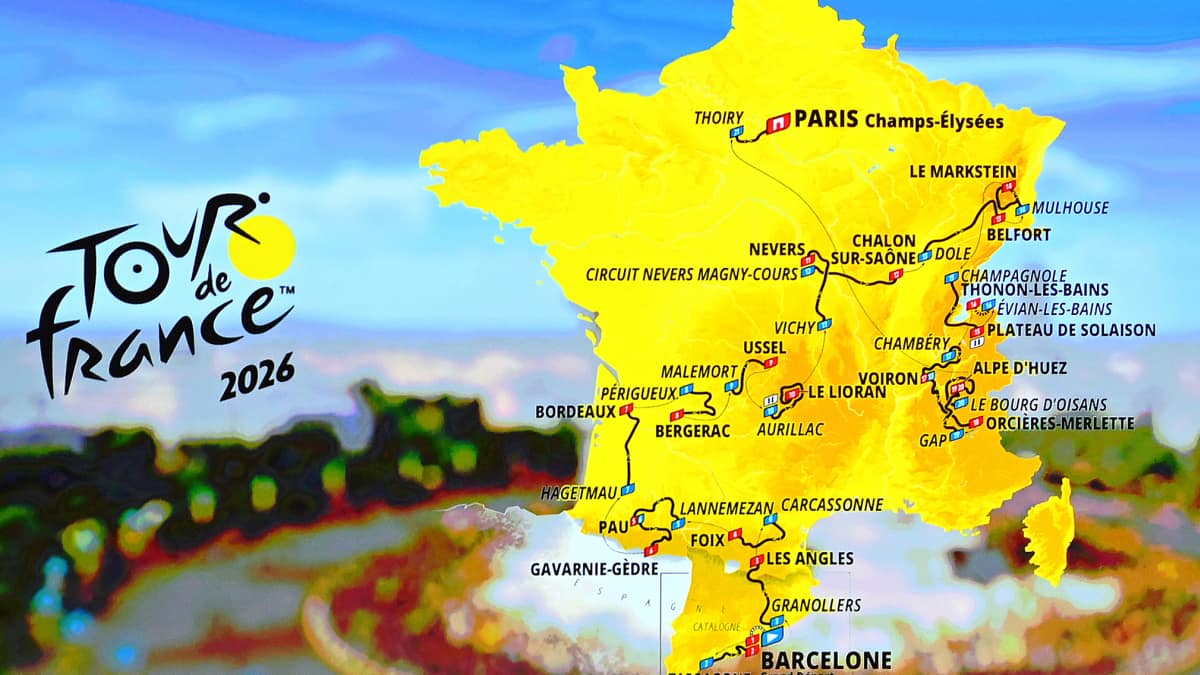
Route of the 2026 Tour de France
The Grand Départ of the 2026 Tour de France will take place in Barcelona with a team time trial. The route passes through three Catalan provinces: Barcelona, Tarragona and Girona. In France, the peloton will pass through 29 départements in seven regions. There are 37 start and finish locations along the route, including ten new ones: Tarragona, Granollers, Les Angles, Gavarnie-Gèdre, Hagetmau, Malemort, Ussel, Circuit Nevers Magny-Cours, Plateau de Solaison and Thoiry.
The tour comprises seven flat stages, four undulating stages and eight mountain stages. Two rest days are scheduled for 13 July in the Cantal and 20 July in Haute-Savoie. The individual time trial on stage 16 runs from Évian-les-Bains to Thonon-les-Bains.
Mountains and climbs in the 2026 Tour de France
30 classified climbs in Categories 2, 1 and Hors Catégorie await the riders in the 2026 Tour de France:
- 13 climbs in the Alps
- 6 climbs in the Pyrenees
- 4 climbs in the Massif Central
- 5 in the Vosges
- 1 Ascent in the Jura
- 1 increase in Catalonia
At 2,642 metres, the Col du Galibier is the highest point of the 2026 Tour and has been awarded the Souvenir Henri Desgrange.

The 2026 Tour de France will feature mountain finishes at Les Angles, Gavarnie-Gèdre, Le Lioran, Le Markstein, Plateau de Solaison, Orcières-Merlette and Alpe d'Huez. The final stage traditionally finishes on the Champs-Élysées in Paris.
Safety and medical care
- 300 police officers are providing round-the-clock cover for the tour
- 28,000 police officers, gendarmes and firefighters are securing the route
- 3,000 departmental staff are responsible for setting up the course, putting up signage and ensuring safety along the route
- 3,800 road signs mark hazardous spots along the route
- Ahead of the tour, 1,000 people attended training sessions on safety and prevention. A national safety campaign is running on TV, radio, in the press and on digital media.
The medical service comprises ten doctors from all specialisms, seven nurses, eight ambulances, two mobile medical units, a medical motorbike and an X-ray van.
Media and broadcast coverage of the 2026 Tour de France
- 190 countries will broadcast the 2026 Tour de France
- 100 channels are showing the race, 60 of them live. All stages will be broadcast in full. The international feed provides 110 hours of live coverage
- 3,500 accredited media representatives are covering the tour, including 1,800 journalists from 500 media organisations.
- In 2025, viewers watched over a billion hours of Tour coverage.
The Team Radio system is now in its fourth consecutive year and broadcasts live the communications between riders and sports directors.
Digital reach
- The official Tour de France app recorded 41 million sessions in 2025.
- Over 1.3 billion videos were viewed on the official platforms between 29 October 2024 and 22 October 2025
- The letour.fr website recorded 117 million visits, of which 76 million were from overseas and 40 million were unique visitors.
- 14.6 million followers are following the Tour on all social media channels via @letour.
- The digital community has over a million members. There are specific accounts for different languages: @radiotour_fr, @radiotour_es, @radiotour_en, @letour_de and @letour_uk.
At this point, you will find external content that complements the article. You can display and hide it with a click.
Sustainability and social programmes
All of the organisation’s vehicles are hybrid or electric. 100 per cent of XPO Logistics’ lorries run on biofuel. 101 sensitive Natura 2000 areas are protected. 118 waste collection points for drivers have been set up, with four to eight per stage. A mobile charging trailer supplies electric vehicles. Special TER rail services, a car-sharing platform and cycle parking facilities encourage environmentally friendly travel. 203 towns have been awarded a sustainability label since 2021.
Since 2018, the “Les P’tits Vélos” programme has introduced 700,000 children to cycling. Since the programme began, “1 Vélo pour Tous” has donated 7,200 bicycles and 7,300 balance bikes. The partnership with HandiCapZéro has been in place since 1996 and offers adapted models as well as tandem demonstrations for visually impaired people.
Promotional convoy and spectators
- The advertising caravan stretches for twelve kilometres
- Every day, 180 vehicles entertain spectators for 40 minutes; 32 per cent of them are hybrid or electric
- 700 members of the caravan are mobilising their teams along the route. 55 supervisors are coordinating the event.
- One in two spectators comes to the Tour mainly to see the caravan.
- 90 per cent of viewers would like to receive promotional gifts
- 75 per cent watch the parade with their families
- 78 per cent keep the gifts they receive and find them useful.
- Spectators spend an average of 7 hours and 22 minutes at the roadside to watch the convoy and the riders.


Kristian Bauer
Editor