


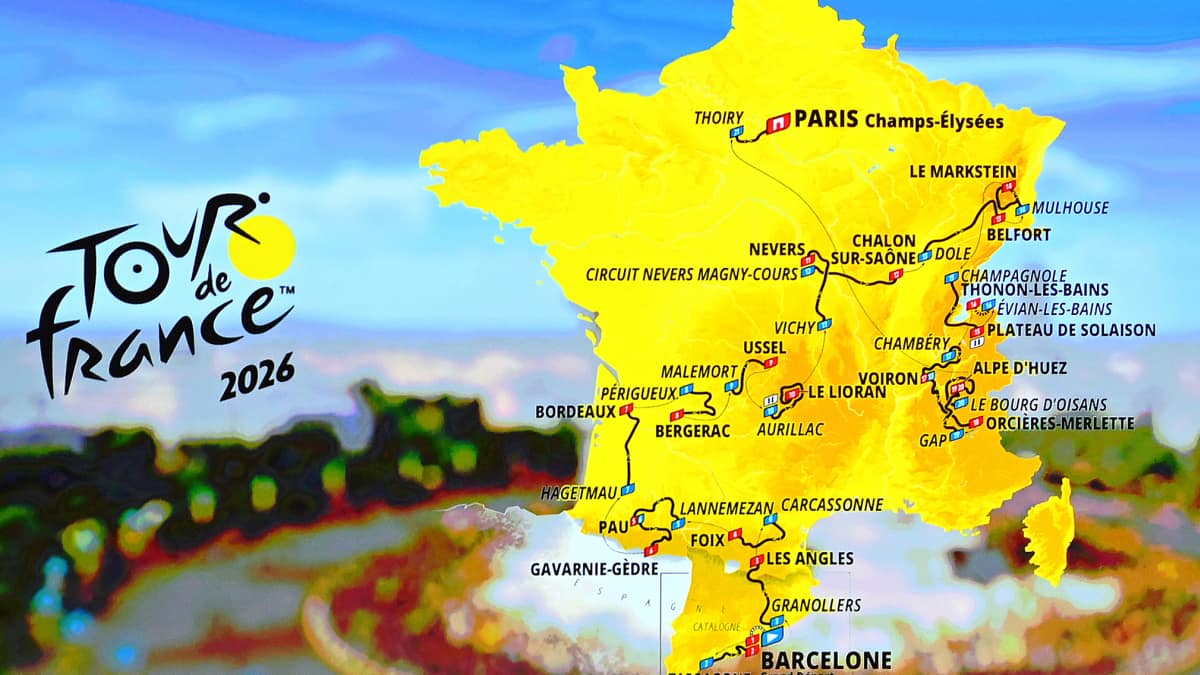
After the team time trial the day before, the second day features a stage finale that could come as a surprise. The second stage of the Tour 2026 leads from Tarragona to Barcelona and ends with a ramp up to the Olympic site. Of course, you can't make any major time differences on this short stretch. But a first exclamation mark, with a psychological effect, in the battle for the yellow jersey is possible. Montjuïc marks the start of our series on the decisive vertical metres of the 2026 Tour.
Montjuïc as a cycling arena
Montjuïc is much more than just a strategically favourable hill on the outskirts of Barcelona. This 173 metre high elevation became an icon of international sport thanks to the 1992 Olympic Games. The architectural transformation of Montjuïc for the Olympic Games not only created impressive sports venues such as the Palau de la Música Catalana and the Olympic stadium, but also a unique terrain for cycling. The road up to the top of the hill offers various climbs with different characteristics - from gently rising boulevards to steep ramps that can push even the strongest climbers to their limits. When you think of the Tour de France's loop to Montmartre in Paris, you realise that even small elevations in the city can provide excitement.
Montjuïc with selection potential
The gradient profile of the Montjuïc climb differs from the classic mountain finishes of the grand tours. With an average gradient of 6.8 per cent over 2.4 kilometres, the climb may appear moderate on paper, but the decisive sections have ramps of up to 12 per cent. These short but intense peaks require explosive power and can create time differences after just a few hundred metres. What makes the climb so treacherous is its position at the end of a 198-kilometre stage. After the long approach from Tarragona, the legs will be heavy and the high speed in the finale will also sap your strength. The prospect of the yellow jersey guarantees a tough battle for the stage win.

Significance after the team time trial
The TTT formula from the previous day, in which individual times are taken in a team time trial for the first time, creates an exciting starting position for the Montjuïc stage. Unlike in classic team time trials, where the differences between the top favourites usually remain minimal, there could already be significant time gaps in the overall classification after the first day. These early differences significantly increase the pressure on the second stage. Riders who have already lost time will be forced to attack early and thus run the risk of further losses. At the same time, those who have benefited from the time trial can behave defensively and wait for their rivals to make mistakes. This dynamic makes Montjuïc a psychological test in which nervousness and tactical errors are quickly penalised.
Barcelona's cycling tradition
The Catalan capital can look back on a rich cycling history that is closely interwoven with the Tour de France. René Privat won the first Tour stage in Barcelona back in 1957, followed by Jacques Anquetil in the individual time trial. In 1965, the Spaniard José Pérez Francés triumphed in front of his home crowd, and in 2009 Thor Hushovd secured the stage win in a memorable sprint. These historic moments emphasise Barcelona's status as one of the most important sporting cities in Europe. As the only metropolis to have hosted the Football World Cup (1982), the Olympic Games (1992) and the America's Cup (2024), Barcelona has unique expertise in handling major events. Mayor Jaume Collboni Cuadrado emphasises the importance of the Grand Départ for the city: "We will once again be part of the Tour family and create a unique setting for this Grand Départ."
Psychological factors
The mental component of the Montjuïc stage should not be underestimated. After the nervousness and pressure of the team time trial, the riders are under tension. Losing time early on can set off a negative spiral that continues throughout the entire Tour. Conversely, a strong performance on Montjuïc can boost self-confidence for the upcoming mountain stages. Experience shows that riders who want to "hide" in the first week of the Tour are often caught up in reality. Modern Tour stages leave less and less room for defensive tactics, and Montjuïc is the perfect example of this development. The combination of technical demands and strategic importance makes every metre a potential decision between victory and defeat.
Montjuïc as a yardstick for the overall tour
In the context of our series "The key stages of the Tour de France 2026", Montjuïc plays a special role. It is only a small hill, but as the first real touchstone of the 2026 Tour, this climb will reveal the form and condition of the favourites on the day. The performances shown here will allow conclusions to be drawn about the chances in the later Pyrenean and Alpine stages. Montjuïc provides the stage for such a moment - a moment in which the wheat is separated from the chaff and the true contenders for the yellow jersey are crystallised. In addition, the first stages are always very hectic and the first crashes could already weaken riders.
Long-term effects on the tour strategy
The results from Montjuïc will influence the strategic direction of the teams for the next three weeks. Riders with early time losses will have to take greater risks on the next stages, while those with a lead will be able to ride more controlled races. Furthermore, Montjuïc has the potential to shift the psychological balance of power in the peloton. A dominant victory by a favourite can intimidate rivals and create momentum for the coming stages. Conversely, a surprise by an outsider can upset the established order and create new alliances in the peloton.

Kristian Bauer
Editor