


Key stages of the 2026 Tour de France: The individual time trial on Lake Geneva
Kristian Bauer
· 12.06.2026

Following the crucial stages in the Vosges and the first Alpine stages, 21 July brings what appears to be a breather: a 26-kilometre individual time trial between the two spa towns of Évian-les-Bains and Thonon-les-Bains on the shores of Lake Geneva. But appearances can be deceiving – Christian Prudhomme warns of an “explosive cocktail” that only the most complete time trialists can handle. One-third climb, one-third descent, one-third flat section: this 16th stage could be the last chance for those who have struggled on the previous mountain stages to make up crucial seconds before the Tour enters the final Alpine block.
EZF Tour de France 2026: More than just a lakeside promenade
On closer inspection, the 26-kilometre stretch between Évian-les-Bains and Thonon-les-Bains reveals a profile that presents riders with three completely different challenges. The first section of the route covers 9.7 kilometres to the Côte de Larringes, with an average gradient of 4.3 per cent up to an altitude of 799 metres – a climb that demands climbing skills and can already cause problems for pure time trial specialists. From Champanges, the route develops into a continuous climb where aerodynamic positions reach their limits and power output determines victory or defeat. The highest point at Féternes marks the transition to the second phase: A technically demanding descent to the Pont de la Douceur, covering 370 metres of descent. This is where the wheat is separated from the chaff – anyone showing weaknesses in their descending technique or having made the wrong choices regarding equipment will lose precious seconds. The final nine kilometres along Lake Geneva to Thonon-les-Bains seem relaxed at first, but after the rigours of the first two sections, this flat final stretch becomes a test of willpower.

Tactical challenges and a battle of attrition
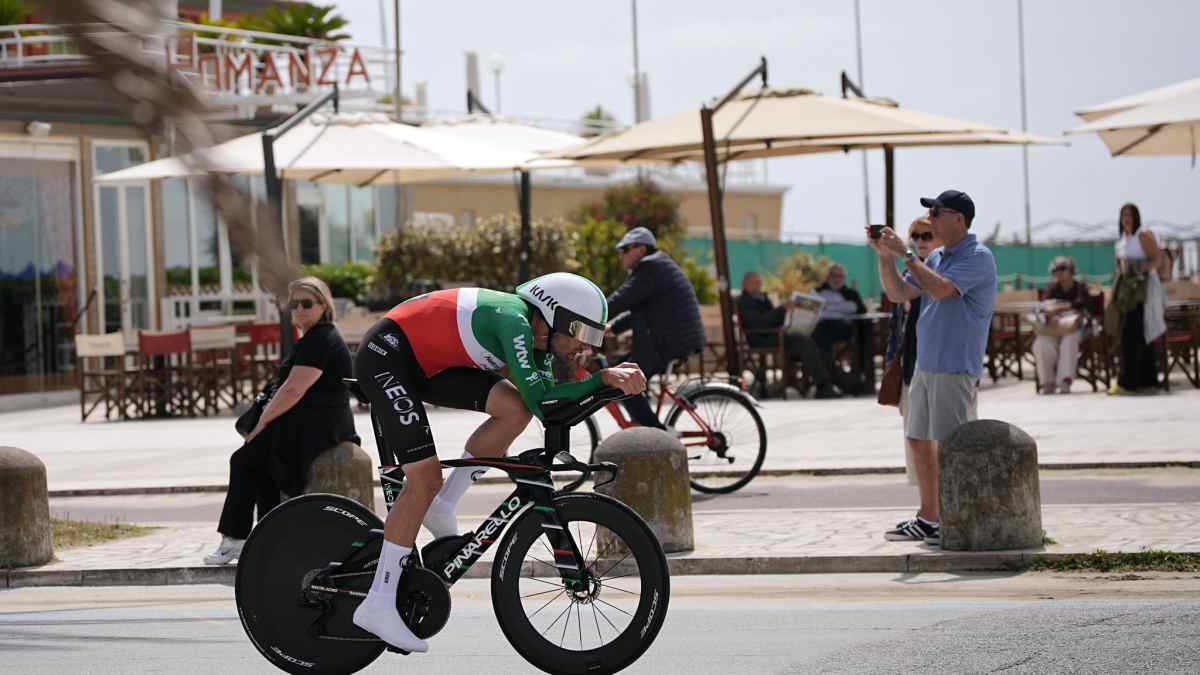
The total climb of 500 metres presents the teams with a dilemma when it comes to choosing their equipment. Whilst a classic time trial bike offers advantages on the flat sections, it proves to be a disadvantage on the climb up the Côte de Larringes. Many riders will opt for a compromise: time trial bikes with adjusted gear ratios or even road bikes in an aerodynamic configuration. The choice of wheels could also vary – deep-section carbon rims for aerodynamics versus lighter climbing wheels for the ascent. In the first phase of the climb, riders must abandon their aerodynamic position and switch to a more powerful climbing position to generate the necessary power output. The transition back into the time trial position for the descent and the flat final section requires not only technical skill, but also the ability to recalibrate the body within seconds.
Strategy for the course
Managing one’s energy across three such varied sections of the course requires a well-thought-out pacing strategy. Some riders will make the mistake of tackling the climb up the Côte de Larringes too conservatively in order to save energy for the final stretch. Yet experience shows: time lost on the climb can hardly be made up on the flat. The most successful riders will tackle the climb aggressively and take the risk of suffering in the final kilometres. Risk management on the technical descent from Féternes to the Pont de la Douceur will also be crucial. Here, daring riders can gain crucial seconds – or, in the event of a crash, bury their entire Tour ambitions. The tight bends and changing road surfaces demand absolute concentration and perfect bike set-up. Anyone riding here with tyres that are too soft or poorly adjusted brakes will pay dearly.
Tour de France General Classification
This 16th stage could prove to be a turning point in the overall standings. The time bonuses of 10, 6 and 4 seconds for the top three places are just the tip of the iceberg – time gaps of 30 to 40 seconds between the favourites in the general classification are a realistic prospect. For riders who have lost time in the previous mountain stages, this offers a last chance to attack once more before the final Alpine stages. The situation will be particularly interesting for the defeated mountain specialists with time trial ambitions. Riders who lost precious seconds on the Plateau de Solaison can combine their climbing skills with time-trial power here. The undulating profile suits all-rounders who are neither pure climbers nor classic time-trial specialists, but who can deliver solid performances in both disciplines.
Lake Geneva during the Tour de France
Lake Geneva has already served as the setting for several decisive time trial moments in the history of the Tour. In 1979, Bernard Hinault snatched the Yellow Jersey from Joop Zoetemelk during the 55-kilometre time trial from Évian to Avoriaz – a feat that gave the Breton a decisive boost on his way to his first Tour victory. The parallels with the current stage are unmistakable: back then, too, the riders had to tackle a significant climb that shook up the pure time trial hierarchy. Évian itself looks back on an impressive Tour tradition. As the first provincial town ever, the spa town was already chosen to host a Grand Départ in 1926 – at a time when the Tour was still on a much more modest scale. Évian hosted Tour stages for twelve consecutive years, underlining the region’s strategic importance. More recently, Alberto Contador proved in the 2010 Critérium du Dauphiné prologue that the undulating topography around Lake Geneva demands exceptional time trial skills.
Role in the 2026 Tour de France
Following the initial climb in the Vosges and the opening stage in the Alps on the Plateau de Solaison, the time trial between the thermal baths serves as the final opportunity to make up ground before the final decisions are made. The seconds gained or lost here will be of crucial importance in the upcoming stages to the Alpe d’Huez ski resort and over the Col du Galibier (2,642 metres, the highest point of the 2026 Tour). Riders who make up time here will head into the queen stages with boosted confidence. Conversely, further time losses can weaken morale to such an extent that the necessary willingness to take risks is no longer present, even in the mountains. The psychological aspect of this time trial must not be underestimated – it is the last opportunity for riders to improve their position in the general classification through their own efforts, without tactical manoeuvring or team support.

Kristian Bauer
Editor