


There are certain scenes in cycling that one would really rather not see anymore. Riders who, at a crucial stage of the race, have to contend not only with their rivals but also with cars on the course are undoubtedly among them. Yet that is precisely what happened on the sixth stage of the Tour de France Femmes to be observed once again.
A few kilometres before the finish, the race organisers had ordered all vehicles to be withdrawn from the area between the leading group and the peloton. The gap had become too narrow. Although this was essentially a routine measure, it resulted in a scene that left many spectators stunned. On a descent, the driver of the neutral support vehicle tried with all his might to overtake the leading group. Honking its horn, the vehicle forced its way between the riders, coming dangerously close to them on several occasions and at times even forcing two riders to abandon their positions in the group. The fact that this did not result in a serious crash was probably down more to luck than to the skill of those involved.
A sense of déjà vu in modern professional cycling
This incident is the latest in a long line of similar incidents involving support vehicles. Just a few days ago, Einer Rubio made the headlines at the Tour de France when he crashed into the back of a team vehicle on the way to Alpe d’Huez. The car had been forced to brake suddenly after a spectator had fallen onto the track. Rubio was unable to swerve out of the way and sustained serious injuries as a result.
Although the cause in this case was different, the underlying problem was the same: a vehicle found itself in a situation on the track where there was hardly any room for manoeuvre. Amidst densely packed fans, steep ramps and an already chaotic racing environment, the car itself became an additional risk factor.

Of course, in such cases, no one bears sole responsibility. Spectators, organisers, drivers and team members all operate within a highly complex system. Nevertheless, the question arises as to whether the presence of the cars in such racing situations still serves the intended purpose at all.
The benefits are undisputed
Team cars and neutral support vehicles are an integral part of professional cycling. Without them, it would be hard to imagine a modern road race. They supply spare bikes, provide riders with water bottles and clothing, relay information and enable rapid assistance in the event of mechanical problems.
Particularly on long stages, they can make the difference between victory and defeat. No one would seriously suggest banning support vehicles from racing altogether. However, the mere existence of a system does not automatically mean that its current use is optimal.
When help becomes practically impossible
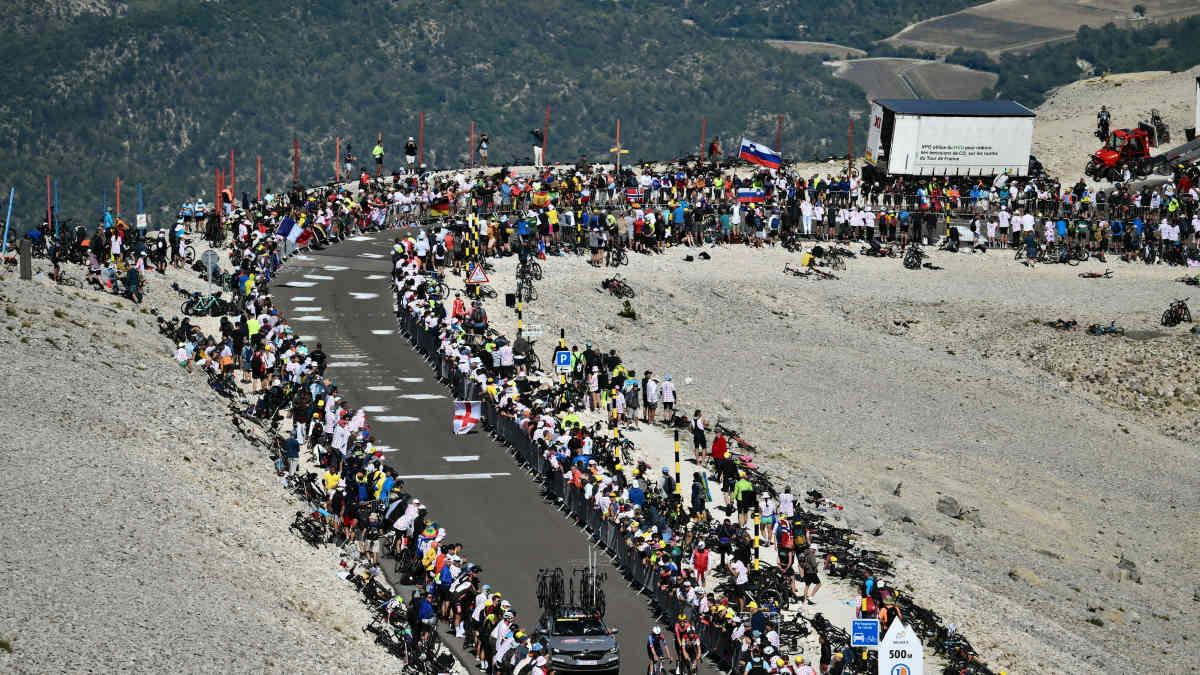
This is particularly evident on legendary climbs such as Alpe d’Huez, Mont Ventoux or the Col du Tourmalet. There, tens of thousands or even hundreds of thousands of spectators often crowd the route. The road narrows to just a few metres, speeds drop dramatically and the vehicles’ freedom of movement approaches zero.
This is precisely where a major question arises for me: what practical use does an escort vehicle actually serve in situations like this?
If a mechanical failure occurs in the final kilometres of a closing climb, the rider affected usually loses any chance of victory anyway. Even if the support car could theoretically reach the rider with spare parts, it would first have to find a way through the crowds of spectators. Changing the wheel then takes time, which is almost impossible to make up at that crucial moment in the race.
Added to this is the logistical reality. On many of these mountain roads, there is simply no space to stop safely and remove a spare wheel from the roof. As a result, the vehicle becomes an obstacle rather than a potential source of help.
The dangerous grey area
The incident at the Tour de France Femmes highlights yet another aspect. The danger does not arise solely from a collision. Even the mere attempt to manoeuvre support vehicles out of critical racing situations can have a massive impact on the race.
When cars drive past groups, honking their horns, forcing riders outwards or causing them to change their line, traffic directly interferes with the sporting competition. Even without a crash, positions are altered, energy is expended and tactical situations are affected.
In an age of ever-increasing speeds, this seems increasingly absurd. The cycling world invests enormous resources in the safety of the professional riders themselves, in course safety measures and in crash prevention. At the same time, it continues to accept situations in which vehicles weighing several tonnes travel along the same carriageway just centimetres away from the riders.
Time for some new ideas?
The real debate should therefore not be about whether support vehicles are necessary. They are. The question is rather when and where they are actually used effectively. Why do team vehicles still have to be riding amongst the riders during the final kilometres of extremely crowded closing climbs? Wouldn’t it make more sense to pull them out of the peloton before particularly narrow sections of the race? Could neutral service motorbikes take over some of their tasks? Or do we need completely new support concepts for final mountain finishes?
Other sports consistently adapt their procedures to address safety risks. Cycling, on the other hand, clings to many traditions, even though the circumstances have long since changed. The fields are getting bigger, the races are getting faster, and the number of spectators along the routes is increasing year on year.
A warning sign that should be taken seriously
The incident at the Tour de France Femmes is likely to be overshadowed by the next racing events before long. But that is precisely where the danger lies. Scenes like this often only become a major issue when someone is actually seriously injured.
Both the near-collisions in the women’s race and the crash involving Einer Rubio convey the same message: vehicles are not only part of the solution, but also part of the problem in certain racing situations.
Modern professional cycling will never be able to do away with support vehicles entirely. But it should finally ask itself whether their presence is really indispensable at every stage of a race. Sometimes, greater safety does not mean introducing additional measures. Sometimes it simply means having one less car on the road.

Leon Weidner
Editor