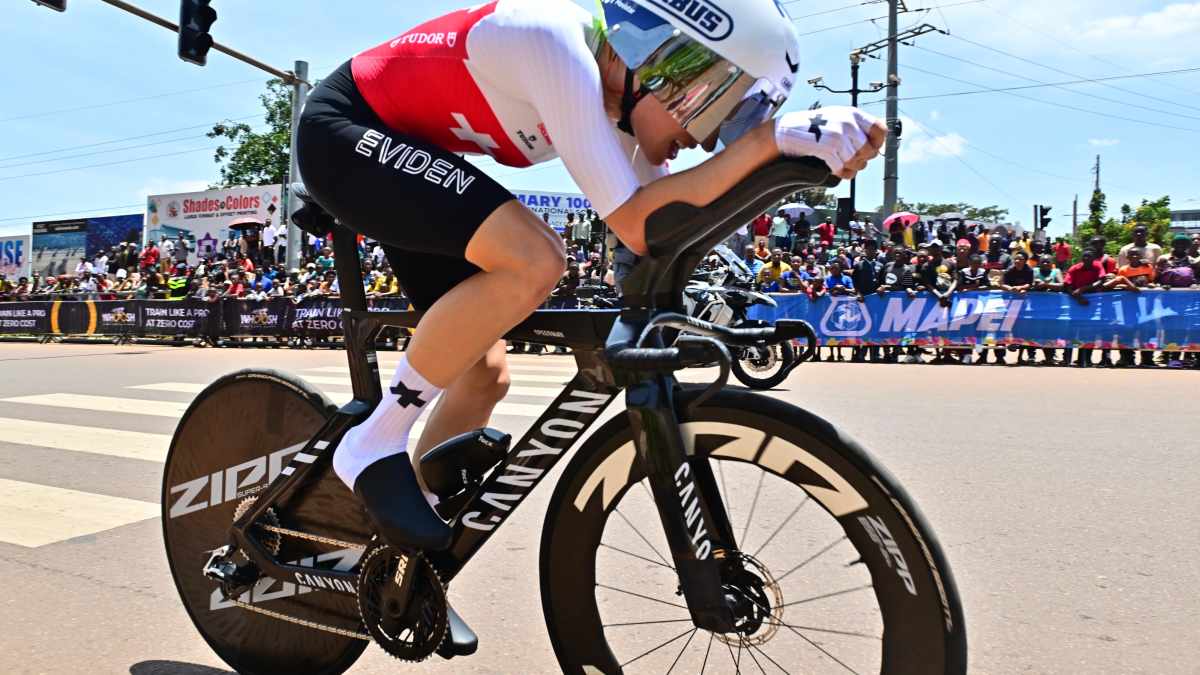
2026 World Championships – Women’s Individual Time Trial: Reusser celebrates defending her title on her birthday; bronze for Koch
Sebastian Lindner
· 20.09.2026

Reusser started last on the 39.2-kilometre city circuit in Montréal and completed the course in 50:24 minutes. At the first split, she was only fifth, ten seconds behind Bäckstedt, which certainly left room for surprises. But Reusser stepped up her pace as the race progressed; by the second split, halfway through the race, she was just three seconds behind the British rider and was then on course for victory.
Bäckstedt, who was still the U23 world champion the previous year, struggled particularly on the 600-metre-long final climb on the otherwise relatively flat course, and it was there that she lost most of her lead. She also lost ground to Koch there, but ultimately managed to hold on to a lead of just under six seconds as she crossed the line. The 26-year-old from Mettmann, who went into the World Championships as the German time trial champion, had a lead of just under five seconds over Elisa Longo Borghini (Italy), who in turn managed to make up time towards the end.
Antonia Niedermaier, the second German competitor, finished seventh, 1 minute and 50 seconds behind Reusser. Niedermaier had adopted a similar approach to the winner; she was not among the top 10 at the first timing point, but then improved step by step.

Reusser: “So I had something to celebrate, whether I won or not”
The rider from the Movistar Team had competed in and won a time trial near Ottawa four days before the World Championships, although many of her international rivals were absent from that event. Prior to that, her last race had been the Tour de France Femmes, where she had also won the time trial.

“I always tell myself that I’m not under any pressure, because every race starts from scratch, regardless of whether I’ve won before or not,” said Reusser, explaining her approach to the race. Nevertheless, she admitted to having been very nervous. “On the one hand, I was looking forward to the race because parts of the course are very technical, which made it exciting for me. On the other hand, there was the distance. We very rarely have races like this; I’m used to 20 kilometres. That’s why, even whilst I was running, I wasn’t sure whether I was maintaining the right pace.”
She could have had her competitors’ split times relayed to her from her support car. However, the Bernese athlete chose not to do so; she appeared very relaxed at the finish line and, unlike Bäckstedt or Koch, was clearly not pushing herself to her absolute limit. Whether that was down to it being her birthday is hard to say. However, Reusser said with a grin after her race: “It was good that the race took place today, because that meant I had something to celebrate, whether I won or not.”
Meanwhile, Koch was also delighted with her success: “The course, with its waves, worked in my favour. I realised straight after the start that today was going to be a good day. I’m really very happy with this bronze medal here.”
2026 World Championships Individual Time Trial – Women’s Results
World Championships WE - ITT: Montreal - Montreal
World Championships WE - ITT 2026: World Championships WE - ITT, Montreal - Montreal
| Rnk. | Riders | Time |
|---|---|---|
| 1 | Switzerland | 00:50:24 |
| 2 | Great Britain | +000:00:41 |
| 3 | Germany | +000:00:46 |
| 4 | Italy | +000:00:51 |
| 5 | France | +000:01:11 |
| 6 | Belgium | +000:01:48 |

How the women’s individual time trial went at the 2026 World Championships

48 women lined up for the first race of this World Championship. The start took place at intervals of one and a half minutes from start to finish. Skye Davidson from Zimbabwe opened the competition. Things became a little more high-profile after the first 13 riders, when Romina Hinojosa from Mexico – riding for Lotto Intermaché Ladies and Isaac Del Toro’s girlfriend – set off. Shortly after her, the first top-level athlete, US triathlete Taylor Knibb, also took to the course.
However, Knibb ultimately failed to make an impact in the battle for the top 10. Although she clocked a clear fastest time on crossing the finish line, with a lead of just under three and a half minutes, she played no part in the battle for the top 10. Subsequently, however, minutes turned into seconds. Initially, Lotte Claes (Belgium) was ten seconds faster, but Dominika Włodarczyk (Poland), who came next, beat that time by a further ten seconds.
But then the focus shifted to the first split time after ten good kilometres, as all the women crossed the line there at the same time. And the first surprises began to emerge. Bäckstedt clocked the fastest time there at 13 minutes 36 seconds – two seconds faster than Cédrine Kerbaol (France) and three seconds faster than Koch. Top favourite Reusser was fifth here, ten seconds behind, whilst Demi Vollering (Netherlands) was already 34 seconds behind and thus out of the running for a medal at this early stage.
Reusser overtakes Vollering
Koch, on the other hand, crossed the finish line with yet another significant personal best, more than 1 minute and 13 seconds ahead of the Polish skier. Meanwhile, Bäckstedt reached the second timing point six seconds ahead of Koch. Reusser also made up ground, settling three seconds behind the British skier and three ahead of Koch, who was now firmly on course for a medal. Niedermaier also broke into the top 10 at the halfway stage, but was already 55 seconds behind the leader.
By the third split time, Bäckstedt had extended her lead over Koch to eight seconds, and Reusser had also put further seconds between herself and the rest of the field. Shortly after the timing point, the Swiss athlete overtook Vollering, who had started ahead of her and who failed to reach her full potential even later in the race.
Then Bäckstedt crossed the finish line. In the gruelling final, which featured a 600-metre climb to the finish, she lost a little more time to Koch but still managed to hold on to a six-second lead. Meanwhile, Reusser didn’t put a foot wrong and celebrated a commanding defence of her title.