


These days, as a road cyclist, you can almost end up with an inferiority complex if you don’t have a power metre fitted to your bike. But does everyone really need one? And wouldn’t most amateur cyclists be better off with a different piece of kit? A case for the heart rate monitor
Let’s be blunt: I ride a road bike – but I don’t train. And apart from a few brief periods, that’s actually been the case ever since I discovered road cycling – 40 years ago. Perhaps I shouldn’t have become an editor at *TOUR*. I’ve simply never had enough time – or enough inner drive – to follow a strict training plan that tells me exactly what to do, more or less every day of the week, to improve my form and fitness. On average, I cover about 4,500 kilometres on my bike each year – sometimes a bit more, sometimes a bit less. If you take an 80-kilometre ride as the average, that works out at about 56 rides a year – just over one ride a week. If you condense the cycling year into nine months, that works out, purely mathematically, at 1.6 rides per week. Every coach will tell you that this number of rides has nothing to do with systematic training and is clearly far too few to serve as a basis for targeted fitness development.
Too much information
That’s probably also why I’m only marginally interested in training or performance data. Of course, as an editor at TOUR, I had the opportunity to try out power measurement on a bike quite early on. But alongside the realisation that a power metre can be an exceptionally useful training tool, I also came to the conclusion that I don’t need any of it.
Things used to be different. When heart rate monitors took the amateur sports world by storm in the early to mid-90s, it coincided with our days as young men. Naturally, we soon had one of those gadgets too. And we had everything in abundance: energy, strength, the urge to race – and no clue. Mesmerised, we stared at our heart rate monitors and threw the figures at each other like the horsepower ratings of supercars from the ‘Auto-Quartett’ card game. Whoever could complete the Black Forest circuit with the lowest average heart rate was the coolest bloke in the peloton; and whoever could whip their heart rate up to over 200 on a climb was regarded as a rocket on a bike. The fact that comparing individual heart rate readings was utter nonsense – who cared? The fact that you could have used your heart rate to manage your training effectively – well, that’s another story…

A new, yet familiar insight
Over time, my interest in my performance data gradually waned. Over the past ten years, I’ve worn a sports watch to record my cycle rides and upload them to Strava (otherwise they wouldn’t have counted), but I’ve only had a passing interest in the data I’ve collected.
On the other hand: I don’t train systematically, but I do, of course, still cycle to get or stay fit. And whilst looking into training methodology for a TOUR article a while ago, something just ‘clicked’ for me. It’s not a new realisation, but this time it really stuck in my mind: like many other road cyclists, I suppose, I belong to the ranks of the ‘semi-fast’ riders. I always ride at a brisk pace, push hard uphill and rarely ease off. The result: I simply can’t do anything else anymore. If I actually do try to ride fast, I’m completely knackered in no time. And if I do try to ride more slowly on purpose, after a minute at most my subconscious takes over and switches me back to ‘semi-fast’ mode.
Differentiation is important
‘This has to change,’ I thought to myself. Our After all, training expert Robert Kühnen has explained it often enough: It is important to differentiate. So, either the foundation – or the intensity. This applies both to the sequence of training rides and to each individual ride.
I’ve been trying to put this into practice for a few months now. I’ve made a point of not riding too fast when training my basic endurance, whilst also going flat out on the hills during high-intensity sessions. I soon realised, though, that it wouldn’t be a bad idea to have a point of reference – especially for what ‘not too fast’ actually means. Going flat out is going flat out; you can definitely feel that. But you don’t really notice what doesn’t hurt.
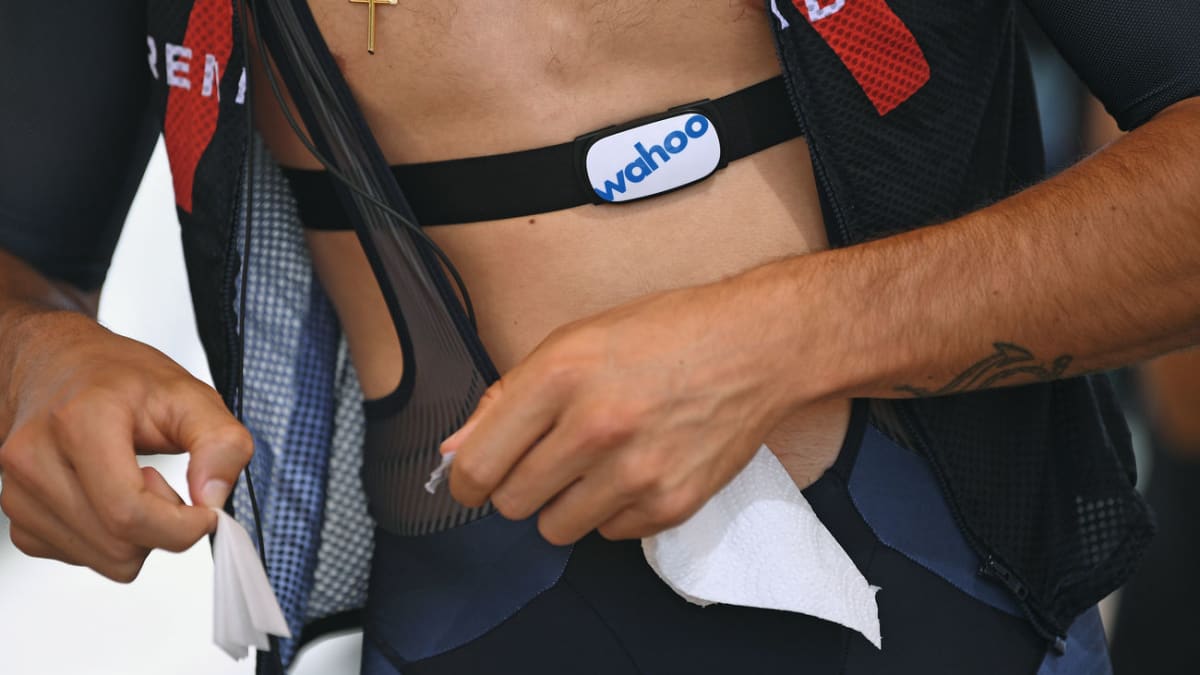
A few weeks ago, I dug out my old chest strap for this very reason and was delighted to find that it still works. And now there’s a cycle computer back on my bike’s handlebars. It shows me a heart rate graph in real time and in colour, which I’m following with renewed interest.
Findings
Insight 1: ‘Slow’ has now become very slow indeed. That might be down to my age. Sometimes that’s good news: when a lack of time and stress from work tempt me to go for another half-hearted ride around the area. Sometimes it’s bad news too – for example, when other road cyclists overtake me and I realise just how slow I actually am. Then you have to be brave and make a point of ignoring your average speed for the lap.
Insight 2: For the way I ride my road bike, a heart rate monitor is more than enough. It literally shows me my limits. The fact that my heart rate reacts with a delay when I pick up the pace – never mind. I have learnt a thing or two about my body over the years, and if I need to pedal at a higher intensity for a few minutes, I can manage that even without the precise real-time readings of a power meter. Besides, I’m not sure whether it would motivate me if my sustained power output was just hovering around 150 watts.
Insight 3: A few weeks ago, I was in France with some cycling mates, tackling mountain passes. The highlight and the final leg: the Col du Galibier from St Jean de Maurienne, via the Col de Télégraphe. I’m not sure whether – or in what condition – I would have reached the summit at 2,642 metres without a heart rate monitor. Knowing myself, I would have pushed too hard right from the start and would have hit the wall by Plan Lachat at the latest, where the road changes sides of the slope. Under the ‘dictates of the heart rate monitor’, however, I stayed in the green and then the light red zones for as long as possible and was able to hold out until the turn-off before the tunnel. That’s quite a nice achievement for a bloke of my age. Here’s to the heart rate monitor!


Thomas Musch
Publisher