


Canyon Grail CF SLX 7 Di2 review: Just how fast is the new race gravel bike?
Jan Timmermann
· 17.09.2026


Data and facts about the Canyon Grail CF SLX 7 Di2
| Weight | 9.495 kg |
| Drivetrain | Shimano GRX RD-RX 827 |
| Front brake | Shimano GRX ST-RX 825 / BR-RX 410 |
| Front tire | Schwalbe Thunder Burt Evo AddixSpeed SuperGround TLE 29 x 2,25 |
Canyon has given the popular Grail a much-needed revamp, bringing this race gravel bike up to the very latest standards. Featuring a new aero design, wide tyres and a host of clever integration solutions, the new Grail is set to challenge the record times in the world’s most prestigious gravel races. Drawing on input from the Canyon All-Terrain Racing Team, the developers in Koblenz have ushered the Grail into a new era and promise: ‘No Canyon gravel bike has ever been this fast!’ We’ve already put this to the test in an in-depth review to see if it’s really true.
Conclusion
There’s no doubt about it: the Canyon Grail is a really fast gravel bike for long off-road races. With space for wide tyres and plenty of practical features, this carbon frame is the Swiss Army knife of race gravel bikes. Whilst this reimagined model may not exactly shine on the scales, its riding characteristics are truly impressive and it offers excellent value for money. - Jan Timmermann, TOUR editor
The right footwear
Alongside the new Canyon Grail, the Koblenz-based direct-to-consumer retailer has provided data from internal wind tunnel tests which show that wide tyres play a less significant role in aerodynamics than many might think. To put this into perspective: around 70 per cent of drag is attributable to the rider, with only about 30 per cent coming from the bike. When it comes to aerodynamics, the wheelset is the most important component on the bike – and this means the tyres are also relevant.

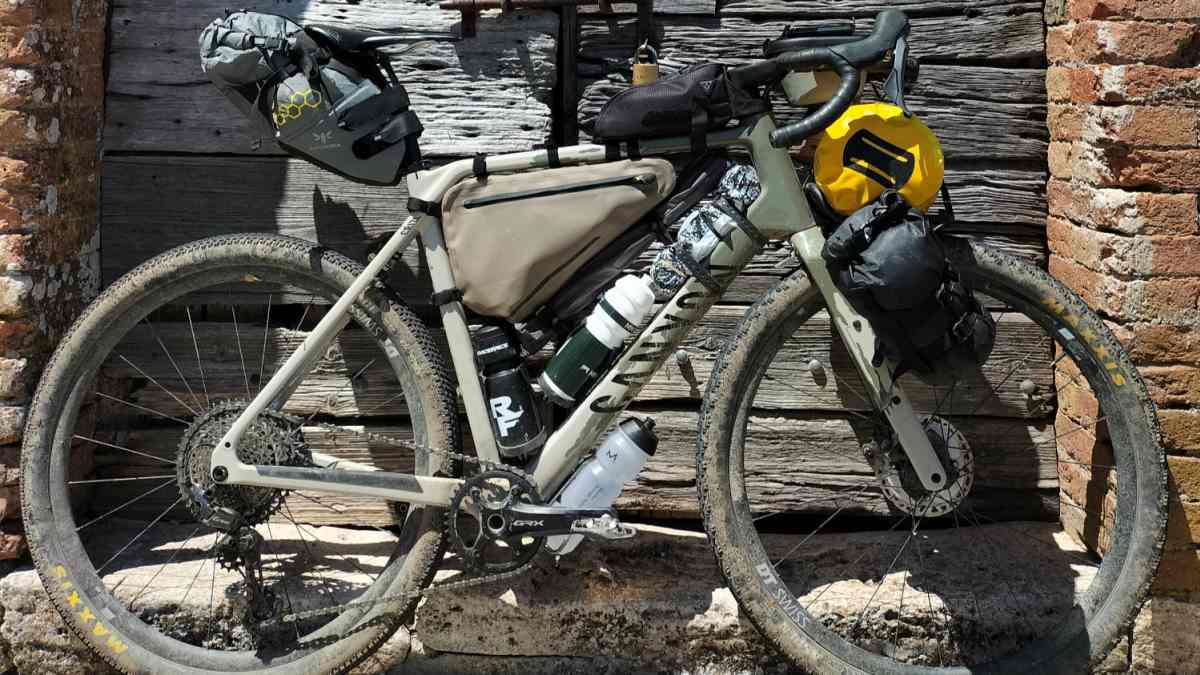
According to Canyon, a 45-millimetre-wide gravel tyre on the new third-generation Grail generates 0.6 watts less aerodynamic drag at a speed of 35 km/h than a 40-millimetre tyre. A 55-millimetre tyre, on the other hand, requires 4.2 watts more than the 45-millimetre version. The Grail therefore cuts through the wind most efficiently with the factory-fitted 45-millimetre Schwalbe G-One R tyres; however, the difference compared to the 55-millimetre version is negligible. That’s why Canyon has included a set of Schwalbe Thunder Burt tyres with our test bike. They make full use of the new 57-millimetre tyre clearance, measure 29 by 2.25 inches and add exactly 192 grams to the bike’s weight. They fit perfectly onto Canyon’s equally new and wide carbon rims in a tubeless setup and will therefore serve as our test tyres.
Despite its wide tyres, comfort is only average. Canyon has opted for a proprietary aero seatpost, which incorporates a special flex element and is designed to offer greater seating comfort. However, neither in practice nor on our test benches did the rear comfort score highly. Anyone who wants to ride in comfort day in, day out would be better off opting for its adventure-oriented sibling, the Canyon Grizl.
Roles as a core competence
The wide tyres increase the Canyon Grail’s wheel inertia. As a result, the race gravel bike can no longer keep up with the most responsive sprinters in its category during acceleration. The total weight of our XL test bike, fitted with wide Schwalbe Thunder Burt tyres, is also a hefty 9.5 kilos. The Grail is a far cry from agile, responsive road bikes. Frequent changes in speed and significant elevation gain aren’t this bike’s strong suit. That said, it’s worth noting that race gravel bikes are primarily designed for long, uninterrupted stretches of road anyway. After all, you wouldn’t use a Paris–Dakar rally car just to sprint from traffic light to traffic light, but rather to tackle gruelling off-road stages. For winding city centres, mountain time trials and slaloms through undergrowth, there are other specialist bikes besides the Canyon Grail.
The thick tyres not only increase the air volume inside the tyre, but also the overall diameter of the wheels. Ever since the debate about 32-inch wheels on gravel bikes, everyone has been talking about the superior roll-over performance of large wheels. With 29er tyres, this is also noticeable in practice on the Grail. The reduced roll-over angle allows the bike to simply roll right over edges as if nothing had happened. Once the wheels have gained momentum, there’s hardly anything that can stop them. On rough terrain, they lose very little speed and just keep rolling and rolling and rolling.
It runs for a long time
Of course, the wide tyres aren’t the only features of the new Canyon Grail. The geometry has also been revised. Although the reach is similar to that of its already long predecessor, the riding position has been made even longer. This is mainly due to the noticeably lower stack height, which positions the rider in an aerodynamic stance across the frame. The riding position is sporty and stretched out. Added to this are extended chainstays, which give the race gravel bike greater directional stability. Overall, the spacious Canyon carries itself with great composure. Its smoothness at high speeds is remarkable. Combined with the tyres’ excellent rolling performance and aerodynamics that have been noticeably improved compared to the previous generation, this bike seems as though it would never want to stop covering ground.
Even on fast descents, the long Grail impresses, hurtling down towards the valley as if on rails. This race gravel bike is designed to take the fastest route to the finish line – that much is clear. It’s not keen to be held up by detours. In narrow sections, the rider soon realises that the Grail is a big bike to manoeuvre. This calls for a bit of experience and a fair bit of effort. It’s a good thing that Canyon offers seven finely graded frame sizes. Anyone who falls between sizes and feels overwhelmed by the handling of a larger bike might be better off opting for the smaller frame.
The little things
Canyon deserve praise for the wealth of frame features. From the down tube storage compartment to the detachable handlebars, a third bottle cage and mudguard mounts, our test bike – the Canyon Grail CF SLX Di2 – is packed to the brim with added value for long-distance and frequent riders. On a bike designed for competition, this is anything but a given. Taking this into account, along with the truly large XL frame and the chunky tyres, one can certainly justify the hefty overall weight. The elegantly integrated Cyclite bags sit rock-solid and allow you to carry small items such as snacks and car keys. Unfortunately, during our test, we often got caught on the ‘noses’ of the lower bag – which round off the transition to the frame – depending on the trousers we were wearing.
For just under 4,500 euros, the Grail is fitted with Shimano’s top-of-the-range RX715 GRX Di2 groupset. The brakes are among the best an average gravel bike can offer, and the wireless gear-shifting system is a dream. The value for money is excellent. Grail riders will have to make do with just a single chainring. On the Grail CF SLX Di2, Canyon has fitted an affordable Deore cassette from the mountain bike range. With its twelve gears, the race gravel bike offers a wide gear range, but the gear spacing isn’t particularly fine.
Information on the Canyon Grail CF SLX Di2
- Intended use: Race gravel bike
- Maximum tyre clearance: 57 mm
- Frame material: carbon
- Weight: 9.5 kg (TOUR measurement, size XL, with Schwalbe Thunder Burt 29 x 2.25”, excluding pedals and accessories)
- Price: 4,499 euros
- Special features: Frame storage compartment, Cyclite bag system, mudguard mounts, Flex seatpost, detachable cockpit unit
Facilities
- Drivetrain: Shimano RX715 GRX Di2 / Deore, 40; 10–51 (510 per cent)
- Brakes: Shimano GRX 825, 160 / 160 mm
- Bikes: Canyon GR 50 CF
- Tyres: Schwalbe Thunder Burt Evo AddixSpeed SuperGround, 29 x 2.25” (57 mm)
The TOUR rating
At TOUR, we don’t rely on manufacturers’ specifications; we carry out our own measurements. No other specialist publication in the world tests bikes in such detail. To this end, we operate our own test laboratory equipped with the relevant test benches. The TOUR mark is not based on price and is modelled on the school grading system.
Measurements and marks
- Total weight: 9,495 g (of which wheels: 4,102 g) / Weighting: 25% / Rating: 3.3
- Rear comfort: 142.5 N/mm / Weighting 20% / Score 2.3
- Front comfort: 65.2 N/mm / Weighting 10% / Score 1.7
- Starting value: 45.3 N/mm / Weighting: 10% / Mark: 3.7
- Handling stability: 7.4 N/mm / Weighting 10% / Mark 2.3
- Lab mark (75% weighting): 2.7
- Brakes: Weighting 5% / Mark 1.0
- Switching: Weighting 5% / Mark 2.0
- Tyres: Weighting 5% / Mark 1.0
- Paintwork: Weighting 5% / Mark 1.0
- Equipment mark (weighting 25 per cent): 1.4
- Overall TOUR mark (weighting 100 per cent): 2.4
Strengths and weaknesses
Pro
- useful aerodynamic update
- Plenty of ground clearance sets you up for proper off-road racing
- sporty, confident seating position
- high driving stability and good handling characteristics
- good value for money
Cons
- Comfort: only average
- no lightweight
What do you think: would you opt for wide tyres on a gravel bike when racing against the clock? Let us know in the comments!

Jan Timmermann
Editor