


Breakaway group shakes up the standings: Switzerland’s Schmid takes the Lion
Matthias Borchers
· 18.07.2026

1: Schmid takes the lion’s share
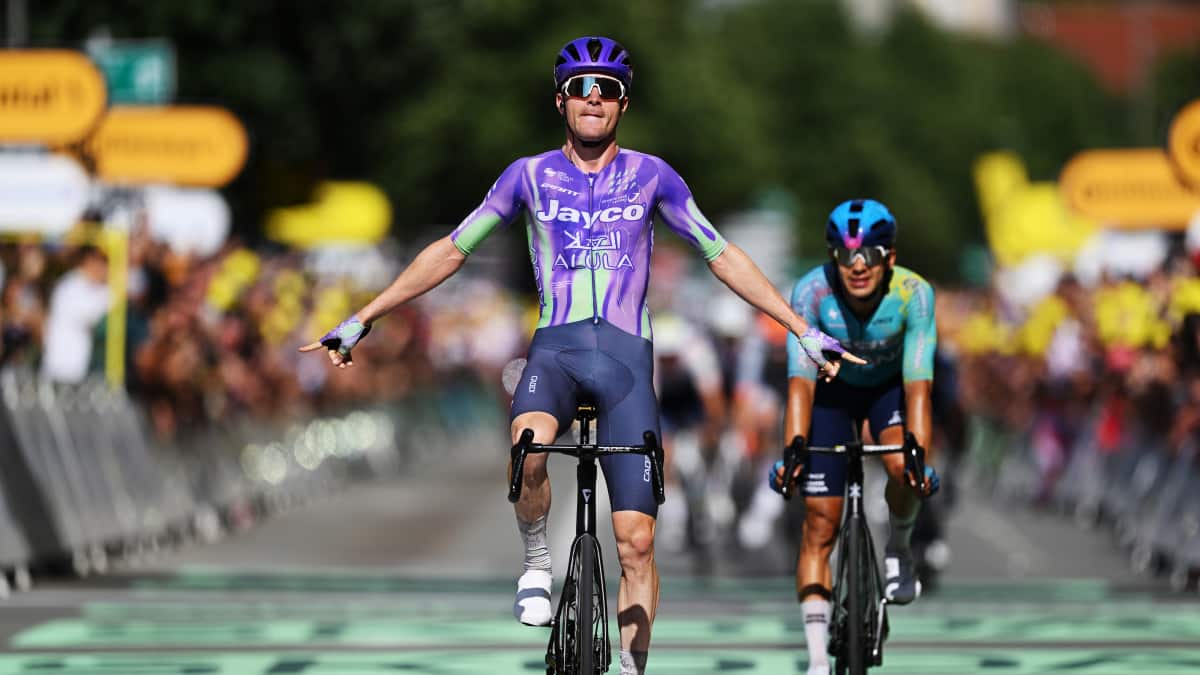
Mauro Schmid celebrated his first stage victory in the Tour de France in Belfort. Following a strong performance, the Swiss rider broke away from the breakaway group to claim a long-awaited milestone in his career.
Having only been pipped to the post by Jonas Abrahamsen in Toulouse last year, the Jayco-AlUla rider has now achieved his big breakthrough at the Tour de France. Schmid is already the fourth rider in this year’s race to celebrate his first stage victory. Previously, Isaac Del Toro, Olav Kooij and Sören Wærenskjold had all triumphed for the first time at the Grande Boucle.
14: A career on the rise
With his victory beneath the famous Lion of Belfort, Mauro Schmid celebrated the 14th professional win of his career. The 26-year-old has thus cemented what has been his most successful season to date.
The former Swiss champion had already secured his first Grand Tour victory back in 2021 at the Giro d’Italia, when he won a spectacular gravel stage in Tuscany. This year, Schmid has already racked up five victories, including a stage win at the Tour of Oman and overall victory at the Settimana Coppi e Bartali.

60: Switzerland is celebrating once again
Six years after Switzerland’s last Tour stage victory to date, the country is back at the very top of the podium. No Swiss rider had won a Tour stage since Marc Hirschi’s victory in Sarran in 2020.
Schmid’s victory brings the total number of Swiss stage wins in the Tour de France to 60. Switzerland played a historic role right from the tour’s inception: in 1903, Charles Laeser caused a sensation by becoming the first foreign stage winner in the history of the Tour.
The most successful Swiss cyclists remain Fabian Cancellara and Ferdi Kübler. Both have eight stage wins to their names. Kübler also won the Tour de France in 1950.
1: A Swiss man wins the Ballon d’Alsace
For the 29th time, the Tour de France passed over the legendary Ballon d’Alsace. Mauro Schmid seized the opportunity to write another small chapter in the history of the Tour.
Never before had a Swiss rider won a Tour stage that included this historic climb in the Vosges on its route. The first winner of a Ballon d’Alsace stage was the Frenchman Hippolyte Aucouturier in 1905, although the finish was in Besançon at that time.
The last time the Tour saw a stage winner in Belfort after crossing the Ballon d’Alsace was in 1907. On that occasion, the Frenchman Émile Georget triumphed.
3: The series lives on
For Jayco-AlUla, Mauro Schmid’s victory was far more than just another stage win. It meant that the Australian team had won at least one stage in three consecutive Tour de France races.
In 2024, Dylan Groenewegen triumphed in Dijon; a year earlier, Ben O’Connor won the prestigious Alpine stage to the Col de la Loze. Since the team’s Tour debut in 2012, it has now racked up a total of twelve stage victories.
Simon Gerrans secured the team’s first victory in Calvi in 2013, when it was still known by a different name.
4: Pidcock’s remarkable comeback
Tom Pidcock made perfect use of the opportunities afforded by the large breakaway group. The Briton was part of a leading group of 57 riders and, as a result, gained a 7:34-minute lead over overall leader Tadej Pogacar.
As a result, the two-time Olympic mountain bike champion moved up from tenth to fourth place in the overall standings. He is now just 4 minutes and 15 seconds behind Pogacar.
This means Pidcock has achieved his best overall position in his Tour career to date. His previous best was fifth place after the sixth stage of the 2022 Tour.
1: A historic award
Although Pinarello-Q36.5 missed out on the stage win, the team had a first to celebrate. Thanks to Tom Pidcock, the team secured its first-ever podium finish at the Tour de France.
Following his attacking ride over the Ballon d’Alsace, the British rider was honoured as the most combative rider of the day. He also benefited from the strong support of his team-mates Fred Wright, Xandro Meurisse and Quinten Hermans, who played a key role in the breakaway group’s success.
With this honour, every team in the 2026 Tour de France has now received at least one official award in the history of the race.
205.8: The shortest longest stage

At 205.8 kilometres, the route from Dole to Belfort was the longest stage of the 2026 Tour de France. Historically speaking, however, it is one of the shortest ‘queen stages’ in this category.
In fact, it is the shortest longest stage in the entire history of the Tour. The five shortest longest stages all took place in the 2020s:
- 2026: Dole – Belfort, 205.8 km
- 2023: Vitoria-Gasteiz – San Sebastián, 207.3 km
- 2025: Lauwin-Planque – Boulogne-sur-Mer, 209.1 km
- 2020: Chauvigny – Sarran, 218 km
- 2022: Binche – Longwy, 219.9 km
70: The UAE is decked out in yellow
Tadej Pogacar once again confidently defended his overall lead in Belfort and donned the Yellow Jersey for the 63rd time in his career. But it is not only the Slovenian himself who benefits from this dominance; his team does too.
For UAE Emirates-XRG, this was already the 70th yellow jersey in the team’s history. The first two days in yellow can be traced back to Rubens Bertogliati, who took the overall lead in 2002 for what was then Team Lampre-Daikin. This was later followed by one day in yellow for Alexander Kristoff at the 2020 Tour, as well as four days for Adam Yates in 2023.
However, Pogacar accounts for the lion’s share of this impressive record. With 63 yellow jerseys to his name, the Slovenian has made the team one of the most successful in the modern history of the Tour and continues to add to the number of days spent at the top of the general classification.

Matthias Borchers
Editor