


In this article, we use so-called affiliate links. With every purchase through these links, we receive a commission from the merchant. All relevant referral links are marked with . Learn more.
Data and facts about the Storck Aerfast 5 Pro SRAM Red
| Weight | 6.89 kg |
| Drivetrain | SRAM Red AXS |
| Front brake | SRAM Red |
| Wheelset | DT-SWiss ARC 1100 |
| Front tire | Continental Aero 111 29-622 |
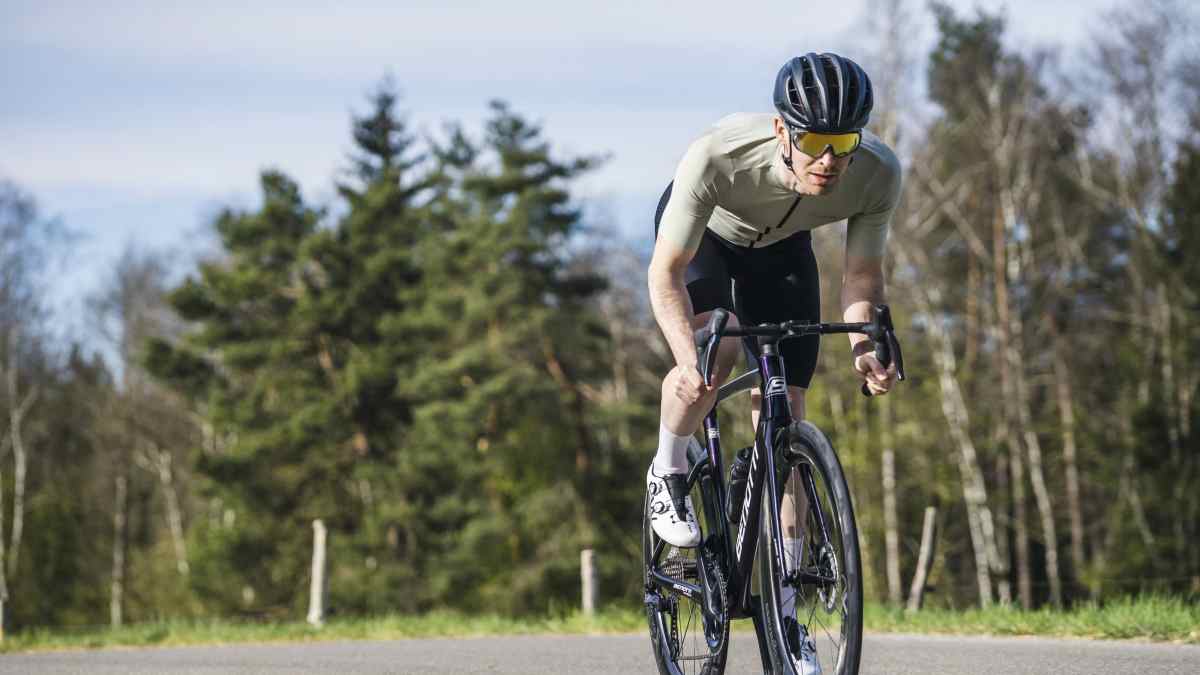
You can’t ride slowly on this bike. The saddle at lofty heights and the handlebars just above the road force your body into such an aggressive position that you simply can’t help but live up to the motto emblazoned on the sides of the extended lower handlebar ends: ‘pedal hard’, it says. That’s exactly what I do. Because this bike sharpens your senses for speed. You can really feel the road. And the gusty wind, too. The front wheel, with its 65-millimetre-high rim, wobbles in such a way that it’s more of an incentive than a risk to really put the spurs to this red speedster. The fact that the bike is still easy to ride despite the high rims is also down to the aero tyres fitted. The tread grooves in the Conti Aero 111 ( >> available here) prevent early stall and help to reduce front-wheel wobble. And so I give myself over to the thrill of the road, gliding over the tarmac, looking for small ruts where car tyres have left their mark on the surface. Narrow handlebars, direct feedback from the road and surroundings: pure racing sensation; the bike rides effortlessly.
On the first descent down a wet road, the bike builds up almost too much speed to just let it run as usual. But just in case, the exceptionally reliable Red brakes are there to the rescue. The bike’s looks certainly contribute to the thrill of riding fast. Before, during and even afterwards, when the bike is back on the hook, it sends out a clear message: speed, speed, speed.
Limited scope of application
As you ride, your gaze falls on the slender, gleaming red tubing. 80-millimetre-deep fork legs – the maximum permitted by the UCI – slice through the air. The cockpit matches this: equally slender and sleek. The aerodynamic optimisation extends down to the very last detail. The bend of the 38-centimetre-wide handlebars is aerodynamically shaped, as are the bar ends. Everything offers a good grip, and the optimisation does not compromise ergonomics. In keeping with the concept of a minimalist speed machine is the aero chainring of the 1x12 drivetrain. Mountain gears? There aren’t any. The single-chainring drivetrain (50 to 10–30 teeth) demands muscle power and tolerance for variations in cadence. A bike for sprinting in criteriums or for a quick lap around the neighbourhood. In the lightest 50/30 gear, the chain is already making an audible grinding noise, and the short chainstays take their toll.

But riding fast suits it much better anyway. The centre of the road is the Aerfast’s natural habitat. If a cyclist appears in front of me, I have to overtake them. In the long run, this can become problematic, because riding at full throttle all the time – that much is clear – takes its toll. As a second bike, the Aerfast – in this configuration – is therefore more conceivable than as a sole sports bike: it isn’t particularly versatile. Should a serious obstacle crop up – such as a vineyard with a double-digit gradient – things get really tough. Not to mention an Alpine pass. This speed demon isn’t much fun on poor road surfaces either. But when the tarmac is in tip-top condition, it’s a real treat to fly down the road, devouring the kilometres. Other set-ups for a more moderate pace and greater flexibility are possible, but the 1x12 drivetrain with an aero chainring really brings out its racing genes. The minimalist Alpitude carbon saddle is a perfect match, and it also proves to be surprisingly comfortable. The fact that the shape fits well may be a coincidence. But the saddle cover provides cushioning and the generous cut-out reduces pressure in the crotch – these are objective advantages beyond just the fit.
Full force
The solid Aero seatpost, on the other hand, offers hardly any give, whilst the low-set seat stays do provide some frame flex. In practical terms, however, the rear suspension is effectively limited to the tyre, which, at 25 millimetres, is particularly narrow. This is a detail that contributes to the outstanding wind tunnel results (around half a watt), but in real-world conditions it’s a rather disadvantageous compromise. A tubeless setup is the obvious choice to make the most of the tyre pressure limits. However, anyone who isn’t a ‘watt fetishist’ will probably opt for a 28-millimetre rear tyre, which offers more leeway and better handling dynamics. A 26-millimetre-wide Conti Aero 111 is fitted at the front. However, according to our measurements, the 29-millimetre version is aerodynamically equivalent on the DT Swiss ARC 1100 wheelsets. The combination of these wheels and tyres propels the Storck right to the top of the aerodynamic rankings. With a head-on airflow, the Stromm Raktt, which we had only recently named the fastest bike (TOUR 5/26), slightly faster, as the resistance curves show. But when exposed to crosswinds, the Storck squeezes out an extra bit of speed, making it roughly one watt faster.

In numerical terms, Storck is therefore in the lead. The ‘195’ marking on the back of the seatpost – which, before the test, seemed somewhat optimistic or was based on a measurement without a water bottle – has now become a reality. It seems as though Markus Storck had a premonition that he would be able to break the barrier at some point. To put this into context, it is worth noting that, that the group of the fastest bikes, with power outputs of around 200 watts, has similar potential. All these bikes are very fast; the right tyre-and-rim combination can make all the difference to who comes out on top in the shoot-out. As we already showed in TOUR 5/26, it is not the frame alone that makes a bike fast. It’s the sum of all its parts. Markus Storck leaves nothing to chance here, however, and assembles the components that, according to the available measurements, work together perfectly. The world championship title is the result of meticulous attention to detail. At Storck, it is the boss himself who crunches the figures and scrutinises every detail. This sets them apart from other bike companies, which tend to rely more on a division of labour and may not be quite as thorough in their approach.
A successful diet
Storck has also made changes to the weight. In the last test, the bike still weighed in at 7.29 kilos. The test bike now weighs just 6.89 kilograms. The 400-gram difference is down to wheels that are 150 grams lighter and a tuned saddle, which shaves off a further 170 grams. The remaining difference is attributable to tuned bolts and one fewer spacer. This weight reduction has played a significant part in the overall score of 1.7 – which is very good for an aero specialist. The handling characteristics remain unchanged. The Aerfast is rock-solid; if anything, the handlebars flex slightly under hard impacts. The bike is very stiff around the bottom bracket, but also very stable to ride. This sets it apart from the Stromm Raktt, which is noticeably less stable but also not quite as stiff on the rider. The bike’s geometry is well-balanced; overall, it feels lively to ride without being twitchy. In terms of price, the Aerfast.5 Pro is also attractive in this configuration: the bike costs 9,199 euros, undercutting most competitors, who generally attach five-figure price tags to their top-of-the-range models. Fitted with an Ultegra groupset and Storck’s own aero wheels, the bike is available from €6,549 and, thanks to its 2x12 drivetrain, is more versatile than the top-of-the-range model tested.

Robert Kühnen
Editor