


France was behind us, but the adventure continued: Across southern Germany on gravel bikes
Dimitri Lehner
· 20.09.2026


Our trip gets off to a bad start. The gravel bike’s handlebars are out of alignment. The brothers are at loggerheads. We cycle side by side in silence.
It was actually meant to be a big adventure: after we’d cycled from Munich to the Baltic Sea last year, I wanted to go one better this year – right across France, over the Massif Central to Bordeaux. A summer fairy tale on gravel.
My brother Laurin was against it. He put forward a whole host of arguments.
Distance: long!
Summer: hot!
Massif Central: steep!
The French: stupid!
His alternative suggestion: three days through southern Germany. From home, where Mum lives, back to Munich. Just under 400 kilometres.
Me: “What?!”
Him: “Just hearing ‘1,100 kilometres’ makes my bum ache. I’d like to lie under an apple tree for a change. It’s not always just ‘chain to the right’.”
Me: “Well, 400 kilometres in three days is no mean feat either.”
I tried to change his mind. To no avail.
Then the forests in France went up in flames. My tour was well and truly over. So now we’re ‘trudging’ from Laufen in the Markgräflerland to Munich: from the Rhine to the Alps.
“That’s brilliant,” says Laurin. “A manageable distance, two nights’ accommodation. An adventure in Germany.”

Adventure: Germany
Yes, yes. He’s right, after all. It just took me a little while to realise it. First, I have to say a mental goodbye: ‘Au revoir, France!’
After all, I’d imagined my own ‘Tour de France’ to be quite an adventure.
In the Münster Valley, my spirits lift again. Partly because Laurin’s tubeless tyres are squelching, squeaking and farting on the tarmac. The 45s are losing air. It’s brilliant watching him get worked up and curse the “bloody milk”. No matter how much he pumps them up with the “smallest bloody pump in the world” – that’s what he calls my air pump – the 45s keep losing air.
The touring cyclists from Duisburg overtake us for the third time: “You lot again!”
At the Sonne inn, the landlord finally gives us a proper floor pump. Three bar. Valve realigned. Fingers crossed.
The air still escapes.
I knew it.
The Steep Black Forest
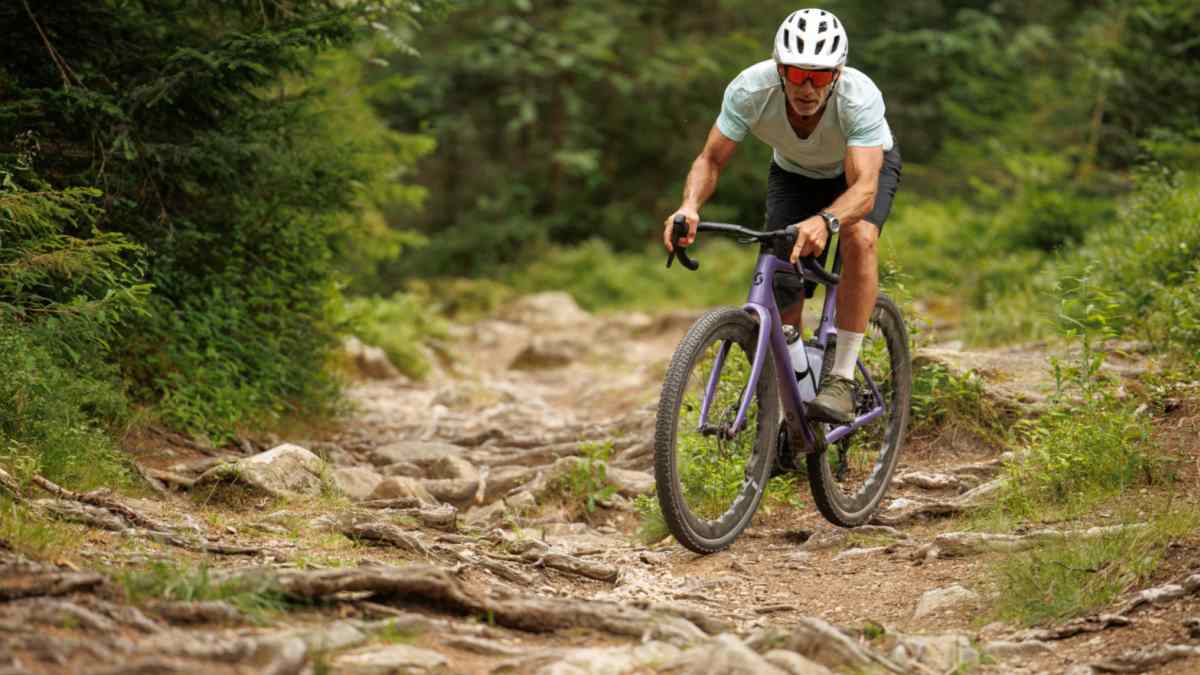
From the Rhine Valley, we climb towards the Feldberg, frequently following singletrack trails. “We call them ‘Wegele’,” read a headline in the *Badische Zeitung* some time ago, referring to the Baden region’s aversion to mountain bike slang. The trails are steep. Then even steeper. At some point, we’re riding at walking pace.
Finally, we’ll give it a go.
Moss on rocks, streams, a dense forest that rustles and growls. It smells of earth and mushrooms.
Not a bad place to go for a walk with your bike. At 1,493 metres, the Feldberg is the highest mountain in the Black Forest – no wonder the climb is steep.
This is where I learnt to snowboard in the late eighties. Back then, I hardly dared to go down the Fahler Loch, the only black run in the Black Forest. We’ve got to get up there. Then back down again – to Schluchsee.
How stupid can you be?
For me, the happiest moments of a ride are the breaks. Filling up with water at the cemetery in Todtnau, for example. We lean our bikes against the wall, drink from the tap and look at the birch crosses. The little wayside shrine dedicated to Aneliese Kreuz, an air force volunteer, moves me. She was only twenty years old when she died in April 1945 – so shortly before the end of the war.
Later on at Schluchsee, we’ll have pork steak, chips and a light lager. We’ve earned it.
Then I hop onto the S-Works and put my foot down. At last, gravity’s on our side. Sandy tracks, full throttle, hands on the lower part of the handlebars, the freewheel screeching, my T-shirt flapping in the wind.
T-shirt fluttering?!
F#*k!
My rucksack is still at Schluchsee.
With my passport, money and mobile phone.
“What did you say?!” says Laurin. “Oh boy. How stupid can you get?”
It turned out to be a really stupid thing to do. We rode downhill at full speed for at least 40 minutes.
Back?
No chance.
Now we need a Winston Wolfe. For those who aren’t familiar with Tarantino’s film *Pulp Fiction*: Mr Wolfe sorts out problems. We’ll ring Dennis Schwald, a childhood friend of Laurin’s who lives by Lake Schluchsee. Dennis has to be our Mr Wolfe.
Whilst we’re hanging about at a petrol station in Bonndorf watching the World Cup final between Spain and Argentina, I’m worried about my rucksack.
Then Dennis comes storming in.
He gets out of the car and holds the Deuter aloft like a World Cup trophy.
Cheers.
The journey can continue.
Gambling: Where to stay?
High above Achdorf, there is a park bench at the edge of the woods.
It’s getting late. Should I stay or carry on?
For bike packers, this is no small matter. The evening is part of the journey. What’s more, it’s a highlight if things go well. That’s why we rate places to stay on a scale of one to ten.
“A five at most,” says Laurin.
Me: “That bad? Just look: the evening sun, no one around, a view of the countryside, a flat spot for the sleeping bags and a bench to chill out on.”
We’re staying.
Landjäger, warm beer, sunset. First we talk about 50c tyres, whether SRAM makes the better gear systems, and whether one-piece cockpits really are ‘the shit’. Typical bike-nerd stuff. Later, as the red wine kicks in, we get round to the topic of all topics: women. Bats flutter about, there’s a rustling in the undergrowth behind us, an owl hoots, and the first stars begin to twinkle.
Quite romantic.
“See, see, see…,” I say to Laurin the next morning as we cycle up the main road towards Blumberg. We wouldn’t have found anywhere decent to stay the night anyway. So we did everything right.
We grin and set off for Tuttlingen.
Go for a run or do some sightseeing?
It’s hardly possible to do both. We give the Celtic tree circles in Grunern a miss. What a shame. We miss the ‘Jesus Footprint’ in the Upper Black Forest – where Jesus is said to have pressed his foot and elbow into the stone. Visible to all. Pilgrims flocked there. The church has always been clever when it comes to marketing.
I would have loved to go in search of the rare asp viper, which in Germany is found only in the Wiesental valley. I’m a snake lover. Laurin says: “You’re mad. We’ll never get there like this!”
We also give Germany’s Grand Canyon – the Wutach Gorge – a miss. It’s said to be one of the most impressive gorge landscapes in Central Europe. We don’t know. We haven’t been there.
Just a few examples on the way east.
It’s only when they reach the Upper Danube Nature Park that Fabi says: “No, lads, not like that!”
Detours are welcome!
Our Coros sat-nav has once again shown the route in a way that’s easy to misinterpret.
Took a wrong turn. We were lucky.
We bump along trails through river meadows. People out walking their dogs warn us: “You can’t go any further that way, unless you fancy a swim!”
We want to.
Unfortunately, it’s a quagmire.
So, over the railway embankment. Lizards scurry across the gravel. Rust-coloured tracks.
“Laurin, why don’t you put your ear to the tracks to see if a train’s coming – it’s an old Indian trick!”
We mess about, push our way through thorny undergrowth, find our way back to the route. Bees buzz, dragonflies flit about. Living in the moment. Mind wandering: off! That’s exactly why I love bikepacking.
They’re all falling down
At Beuron Abbey, our friend Fabi Kleiner takes the lead. Short hair, a D’Artagnan-style moustache, and lively eyes full of a spirit of adventure. The professional filmmaker grew up here; he knows the place inside out. What’s more, Fabi is a walking local history museum. He takes us on a journey into the realm of myths and legends.
He knows a story about every boulder.
“Can you see that one over there? That’s the Button-Maker’s Rock. In 1823, the honourable button-maker Fidelis Martin was riding home from the market in Tuttlingen. Night fell. In the middle of the forest, he came across a beautiful, scantily clad woman. She led the button-maker onto the steep rock – and both man and horse plunged into the abyss. Dead!”
The next rock is called Tuchmacherfels.
That’s right: Tuchmacher fell off.
There are also Metzgerfels, Bischofsfels and Fürstin-Amalien-Fels. The Danube Valley was clearly not a place for those with a fear of heights. If no one has fallen off them, there are castles perched on top. There are more than 40 of them. The best known is Wildenstein Castle, perched high above the valley.
Fabi is also familiar with the geology behind it: around 100 million years ago, the sea receded, the soft rock began to undergo karstification, and caves formed. Stone Age people made use of them. Today, the light-coloured shell limestone cliffs jut out of the valley like teeth.
Fabi leads us along hidden trails and through caves. Down below, storks stand in the wet meadows. We drink spring water from the forest, and later espresso from Fabi’s portafilter machine.
Then come the wild Hungarians, witch burnings and the New Templars, a sort of Swabian Ku Klux Klan, who met in caves in the early 20th century and espoused their own rather crude theories. We listen, marvelling – and then jump off a bridge into the bottle-green Danube. Choked with algae and sluggish, it meanders along.
Summer 2026!
We haven’t got very far today. But high above the valley stand the ruins of Falkenstein Castle. I can already picture it: a campfire, red wine, a cigarette to savour, and a starry sky.
Laurin rolls her eyes.
"We’ll never make it home like this."
Perhaps he’s right.
But that’s exactly what it’s all about.
It’s not about getting as far as possible.
But to experience as much as possible.

Dimitri Lehner
Editor