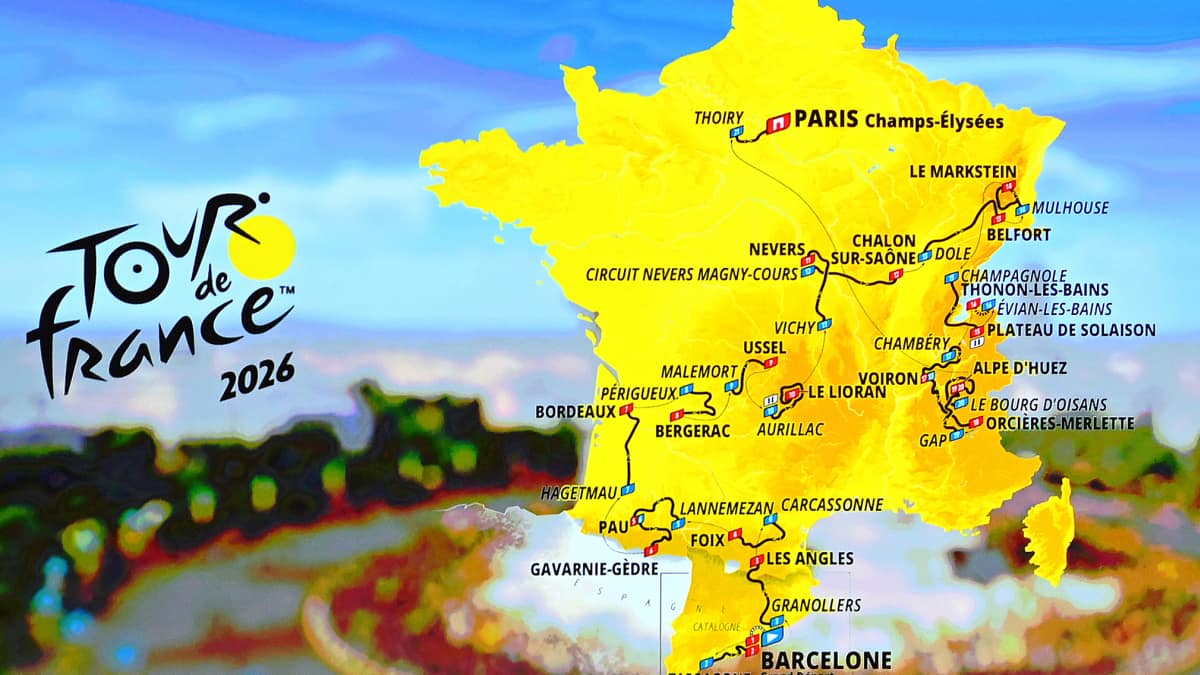
Tour de France 2026: Preview of Stage 6: Tourmalet – no drama in store?
Sebastian Lindner
· 08.07.2026

Key information on Stage 6 of the 2026 Tour de France
- Thursday, 9 July: Pau – Gavarnie-Gèdre
- 186.2 kilometres, 4,100 metres of elevation gain (mountain finish)
- Mountain classifications: km 50.9 (4th category), km 77.3 (3rd category), km 118.1 (1st category), km 147.8 (HC), km 186.2 (2nd category)
- Intermediate sprint: 59.1 km
- Start: 12.25 pm, Finish: approx. 5.29 pm
- Live updates and results
The route of the 6th stage of the Tour de France

Following the sprint finish in Pau the previous day, the Tour peloton remains in the town, as Stage 6 marks the start of the race’s major Pyrenean stage. It’s back into the mountains that the peloton had actually already left behind. The finish is in the village of Gavarnie-Gèdre, with a population of barely 350, where a Tour stage will end for the first time.
The distance between the start and the finish is 186 kilometres, the first half of which presents no major difficulties. The terrain rises only very slightly up to the pilgrimage site of Lourdes; over the following kilometres, a Category 4 climb – a climb just under two kilometres long with a gradient of seven per cent – and, a little later, another three kilometres with a gradient of just under seven per cent (3rd category) – between which the intermediate sprint takes place – do not yet make much of a difference.
In Arreau, having cycled a good 100 kilometres, the climb to the Col d’Aspin (Category 1) begins via the eastern approach, which is then traditionally followed by the Col du Tourmalet (HC). The Aspin is twelve kilometres long with an average gradient of 6.5 per cent, whilst the Tourmalet is 17.1 kilometres long with an average gradient of 7.3 per cent. With almost 90 ascents, the Tourmalet is the most frequently climbed pass in the history of the Tour. The Jacques Goddet Souvenir, named in honour of the second Tour director, is also awarded here in the form of a special prize.
After the Tourmalet, which is crossed at an altitude of 2,115 metres, the Tour then sets off along new routes. At the foot of this Pyrenean giant in Luz-Saint-Sauveur, the route heads towards Gavarnie-Gèdre. The climb consists of a gently ascending mountain road with only a few bends; whilst it has an average gradient of just 3.7 per cent, its length of almost 19 kilometres means it still qualifies as a Category 2 climb and is therefore classified as a mountain finish.
At the finish line, situated in no man’s land on a dead-end road just before the Spanish border, a UNESCO World Heritage panorama awaits the peloton. The Cirque de Gavarnie rock basin surrounds the finish line, with some of the rock faces there almost vertical. It is also home to France’s highest waterfall. At the Grand Cascade, the water plunges 420 metres down into the basin.

A sporting analysis of Stage 6 of the 2026 Tour de France
As far as the Pyrenees are concerned, the queen stage awaits the peloton. Essentially, it’s the same as always when the Tourmalet is on the programme. However, it remains to be seen whether this giant climb will have any bearing on the general classification. For that to happen, Tadej Pogacar (UAE Team Emirates – XRG) and his team-mates would have to launch an early attack. The summit of the Tourmalet is reached 40 kilometres from the finish. And whilst the final climb is long, it is not steep enough to make a difference. Unusually for the Pyrenees, not only is the average gradient low, but there are also no extreme peaks in the gradient.

It would be a risky move to go on the offensive so early in the stage. And as it is still early in the Tour, hardly any of the top riders will take that risk. It might be possible, perhaps, for teams with two leaders to send one of their captains or first officers into a breakaway group to put pressure on the competition. However, it would be an unusual sight to see Remco Evenepoel (Red Bull – BORA – hansgrohe), Isaac Del Toro (UAE Team Emirates – XRG) or Matteo Jorgenson (Team Visma | Lease a Bike) in such a breakaway.
That the top teams will make up the group of the day – which will undoubtedly form – is, however, almost beyond doubt. Just perhaps not quite so prominently. Red Bull could send Jai Hindley, Visma Davide Piganzoli and UAE Brandon McNulty, so as to avoid having to work in the peloton. However, the group – which is likely to be quite large – is also likely to include everyone who has their sights set on the mountains’ jersey or is eyeing up stage wins. Lenny Martinez (Bahrain - Victorious), who was first over the Tourmalet in 2025, or Ben Healy (EF Education - EasyPost) would be experts at such a feat. The likelihood of the group making it through is likely to be relatively high.