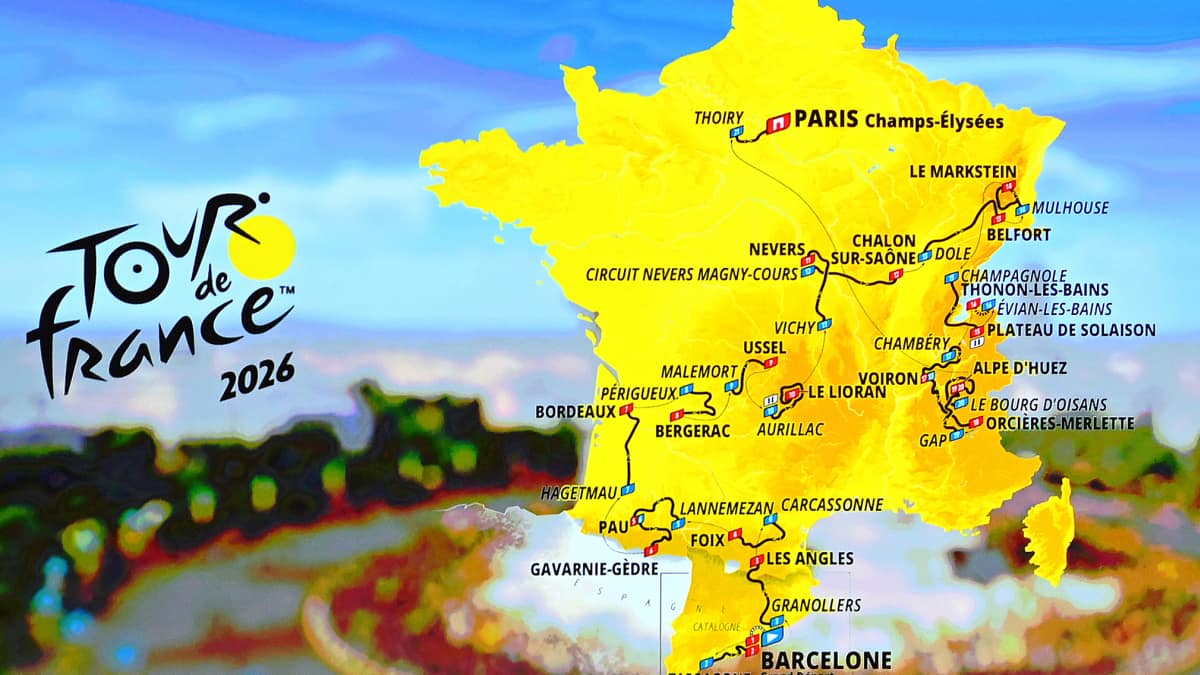
Tour de France 2026: Preview of Stage 3: France welcomes the Tour with a short mountain finish
Sebastian Lindner
· 05.07.2026

Key information about Stage 3 of the 2026 Tour de France
- Monday, 6 July: Granollers – Les Angles
- 195.9 kilometres, 3,850 metres of elevation gain (mountainous)
- Mountain classifications: KM 17.2 (3rd category), KM 127.7 (1st category), KM 172.3 (3rd category), KM 195.5 (3rd category)
- Intermediate sprint: KM 98.4
- Start: 12.10 pm, Finish: approx. 4.54 pm
- Live updates and results
The route of the third stage of the Tour de France

For the first time during this tour, the riders will only catch a glimpse of Barcelona from a distance. The starting point, Granollers, lies 25 kilometres north of the centre of the Catalan metropolis and is known as a heavily industrialised suburb. This is where the second-longest stage of this year’s Tour de France, at 195.0 kilometres, begins. It will finish in France, but a large part of the route still runs through Spain.
The route for the day is clear: northwards towards the Pyrenees. The first hilly taste of what’s to come arrives after just 17 kilometres in Saint Feliu des Codines (3rd category). Overall, the first 30 kilometres to Les Comes are mostly gently uphill. Only then does the route remain predominantly flat for a good hour of racing. But even before the intermediate sprint in Campdevànol (km 98.4), the route begins to climb again. The highlight will be the Col de Toses, the first Category 1 climb of this year’s Tour. Its 9.3 kilometres at an average gradient of 6.5 per cent earn it this distinction.

On the descent from Toses, you pass through La Molina – the most obvious sign that you’ve reached the Pyrenees. But it’s not over yet. The route continues downhill to Puigcerda, where you cross the border into France. Passing the Spanish exclave of Llívia, the Col du Calvaire is the next challenge. Despite being more than eleven kilometres long, with a gradient of just over four per cent, it is only a Category 3 climb. From there, it is just under 25 kilometres to the day’s destination, Les Angles – a winter sports resort with a population of just under 600 – with the descent and ascent being roughly equal in length.
A stage of the Tour ends for the first time in Les Angles, at just under 1,800 metres above sea level. The final nine kilometres are uphill, gaining a further 300 metres in altitude. Only the final 1.7 kilometres – the steepest section at 6.5 per cent – are classified as a mountain climb, which is why it is only a Category 3 climb. Before the ‘Teufelslappen’, there are a few hairpin bends; otherwise, the route heads straight towards the finish line initially, before a long right-hand bend in the very final stretch blocks the best view of the finish line as the riders approach.

A sporting analysis of Stage 3 of the 2026 Tour de France
The Pyrenees will be reached sooner than many riders in the Tour peloton would like. On the other hand, the mountain stages this year are, on the whole, considerably less challenging than in previous editions. Even Stage 3, despite its minor mountain finish, is unlikely to be enough to draw the major favourites for the general classification out of their shell.

A stage win here promises neither the prestige of Barcelona nor the chance to make up a significant amount of time. The climbs are simply not steep enough for that. What’s more, the day’s biggest challenge – the Col de Toses – is too far from the finish. Saving energy for the decisive days is likely to be the order of the day. Consequently, the signs point to an opportunity for breakaway riders with strong climbing ability – those who perhaps didn’t get their chance the previous day on Montjuïc or who were outclassed by the likes of Tadej Pogacar and his team-mates.
Lenny Martinez (Bahrain - Victorious), for example, has announced that he intends to focus not on the general classification but on stage wins and the mountains jersey. He could kick off his campaign in Les Angles.