Tour de France 2026: Preview of Stage 15: The first mountain finish in the Alps before the rest day
Sebastian Lindner
· 18.07.2026

Key information on Stage 15 of the 2026 Tour de France
- Sunday, 19 July: Champagnole – Plateau de Solaison
- 183.9 kilometres, 3,950 metres of elevation gain (mountain finish)
- Mountain classifications: KM 36.8 (3rd category), KM 136.0 (1st category), KM 146.0 (3rd category), KM 183.9 (HC)
- Intermediate sprint: 17.3 km
- Start: 1.10 pm, Finish: approx. 5.41 pm
- Live updates and results
The route of the 15th stage of the Tour de France

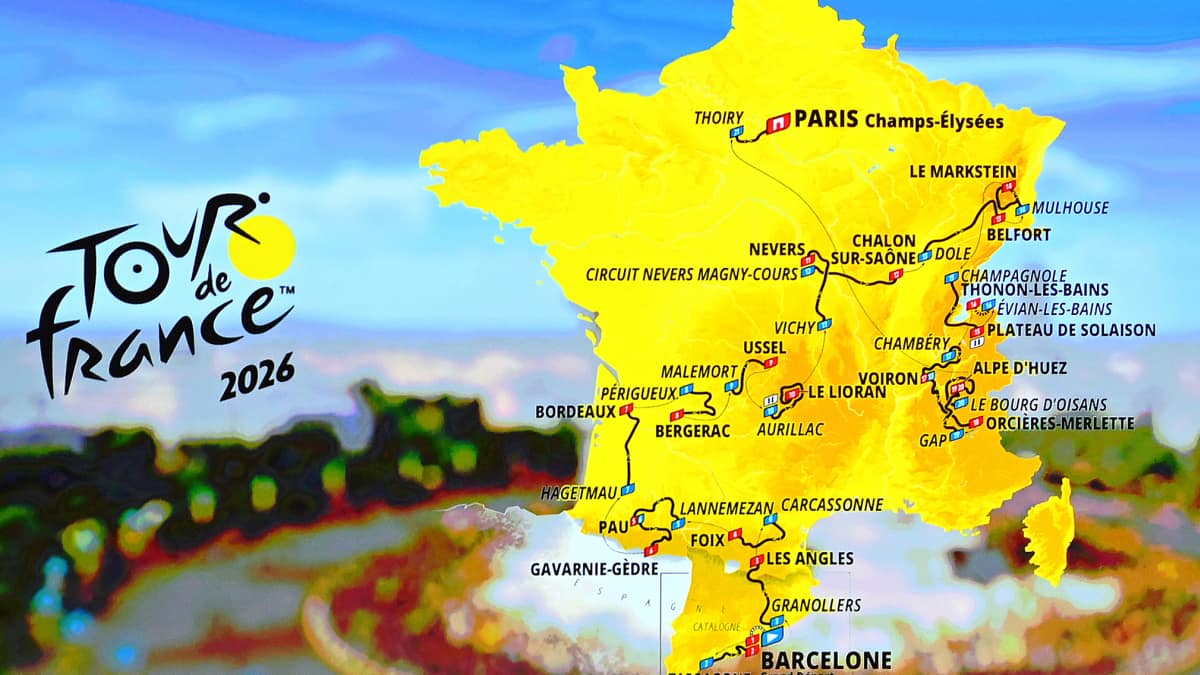
Even before the second rest day, the tour makes the rather long transfer back to the Jura, to Champagnole. This is where the 15th stage begins, crossing the low mountain range from one end to the other before heading straight for the Alps.
But the start of the stage is also quite a challenge. The first 17 kilometres climb in a series of steps up to the intermediate sprint. Shortly afterwards, the Col de la Savine is reached, although it is not classified as a mountain pass. The first classified climb comes after 37 kilometres at the Cote des Rousses (3rd category). The climb continues on to Le Tabagnoz.
As the route continues southwards, now running parallel to Lake Geneva, the next 80 kilometres offer opportunities to relax. From 1,250 metres above sea level, the route descends again to 500 metres, and at one point even to 360 metres. After 115 kilometres, the route skirts the border with Switzerland but does not cross it.
It is there that the route really begins to pick up pace. South of Lake Geneva, the route enters the Alps. First, riders must tackle the Col de la Croissette (Category 1), which, although less than five kilometres long, has an average gradient of more than eleven per cent. The descent from this is followed by the shorter Côte du Mont (Category 3), before a flat section leads to the mountain finish at the Plateau de Solaison (HC). The eleven-kilometre climb has an average gradient of nine per cent, never falling below six per cent.

A sporting analysis of Stage 15 of the 2026 Tour de France
The first day in the Alps is a rather curious one. That’s because the two toughest climbs of the day are actually quite atypical for this mountain range. On the Tour, it’s usually the Pyrenees where things get really steep. But this time it’s different. Even the Col de la Croissette will put the favourites through their first tough test. Anyone here who’s raring to go and willing to take risks could cause a real stir. Teams with two potential general classification contenders are once again more likely to be in the running than others.

Tadej Pogacar’s team (UAE Emirates – XRG) would also have the chance. It seems unlikely that the team leader himself will attack, as even the climb up to the Plateau de Solaison is tough enough to create gaps of several minutes. Isaac Del Toro, however, would be an option to put the competition under pressure, although that wouldn’t actually be necessary. That said, the Mexican knows the final climb well, having won there about a month ago at the Tour Auvergne-Rhône-Alpes. With a slight lead – one that Pogacar himself would certainly not be able to close – he could repeat his triumph.
Meanwhile, it seems a lost cause for breakaway riders to fight for the stage win. The final climb is too gruelling, and the general classification teams are too keen to influence the tight battle for the podium – perhaps even by securing bonus seconds.