Tour de France 2026: Preview of Stage 14: A gruelling challenge in the Vosges
Sebastian Lindner
· 17.07.2026

Key information on Stage 14 of the 2026 Tour de France
- Saturday, 18 July: Mulhouse – Le Markstein
- 155.3 kilometres, 3,800 metres of elevation gain (mountainous)
- Mountain climbs: km 36.6 (1st category), km 71.3 (2nd category), km 94.4 (1st category), km 149.4 (1st category)
- Intermediate sprint: 12.6 km
- Start: 1.10 pm, Finish: approx. 5.24 pm
- Live updates and results
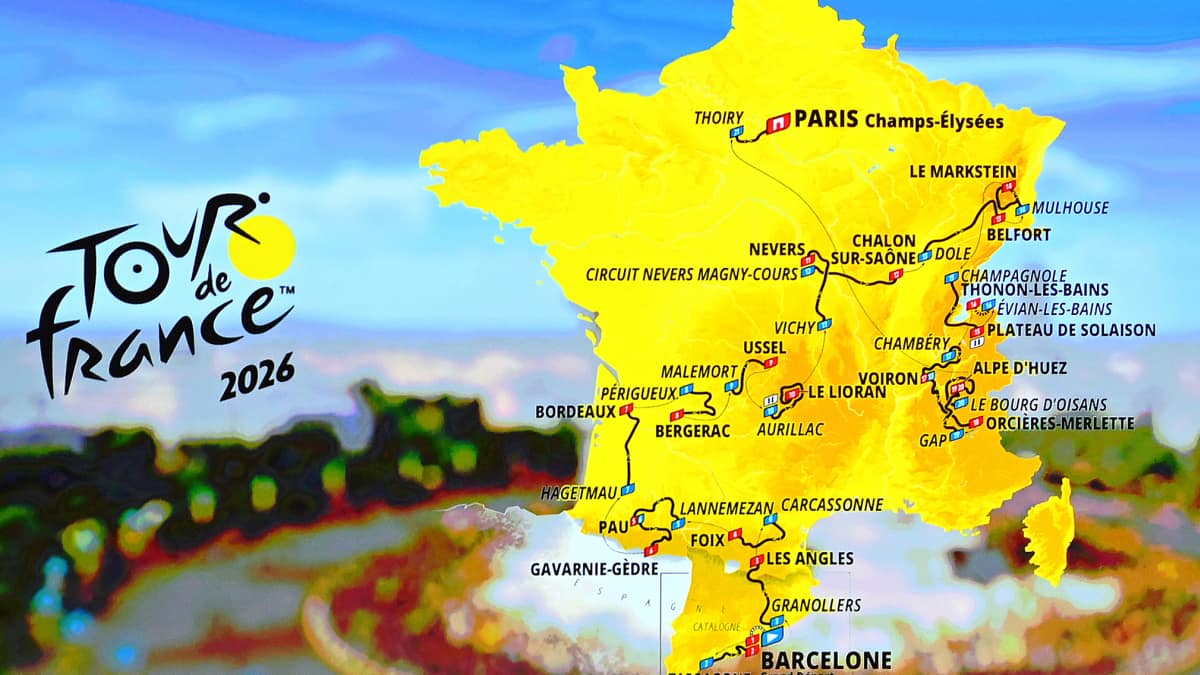
The route of the 14th stage of the Tour de France

Stage 14 sets off from Mulhouse, right on the border with Germany, and will take place mainly in the Vosges. With 3,800 metres of climbing, the day promises to be a real mountain spectacle. And it gets underway early. As soon as the intermediate sprint is completed after just under 13 kilometres, the 22-kilometre, two-stage climb to the Grand Ballon (Category 1) begins. The highest peak in the Vosges is crossed at 1,336 metres above sea level.
Shortly after the summit, the route passes through Le Haag and then continues to the first crossing of the finish line in the ski resort of Le Markstein. These six kilometres between the two villages are covered twice. This is because, after the finish line, the route forms a complete loop, taking in some of the most striking climbs in the Vosges. The route continues over the uncategorised Col d’Oderen to the Col du Page (2nd category), down to Bussang and then – as on the previous day – back over the Col d’Alsace (1st category).
Another long descent follows, and then the Col du Hundsruck – another uncategorised climb – before we reach a first. The route climbs the Col du Haag (1st category) via an ascent just over eleven kilometres long with an average gradient of just over seven per cent, which has only recently been upgraded from a winding forest track to a route suitable for road bikes. The average gradient is misleading, as it includes a short descent along the way. Large sections have a gradient of around nine per cent.
However, the six kilometres from the mountain classification to the finish are flat or even slightly downhill.

A sporting analysis of Stage 14 of the 2026 Tour de France
One of the toughest days of the entire Tour lies ahead in the Vosges. Although the stage is quite short, the riders will have to climb right from the start; it’s either uphill or downhill, often on narrow roads. That means they’ll need to stay fully focused for the entire four hours or so. It’s going to be intense.

Especially for the general classification contenders. No one can hide here; any dip in form is punished immediately. The big question of the day is: when will Pogacar make his move? The final climb is the obvious choice, as it is the steepest. But Pogacar is riding his own race anyway – even if Jonas Vingegaard (Team Visma | Lease a Bike) isn’t yet willing to admit it. And in the battle for second place, or at least third, there will be a variety of tactics on display.
As almost all the top teams still have two well-placed riders in the race, an early attack by one of them to put the competition under pressure is a possibility. The Ballon d’Alsace would be a good place for this, but so would a very early move with the first breakaway group – although that group might then struggle to really pull away.
This stage certainly has the potential to turn the race on its head, given how close the battle for the places behind Pogacar is.