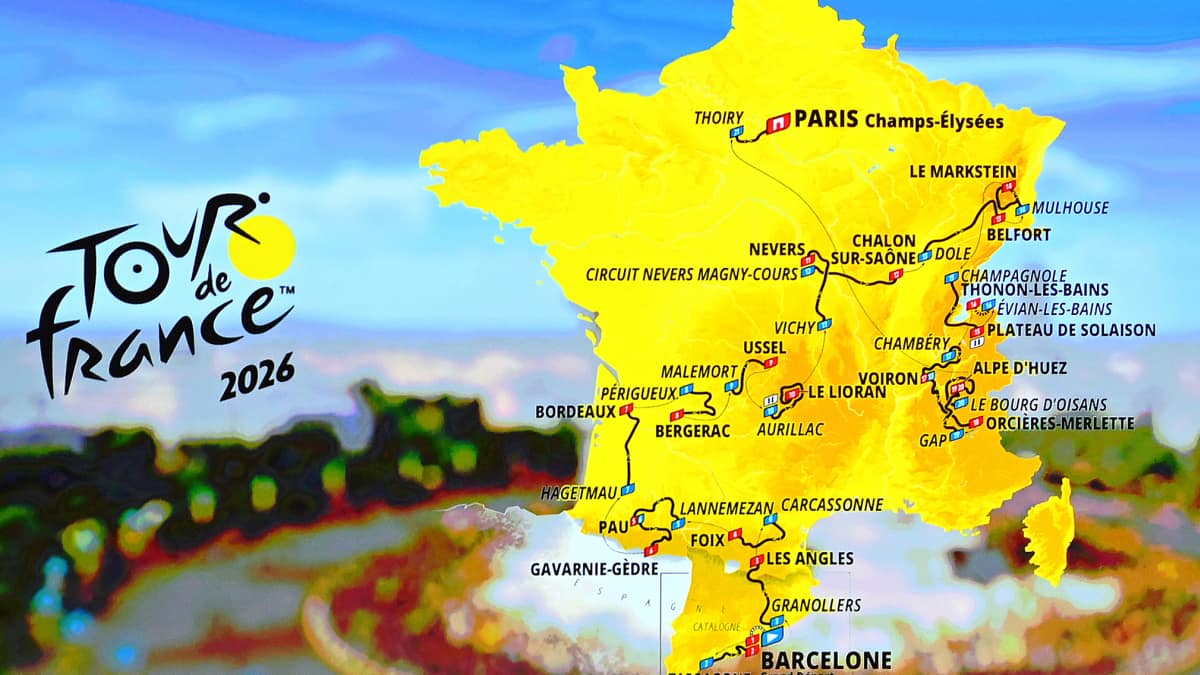
Key information about Stage 1 of the 2026 Tour de France
- Saturday 4 July: Barcelona – Barcelona
- 19.6 kilometres, 200 metres of elevation gain (team time trial)
- First departure: 5.05 pm, last arrival: approx. 7.16 pm
- Live updates and results
The route of the first stage of the Tour de France

Vive le Tour! The most important cycling event of the year – and one of the biggest sporting events in the world – will start in Spain for the third time in 2026. This had already happened three years earlier, meaning that the Iberians are currently even ahead of the French themselves when it comes to hosting Grand Départs. Following on from the Basque Country and Bilbao, it is now Catalonia’s turn, with a city that is as glamorous as it is sports-mad Barcelona, which will kick off the tournament.
For the first time since 1971, the Tour is once again starting with a team time trial. The 19.6-kilometre route through Barcelona at dusk begins for the 23 teams at the Fòrum in the harbour of the Catalan metropolis. After the start at the triangular landmark, the route initially runs along the waterfront before winding its way through numerous bends into the city centre. Among other sights, it passes the Sagrada Familia, which was inaugurated in June and has been the world’s tallest church since the start of the year.

After a good ten kilometres, the second of three intermediate time checks in the opening time trial will be taken there. A third check point comes five kilometres later, before the final stretch begins. The route climbs the final ascent to Montjuïc – Barcelona’s local mountain – which is well known from the Tour of Catalonia. A five per cent gradient awaits there for just over one kilometre, before a short descent – including a flat section – is followed by a further 800 metres with an average gradient of seven per cent. The climb is thus tackled from a different direction before the finish line at the 1992 Olympic Stadium.

A sporting analysis of Stage 1 of the 2026 Tour de France
The fact that team time trials are back on the Tour programme at all after a six-year hiatus (most recently in 2019 in Brussels on Stage 2) has been met with widespread approval. The fact that it is being held in the now not-so-new “A.S.O. format”, however, met with somewhat less approval. Instead of the traditional method of stopping the clock after the third rider, each professional is timed individually. Ralph Denk, CEO of Red Bull – BORA – hansgrohe, described it as an “individual time trial with a long lead-out”.
In the specific case of Barcelona, however, this could work in favour of one of its captains. Red Bull is fielding a team with strong time-trialling capabilities overall, led by the world champion in this discipline. Remco Evenepoel is one of the most promising contenders for the first yellow jersey of the 2026 Tour de France. The 26-year-old combines time-trial prowess with strength on short climbs like no other.
Set for a new Pogacar record?
However, Visma | Lease a Bike and UAE Emirates - XRG are also fielding strong line-ups, which are excellently suited to the time trial. How long the teams will actually stay together, given the format and, above all, the winding course – which requires extremely precise coordination in a time trial – is another matter entirely. By the final 800-metre climb at the very latest, the team captains will drop their support riders; in some cases, they may even tackle the first uphill section – four kilometres from the finish – alone with their final domestique. But in this regard, both Evenepoel with Florian Lipowitz and Jonas Vingegaard with Sepp Kuss, as well as Matteo Jorgenson – and above all the top favourite for the overall victory, Tadej Pogacar, with Isaac Del Toro – are ideally positioned.
For Pogacar in particular, it could be worth making a special effort in the hunt for further records. When, in 1971, the Tour – the last to date to begin with a time trial – got underway, the the legendary Molteni team, led by Eddy Merckx. The Belgian donned the yellow jersey and went on to win the tour. In the meantime, however, he had had to relinquish the jersey once more. So, should Pogacar win – and provided there is sufficient interest – he would have the chance to ride the entire Tour in yellow, given that the route remains challenging the following day as well. Neither Merckx nor anyone else has managed this in the ‘modern era’ of the Tour. Back in the Tour’s early years, when it had a different character – with stages often covering 400 kilometres or more and a rest day following each stage – the Italian Ottavio Bottecchia managed to do so in 1924.