2026 Tour de France: Preview of Stage 4: The stage is set for the breakaway riders
Sebastian Lindner
· 06.07.2026

Key information on Stage 4 of the 2026 Tour de France
- Tuesday, 7 July: Carcassonne – Foix
- 181.9 kilometres, 2,700 metres of elevation gain (hilly)
- Mountain classifications: km 48.2 (4th category), km 64.9 (3rd category), km 104.9 (2nd category), km 146.7 (3rd category)
- Intermediate sprint: KM 93.4
- Start: 1.10 pm, Finish: approx. 5.23 pm
- Live updates and results
The route of the 4th stage of the Tour de France

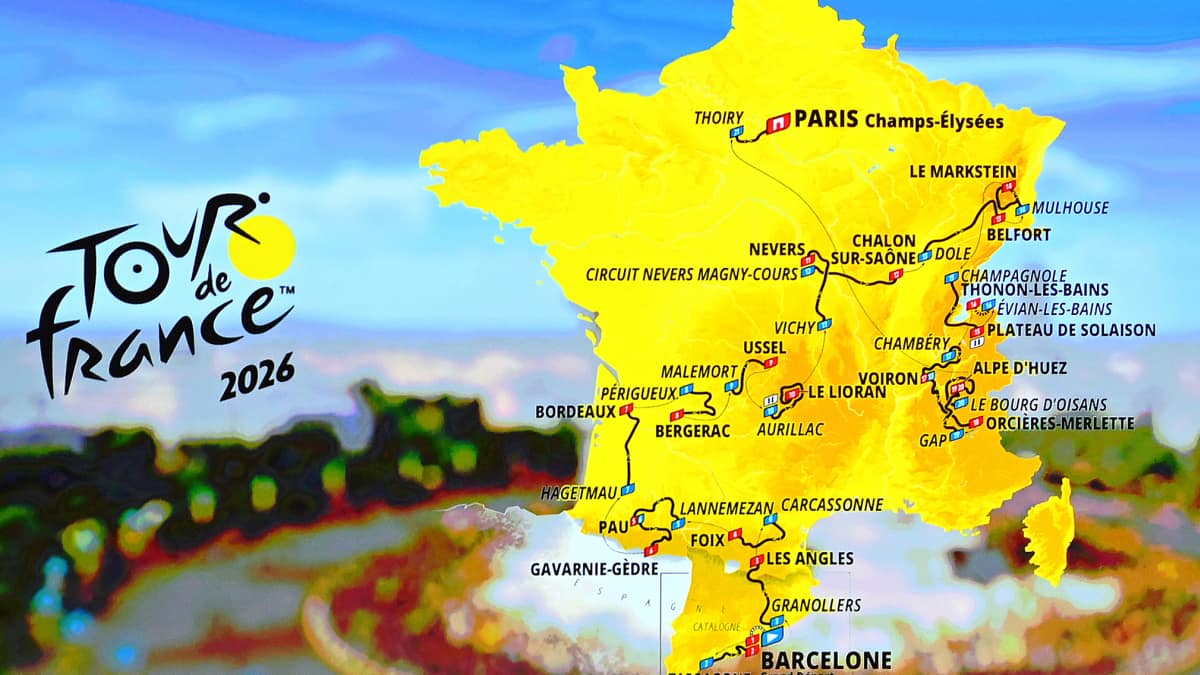
Stage 4 of the 2026 Tour de France will be the first to take place entirely on French soil. It will start in Carcassonne. The city, which is home to just under 50,000 people and is best known for its impressive medieval fortress, has featured in the Tour on several occasions in recent years. Four stages have finished here since 2018, with Tim Wellens winning solo last year.
This year, however, Carcassonne is once again the starting point for a section of the route that initially heads south before winding its way westwards along the Pyrenees. The first 30 kilometres or so are flat, before the route passes through an initial hilly section featuring one 4th-category and one 3rd-category climb. The route then flattens out again before the challenges become tougher after a good 90 kilometres. First up is the Col du Coudons (2nd category). At 10.7 kilometres with an average gradient of 5.5 per cent, it presents an initial challenge, but not yet the biggest of the day.
This comes about 30 kilometres further on, after the peloton has crossed a high plateau and descended a slope. Then the Col de Montségur looms ahead. At just under seven kilometres, it is significantly shorter, but with an average gradient of 6.6 per cent it is also steeper; this is the second Category 2 climb. From the day’s highest point at around 1,000 metres above sea level, the rest of the route to Foix is predominantly downhill, although there are a few small uphill sections to contend with. 320 metres before the finish, the course takes a sharp right-hand bend; otherwise, there are no difficulties to be expected in the final stretch.

A sporting analysis of Stage 4 of the 2026 Tour de France
The last time a stage of the Tour finished here was in 2022. That stage also started in Carcassonne, but had a different character, featuring two Category 1 climbs. The outcome, however, could be similar. Back then, Hugo Houle, a breakaway rider, took the win. The Canadian crossed the finish line solo. This stage is unlikely to be difficult enough for that to happen again, but a bunch sprint is even less likely. The sharp bend just before the finish suggests that even A.S.O. does not expect a particularly large group; otherwise, the route would be remarkable.
We can expect a long battle between a small leading group and a reduced peloton, in which Lotto Intermarché, Lidl - Trek, Jayco AlUla and Netcompany INEOS will be working for Arnaud De Lie, Mads Pedersen, Michael Matthews and Dorian Godon. This quartet represents the strongest climbers amongst the sprinters in the Tour. After the final mountain classification, these teams will have 35 kilometres left to mount a successful chase to the finish without pushing their potentially exhausted riders to the limit.
It is quite possible, however, that this might not be enough. After all, the race is practically crying out for Mathieu van der Poel (Alpecin - Premier Tech) to be in the breakaway group. And once the three-time winner of the Tour of Flanders and Paris–Roubaix has built up a lead, it usually takes a concerted effort to reel him in again.