


TOUR Tech Briefing: “The fastest aero bike is the key to success in Paris”
Robert Kühnen
· 26.07.2026

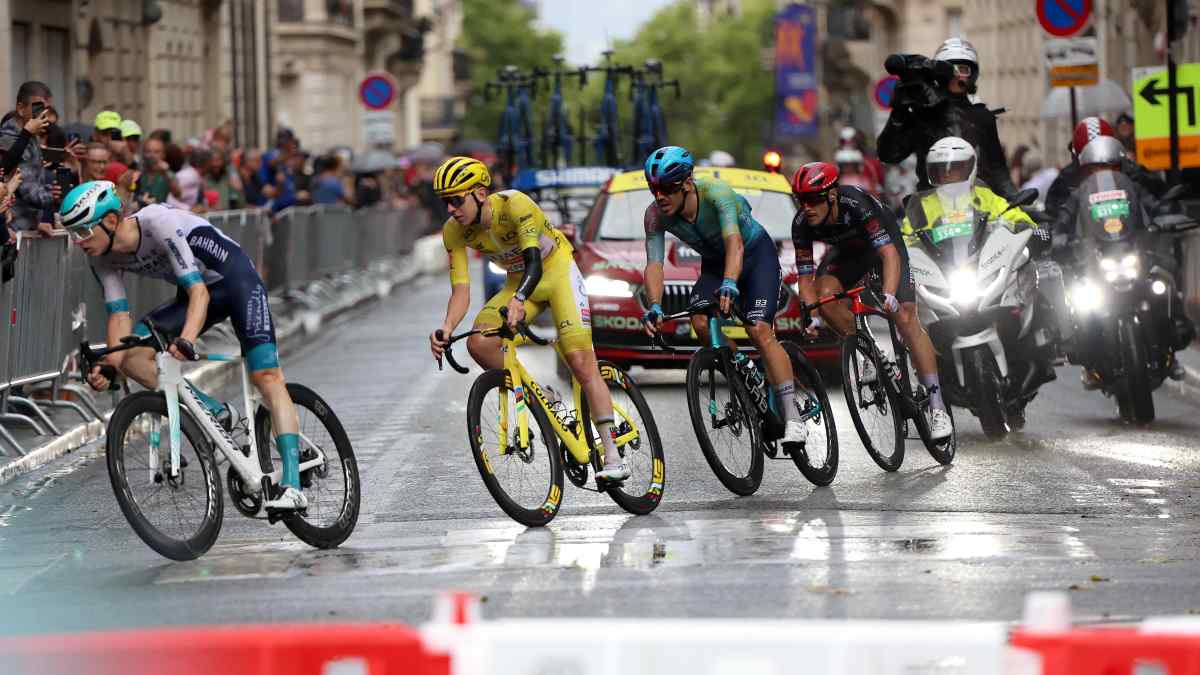
The final stage follows a similar format to last year’s. After a gentle warm-up, there will be a few final laps in Paris, during which the riders will have to tackle the narrow, steep Montmartre hill three times. So, following a gentle start to the stage, we can look forward to some thrilling action to round it off.
A last chance for teams that haven’t managed to score any points so far? Will the sprinters hold their own, or will a solo rider break away on the final climb, as Wout van Aert did last year? Or will Tadej Pogacar be the one to cross the finish line first in Paris? In principle, the stage profile would suit him too.
The city circuit promises a classic atmosphere. Anything is possible – from a puncheur’s solo breakaway to a sprint from a depleted group.

We’re simulating the final 10.2 kilometres of the race to analyse who has the best cycling technique for the Tour’s final stage.
Number of the day: 2 seconds
The result comes as no surprise. The fastest Aerobike in the field is, in the final in Paris too, the machine most likely to secure victory following an attack on the Côte de la Butte Montmartre: Two seconds On paper, the Van Rysel RCR-F Pro is ultimately in the lead.
However, it should be noted that when it comes to attacking directly on a climb, the Cervélo S5 is the better bike because it is significantly lighter.
If you want to defend a lead right to the finish line, you absolutely must have your aerodynamics under control. The calculated average speed, taking the gradient into account: 48.2 km/h.
The anticipated finale is just as fast-paced as the Tour de France itself.
An overview of the (almost) full line-up*:

The order of the bikes during an attack on the final ascent of the Côte de la Butte Montmartre reflects what the entire Tour de France was all about: pace, pace, pace. Aerobikes dominate the rankings. The race to develop even faster bikes will therefore continue unabated.
Thanks for reading – we’ll see you again at the press briefings for the Tour de France Femmes, starting on 1 August. What are you particularly interested in? Drop us a comment.
* Simulation calculations
Based on our own wind tunnel tests, we carry out simulation calculations for the Tour de France tech briefing. How TOUR tests: Aero road bike test in the wind tunnel.
We are investigating which wheels can offer a technical advantage in which situations. The variables we can control in the simulation include wheel weight, rider weight, the inertia of the wheels, the drag coefficient, the rolling resistance coefficient and the efficiency of the drivetrain.
To model ride times, we use realistic power outputs and weights for the riders, combine these with our wind tunnel data, and have the riders race virtually along selected sections of the route, which we extract from the official route data; the derived elevation profiles are key to this. The modelling also includes bends, which we can brake for realistically, and adjustable power profiles for different types of riders. This allows us to distinguish between hill climbs and proper final sprints. Taken together, this makes the simulation very realistic. What we cannot replicate are dynamic handling effects such as the individual behaviour of the wheels on different surfaces.
The journey times calculated for the sections of the route that are decisive for the race highlight the influence of the wheels – provided that the riders always behave in the same way in a given scenario.

Robert Kühnen
Editor
