


Milan-San Remo - The favourites: Can Tadej Pogačar beat Mathieu van der Poel?
Leon Weidner
· 19.03.2026

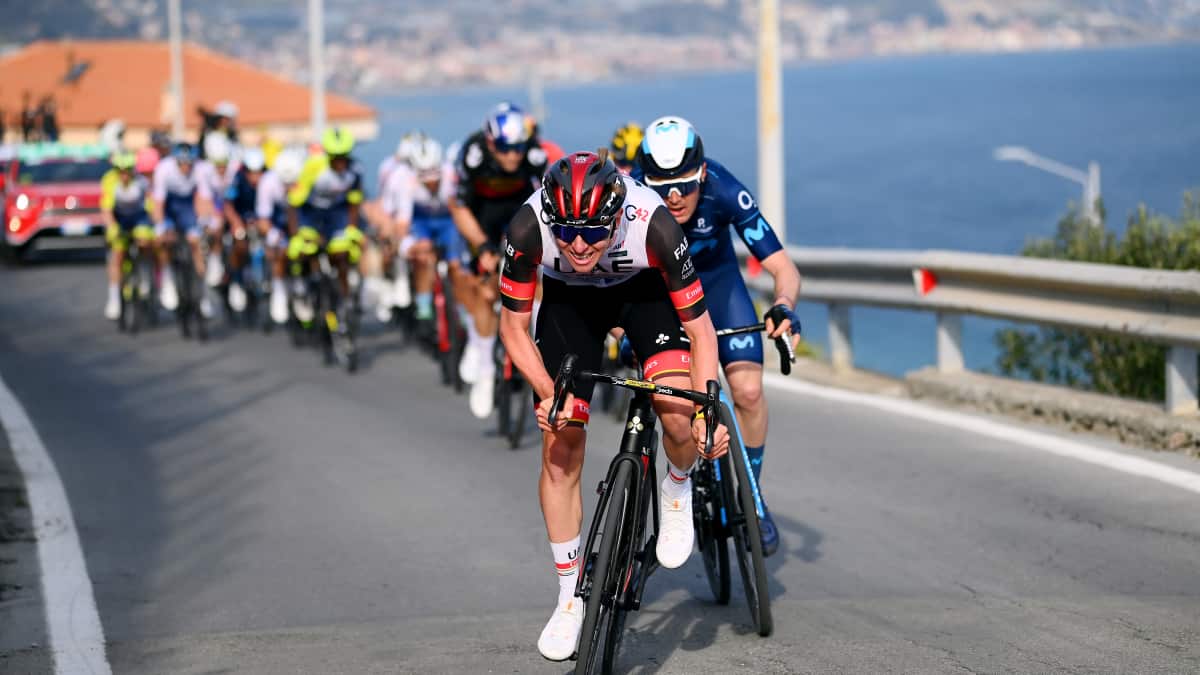
Milan-San Remo rewards not only the strongest legs, but above all timing and positioning. The Poggio is short enough to make a sprint finale possible, but at the same time steep and selective enough to tear the peloton apart if the pace is right. This is precisely where the unpredictability of this race lies: it can tip in two completely different directions in just a few minutes.
If the Cipressa is ridden aggressively and the Poggio is climbed at full throttle, the group of contenders for victory shrinks drastically. Sprinters who "just" want to get through are weeded out and the finale becomes more of a classic duel of punch, attack and counterattack. If, on the other hand, the race is rather managed up to the Cipressa, teams neutralise each other or nobody wants to take the final risk, then significantly more riders will come over the Poggio - and the Via Roma is more likely to become a sprint stage.
The 2025 result shows how close the balance is: Mathieu van der Poel won ahead of Filippo Ganna and Tadej Pogačar. This trio will also shape the favourites in 2026 and at the same time provide a blueprint for how many different types of riders can have a chance of winning right up to the very end.
Van der Poel vs Pogačar: the duel that defines the final
Mathieu van der Poel is the reference rider on this profile. He is explosive enough not only to survive on the Poggio, but also to keep up the pace - and he is sprint strong enough to decide a reduced final against almost all competitors. Added to this is his experience in position battles: in San Remo, it is often not just the best wattage that is decisive, but who is on the right wheels on the Poggio and in the descent.
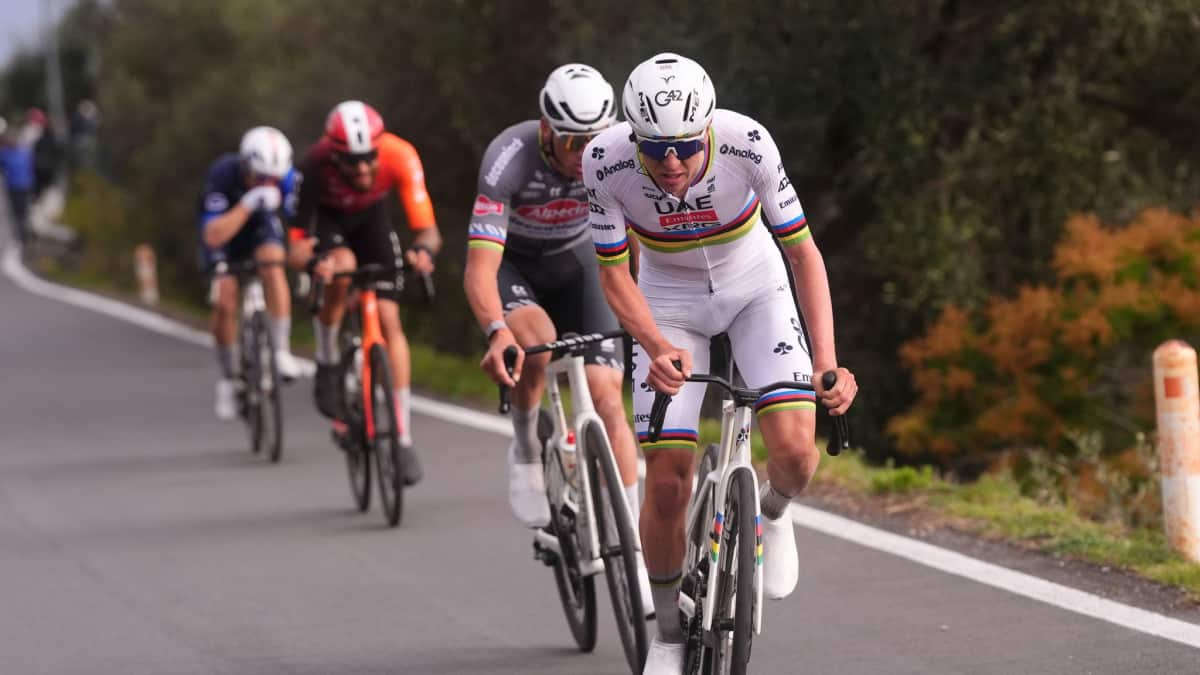
Tadej Pogačar comes to San Remo with a different plan. He is the most dangerous competitor on the mountain because he can really dictate the race there. His challenge is less about form than maths: Pogačar has to get rid of van der Poel - or wear him down so much that his sprint is no longer enough to win in the end. The team commitment is part of the strategy to turn a standard scenario into an exceptional race. Isaac del Toro is to help his captain in this endeavour and ensure that the Milan-San Remo race goes the same way.
Filippo Ganna as the third force with a real chance of victory
Filippo Ganna is more than just the man for second place, even if you might think so after 2023 and 2025. When the pace over Cipressa and Poggio is brutal, when the pure sprinters are gone and the finale turns into a power ride, his time trial qualities play right into his hands. His strength lies in long, consistently high efforts - and that's exactly what San Remo can become in the finale if the favourites don't lurk around each other, but instead pull through. The fact that Ganna finished second again in 2025 underlines the fact that he is not just one of the favourites, but a candidate who can strike at the exact moment when the others are looking too much at each other.
The second row - dangerous because it thrives on scenarios
Behind the big triangle are riders who don't win every race, but need exactly the one that suits them. Wout van Aert is the classic "if-then" favourite: if he gets over in the first group on the Poggio and doesn't have to lose too much energy in the process, he can ride at the front in a small sprint. Despite his poor form this season, the Belgian should not be written off completely.
Thomas Pidcock, on the other hand, is the rider who can capitalise on chaos. He doesn't have to control the race through brute endurance, but through dynamism: short attacks, a bold moment on the Poggio, an aggressive line on the descent. When a finale gets messy, this is often when Pidcock is particularly dangerous.
Outsiders who are suddenly still there in a less tough Poggio are also exciting in 2026. Tobias Lund Andresen would be one such name: his chance lies not in dominating the Poggio, but in still having sprint legs left in a larger group after 290 kilometres. And even a helper like Isaac del Toro can retain a residual chance in San Remo - not because he is planned as captain, but because this race creates situations in which roles can tip at short notice if favourites block each other or a team suddenly needs a plan B.
What if it does turn out to be a sprint?
A sprint is never the default scenario in San Remo, but it is always possible - especially when the Cipressa and Poggio are ridden tactically or when teams neutralise each other. In such a scenario, classic sprinters come more into focus, whereby it is less important who is the best sprinter of the season, but rather who can still combine top speed and positioning after almost 300 kilometres. Then names like Jasper Philipsen, Luke Lamperti, Paul Magnier or Matthew Brennan automatically become more relevant - provided they survive the finale in the first group.
Conclusion: van der Poel has the advantage - but Pogačar has the leverage
Mathieu van der Poel is the logical top favourite because he is the most reliable winner of the typical San Remo standard final. Tadej Pogačar is the man who wants to destroy this standard final - and has the strongest team commitment to do so. That's exactly what makes Milan-San Remo 2026 so attractive: it can seem controlled for a long time and then tip over in a matter of minutes.
Leon Weidner
Working student
