


Ghent-Wevelgem 2026: the most important facts in brief
- Date: 29 March 2026, estimated finish time ~ 16:21 (men) or ~ 17:48 (women)
- Distance240.8 kilometres (men), 135.2 kilometres (women)
- StartMiddelkerke (men), Wevelgem (women), GoalWevelgem
- UCI category: (Women's) WorldTour
- OrganiserFlanders Classics
- Premiere: 1934 (men), 2014 (women)
- Last year's winnerMads Pedersen, Lorena Wiebes
Even after the name change, Middelkerke-Wevelgem is still characterised by one thing in particular: the prominent role of the Kemmelberg. The climb is not only tackled several times during the race, but also from different directions. From the Belvedère side, the Kemmelberg is 1500 metres long and has an average gradient of 6.6 per cent. The ascent from the direction of Ossuaire is even more demanding: although it is shorter at 700 metres, it has an average gradient of 10.4 per cent and reaches 21.1 per cent at its peak.
The route of Middelkerke-Wevelgem 2026
For the men, the route from Middelkerke first leads inland through Diksmuide. It then heads north again briefly before the course swings west towards the French border. From there, the route heads south until the first slipway shortly after the halfway point of the race. A total of nine slip roads await in the hilly area, all of which the pros have to negotiate before heading back towards Wevelgem. The last 35 kilometres to the finish are then predominantly flat.

The women's race takes a different course: The start is in Wevelgem, from where a loop to the west is ridden. Unlike the men, who reach the Hellingen from the north, the women approach the steep climbs from the south. After crossing the five key sections, the route leads back to Wevelgem - and here, too, the final 35 kilometres to the finish are almost flat.
The favourites
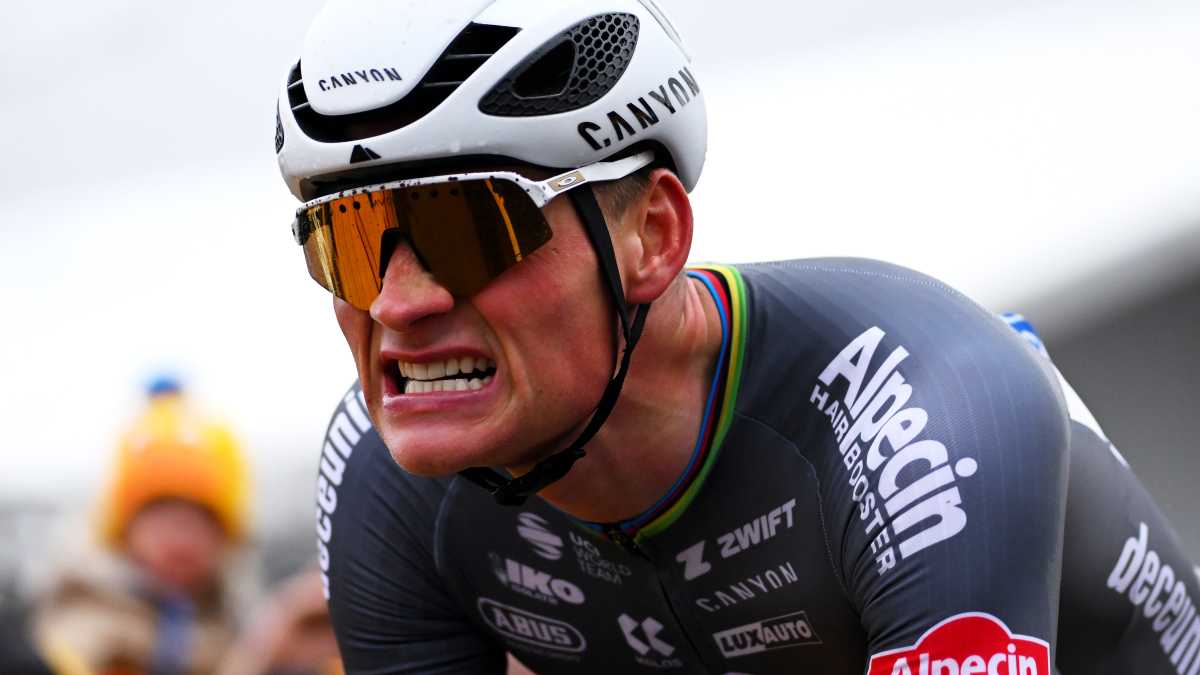
The winner of the last two editions, Mads Pedersen, is also in his team's line-up for this year's slightly different race. However, after his crash at the Tour of Valencia, the Dane quickly got back on track and is once again one of the favourites. However, the competition is prominent: Mathieu van der Poel is returning to the start after his absence last year and is regarded as one of the defining Classics riders of recent years, making him even stronger than Pedersen. Wout van Aert also wants to have a serious say in the race after his third place at Milan-Sanremo and has shown why this is still possible.
An advantage for Pedersen and Van Aert: Van der Poel suffered a minor hand injury - and it is precisely this that could tip the scales at the decisive moment. However, the sheer power of the Dutchman should not be underestimated; on paper, he is the strongest.
Even though a classics specialist has often won the race in recent years, a sprinter's victory is anything but impossible. If the three aforementioned sprinters are unable to pull away far enough at the Hellingen, the sprinters' teams will have just under 35 kilometres to bring their captains back. In this case, sprinters with classic tendencies in particular should have a chance of not missing out completely. The two young riders Paul Magnier, Tobias Lund Andresen, Arnaud de Lie and Matthew Brennan are just as likely as Jasper Philipsen and Jordi Meeus. For Jonathan Milan, however, who will also be starting, the Hellingen are likely to be too difficult. The thoroughbred sprinter has a decisive disadvantage here compared to his rivals.
The favourites
A female rider has also won the last two editions of the women's race. Lorena Wiebes does pretty much what she wants in the sprint in the past and current season - and wins. So she seems to be one of the favourites to win this time as well, should there be a sprint from the group or the peloton anyway. The final Hellingen will decide whether she can secure the hat-trick or whether a rider with classics qualities will take the title.
The classics have become increasingly important in the Women's WorldTour in recent years, which is one of the reasons why clear classics specialists are beginning to emerge. In contrast to the men, these are not yet so pronounced - Middelkerke-Wevelgem could be a turning point this year. Ally Wollaston, Elise Chabbey, Karlijn Swinkels, Cat Ferguson and Chiara Consonni will have to leave Wiebes behind on the climbs to have a chance of winning the day. All the climbs will have to be ridden hard to make life as difficult as possible for the sprinters.
However, Lorena Wiebes probably still has the best cards. The Dutchwoman has also proven in the last two years that she can withstand the attacks of the competition and her form is currently more impressive than ever.
The men's slip rings
- KM 135.0 - Scherpenberg
- KM 143.8 - Baneberg
- KM 149.7 - Monteberg
- KM 151.5 - Kemmelberg (Belvédère)
- KM 182.0 - Monteberg
- KM 183.8 - Kemmelberg (Belvedère)
- KM 191.3 - Scherpenberg
- KM 200.1 - Baneberg
- KM 205.3 - Kemmelberg (Ossuaire)
The women's slip rings
- KM 76.4 - Monteberg
- KM 78.2 - Kemmelberg (Belvédère)
- KM 85.7 - Scherpenberg
- KM 94.5 - Baneberg
- KM 99.7 - Kemmelberg (Ossuaire)
Middelkerke-Wevelgem 2026: TV broadcast and live stream
Both races will be broadcast live on television in Germany. Eurosport 1 and Eurosport 2 show the men's race on Sunday from 14:15-16:45, followed by until 18:15 the women's competition. Parallel to this, there will be a Live stream on Discovery Plus.

Leon Weidner
Editor