


Giro d'Italia Women 2026: Vollering vs Longo Borghini, or a surprise after all?
Leon Weidner
· 28.05.2026

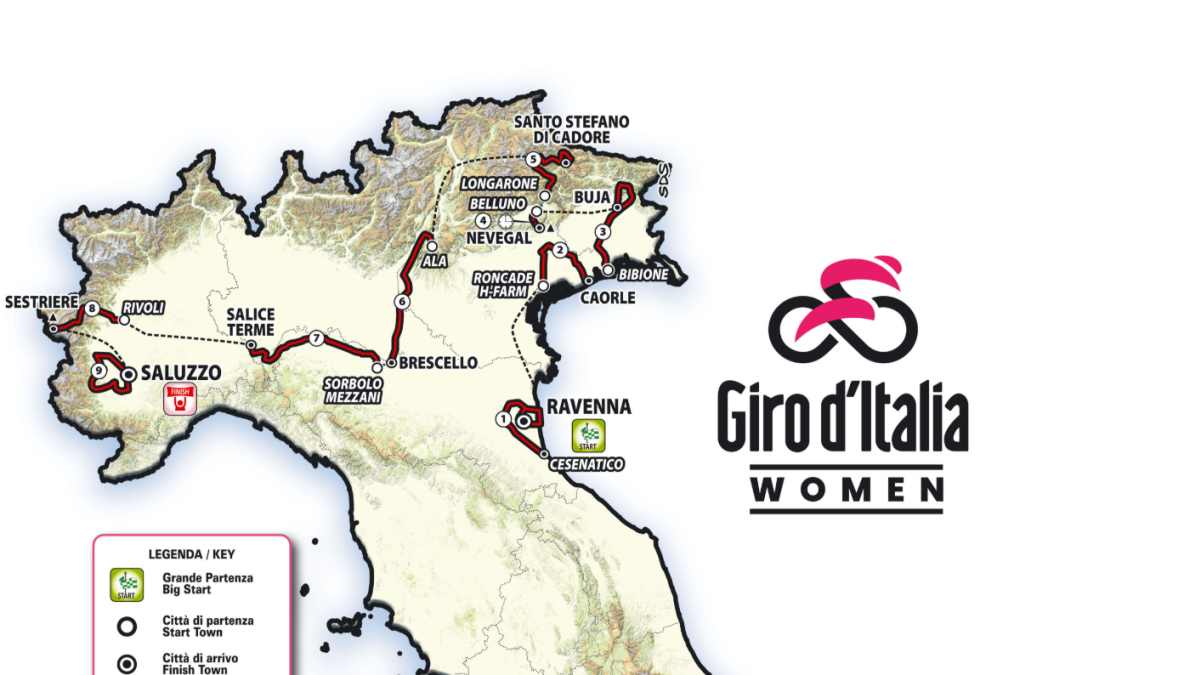
The 37th edition of the women's Tour of Italy will take place from 30 May to 7 June. The event, which was long known as the Giro Donne, has officially been known as the Giro d'Italia Women since it was taken over by RCS - the organiser of the men's Giro d'Italia. The route for 2026 was presented in Rome on 1 December, together with the presentation of the men's race. Compared to last year, the programme has grown significantly: the additional 9th stage increases the total distance to over 1000 kilometres. After 919.2 kilometres in 2025, this year it will be 1177.7 kilometres. At the same time, the elevation profile is less demanding - with around 2200 fewer metres in altitude, the cumulative climbs are 12,100 metres.
The stages and favourites of the Giro d'Italia Women in detail
The women's Tour of Italy begins in Cesenatico with two flat stages for the sprinters. The first stage is completely flat, while the finale is ridden twice on a 23-kilometre circuit. After her season opener, Lorena Wiebes is considered the absolute top favourite to win the stage, but will have to hold her own against Elisa Balsamo, among others. The second stage also ends in a sprint, with the only small climb 88 kilometres before the finish. If everything goes according to plan for the SD Worx - Protime team, Wiebes should also have the best cards here.


First chances for a breakaway and mountain time trial
The third stage of the Giro d'Italia Women starts flat, followed by several short ramps from the halfway point. The last categorised climb is 18 kilometres before the finish and offers riders such as world champion Magdeleine Vallieres and Cat Ferguson the chance of a breakaway victory. The mountain time trial on day four starts with a one kilometre descent before the climb begins. After 3.5 kilometres at 2.9 per cent, a section of almost four kilometres follows with an average gradient of 10.3 per cent and 14 per cent at the top. Towards the finish, another kicker awaits, which will create gaps in the overall classification.
For the first time in this Tour of Italy, the contenders for victory are in demand here. Demi Vollering and Elisa Longo Borghini are the clear favourites. However, Anna van der Breggen has shown with her second place in the Tour of Spain that she is also a force to be reckoned with. Marlen Reusser, meanwhile, is still difficult to assess. The mountain time trial actually suits her, but after an injury break she first has to find her way back to her old strength.
Dolomites and queen stage of the Giro d'Italia Women
The fifth stage leads over four categorised climbs in the Dolomites. The Passo Tre Croci and the Passo di Sant'Antonio are followed by two laps with the Costalissoio climb, the finish line is on the descent. Here Vollering, Longo Borghini, Reusser and Van der Breggen can score points in the mountains for the first time after the time trial. After a flat sprint stage on day six, the seventh stage follows with two third-category mountain classifications, whereby various scenarios are possible. Both an exchange of blows between the favourites for overall victory and a race within the race are possible. If a breakaway group gets a big lead early on, strong riders could save it to the finish. Magdeleine Vallieres or Cat Ferguson would certainly be able to do this. With a view to the following stage, it could be advisable for the overall classification riders to save some energy here.

The eighth stage over the Colle delle Finestre is the queen's stage. 18 kilometres on a 9 per cent gradient, half of it on gravel, decide the race. After a short descent, the mountain finish awaits in Sestriere. Clearly a section for the GC riders, who will try to ride the climb with as many helpers as possible. The teams will play a decisive role here. The ninth and final stage leads over the Montoso after 46 kilometres, followed by the Colletta di Paesana and the Colletta di Brondello. After the probable decision of the stage race the day before, the leading rider in particular will have to remain on alert if the lead is not already several minutes. This final stage of the Giro d'Italia Women 2026 is no walk in the park. This is another reason why breakaways are likely to have a hard time, but a breakaway is not impossible. From the Colletta di Brondello, the route leads downhill to the finish in Saluzzo, where the new winner of the Tour of Italy will be crowned.
Conclusion - what the chances are
In the battle for overall victory, however, there is hardly any way around Demi Vollering. The Dutchwoman has impressively demonstrated this season that she is the strongest rider in the peloton, both in the mountains and in the time trial. Behind her lurks Elisa Longo Borghini, probably her most dangerous rival - not only because of her strong form, but also because she rides on home terrain and knows the decisive climbs like no other. Behind her, things are more open: Marlen Reusser remains a question mark after her injury, but has the potential to make up decisive seconds in the time trial and on long climbs. Anna van der Breggen, who has already shown that she is competitive again after her comeback, can be assessed at a similar level. Should Reusser reach her best form, she should have a slight advantage - but at the moment there is much to be said in favour of a duel between Vollering and Longo Borghini for Rosa.

Leon Weidner
Editor