


Extreme weather is on the rise: Grand Tours – yet another victim of climate change
Leon Weidner
· 17.07.2026

The images from this Tour de France look familiar. With temperatures exceeding 30 degrees Celsius, riders are reaching for ice vests, stuffing their socks full of ice cubes (which is now banned) and gratefully accepting any opportunity to cool down at the feed stations. Commentators discuss heat strategies, fluid loss and the risk of overheating. All of this is no longer a marginal issue.
It is worth asking: Is this trend simply a particularly extreme outlier? Or are we currently witnessing something that could become the new normal? There is much to suggest the latter.
The 2026 Tour is not an isolated case
Of course, gruelling stages have been around for as long as the Tour de France itself. If you look back several decades, you’ll repeatedly find stages that were contested under a blazing sun. The difference, however, is that extreme weather is no longer a one-off occurrence. It now accompanies professional cycling throughout the entire season.
At this year’s Tour de France, high temperatures have been dominating the headlines for many days. Riders, support staff and organisers are no longer debating whether the heat is affecting the race, but only the extent of that impact. The effects are visible everywhere. Road surfaces are being pushed to their limits, organisers are having to take additional measures, and the teams are investing more and more in cooling strategies. The heat is no longer just an unpleasant nuisance. It is becoming a tactical factor. And sometimes even a safety risk.

The Vuelta has already offered a glimpse of a dystopian future
Anyone who thinks the 2026 Tour is a special case need only look at previous Grand Tours. The images from last year’s Vuelta a España were particularly striking. Forest fires had scarred large parts of northern Spain. Individual sections of the route had to be monitored and, in some cases, adapted in line with the fires’ progress. The riders made their way through regions where entire mountain slopes had been scarred by fires. Burnt trees, blackened slopes and barren landscapes dominated the broadcasts. In some cases, even the route itself was under scrutiny because fires were raging close to the race.
Anyone who saw the television footage was reminded more of a scene from a dystopian film than of one of the world’s biggest cycle races. Such images used to be considered the exception. Today, they seem alarmingly plausible.
The Giro was hit by torrential rain
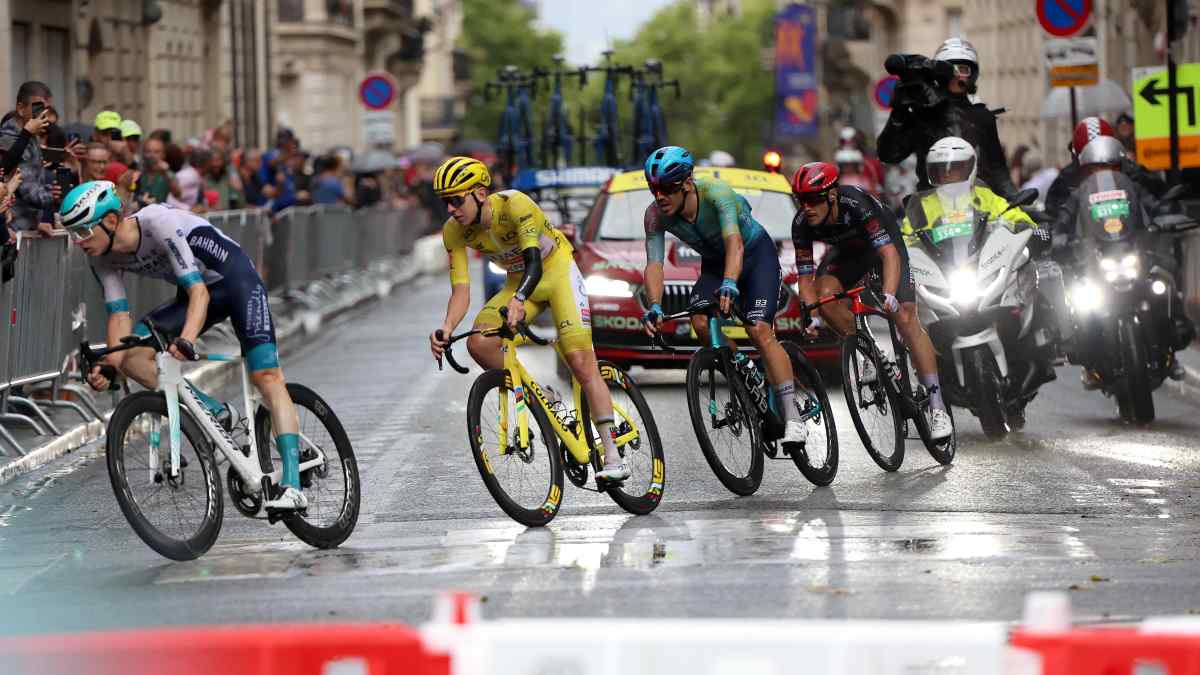
The other extreme was evident this year at the Giro d’Italia. There, it wasn’t the heat that was the problem, but the rain. Heavy downpours created chaotic conditions on Stage 5. In places, the roads turned into rivers, and the riders found themselves battling the elements more than each other.
Professional cycling has long since ceased to be a battle against rising temperatures alone. It is increasingly having to contend with all manner of extreme weather conditions. Heatwaves. Forest fires. Torrential rain. Floods. The list is getting longer.
The new normal in professional cycling
Just a few years ago, freak weather conditions at Grand Tours were often regarded as exceptional occurrences. Today, the opposite seems to be the case. Hardly a three-week stage race goes by without discussions about heat, smoke, rain, wind or safety measures. Organisers are having to adjust routes more and more frequently, teams are employing additional experts in heat management, and riders talk about the weather almost as often as they do about their rivals.
This is also evident in the development of equipment. Cooling vests, ice baths, temperature monitoring and specific hydration strategies are now part of the teams’ standard repertoire. What used to be regarded as a special measure for particularly hot days is increasingly becoming part of everyday racing life.
Where are the limits?
Professional cycling is still managing to adapt. But the crucial question is how long this will remain possible. The Tour de France thrives on its legendary mountain stages. The Vuelta on the arid and often brutal landscapes of Spain. The Giro on the high Alps and Italy’s changeable weather conditions.
However, it is precisely these regions that are among those most severely affected by the consequences of climate change. Higher temperatures increase the risk of forest fires. Heavier rainfall increases the risk of flooding and landslides. At the same time, riders are coming under ever-greater strain on their health. Even today, we are seeing stages where sporting performance almost becomes a secondary consideration because the weather conditions dominate the action.
The exception becomes the rule
Perhaps that is precisely the most important insight to be gained from this Tour de France. The heatwave of 2026 is not just a story about exceptionally high temperatures. It is part of climate change.
The Vuelta passed through landscapes scarred by wildfires. The Giro battled torrential rain. And the Tour is being dominated by a heatwave that is challenging riders and organisers alike. Each individual event could still be dismissed as an exception, but taken together they tell a different story. A story in which extreme weather is no longer a surprising footnote to a Grand Tour, but an integral part of the race.

Leon Weidner
Editor