


95 winners are on the Paris-Roubaix winners' list - 90 men and five women. But the legend of the Hell of the North is characterised by more riders than just the winners. A long list of first-class cyclists have tried again and again to conquer this race, but failed due to a puncture or the wrong brake cable. A series of interviews by organiser A.S.O. is dedicated to riders such as Adrie van der Poel, Juan Antonio Flecha, Marianne Vos, Zdenek Stybar, Steve Bauer and Lorena Wiebes, who never triumphed in the velodrome despite finishing on the podium.
In the famous line of ancestors from Raymond Poulidor to Mathieu van der Poel, Adrie, the father of the "Flying Dutchman", was a great specialist in cyclocross and the classics. In 1996, he secured the rainbow jersey with a world championship title. He had previously won two monuments on the road: the Ronde van Vlaanderen in 1986 and Liège-Bastogne-Liège in 1988, but the race that was closest to his heart, Paris-Roubaix, always eluded him. His record includes 14 participations - as many as Tom Boonen, Roger De Vlaeminck or Raymond Poulidor.

Adrie van der Poel and the 1986 sprint
Van der Poel often went into the race with the aim of winning, especially in 1986, when he had dominated Sean Kelly at the Ronde van Vlaanderen a week earlier. In the Hell of the North, the ranking was reversed in the sprint of a small group. Kelly won ahead of Rudy Dhaenens and Van der Poel. The Dutchman was only 26 years old. Many victories still awaited him, but Roubaix remained out of reach.
His son Mathieu added Van der Poel's name to the list of winners three times. "He's a boy who always surprises me," Adrie tells A.S.O. "This year I think he's ready again. There's no guarantee, but in any case he's done everything he can to be ready."
When Adrie started in Compiègne in 1986, he looked like a title contender in every respect. "I was really strong that year." He had just won the Ronde van Vlaanderen, demonstrating exceptional physical and tactical mastery after a particularly successful start to the season. At 26, he had already proven himself in the Hell of the North, finishing 6th in 1983 when his team-mate Hennie Kuiper took the win - a year after Jan Raas' success.
Love for wet cobblestones
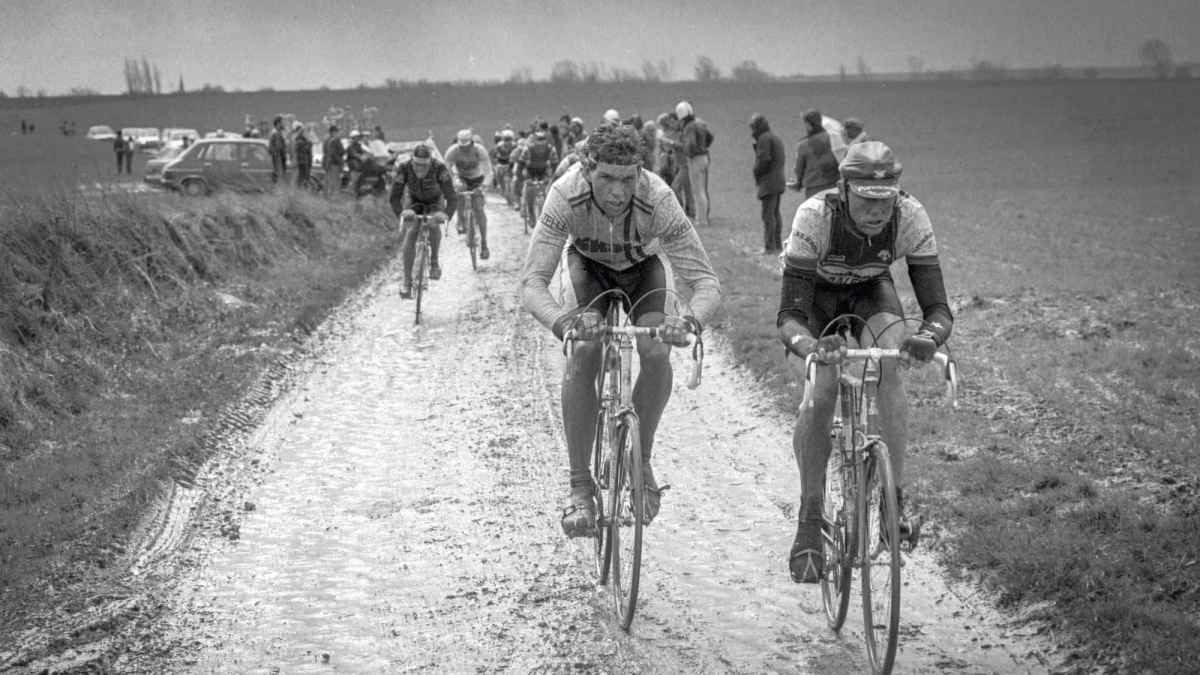
His self-confidence was at its peak. The weather played into his hands. "These were the conditions I favoured: a dry Sunday after a week of rain," he smiles. "I loved it. Some riders like climbs, I like riding on wet cobbles!" In the Kwantum jersey, Van der Poel avoided all the pitfalls and rode confidently towards Roubaix, where the finish was exceptionally in the city. From 1989, they returned to the velodrome. "I felt good, I hadn't had any bad luck in the race," he recalls.
Four men delivered the sprint. Van den Haute set off in a sprint 300 metres before the finish, Van der Poel followed - and Kelly beat them all. The Irishman took his second victory on the Roubaix cobbles after his triumph in 1984. "I probably didn't ride the smartest sprint of my career," admits Van der Poel. "I was already very happy to be at the front and almost certain of a podium finish. That's why I wasn't 100 per cent focused on winning the race."
The rivalry with Sean Kelly
Adrie van der Poel and Sean Kelly have stood on the podium of a Monument together four times. Each time, one of the two was at the top. The Dutchman shone at the Ronde van Vlaanderen in 1986. The other three occasions - Il Lombardia in 1983 and 1985 and Roubaix in 1986 - went in Kelly's favour.
"He is perhaps the best rider of the 1980s and 1990s," says Van der Poel full of admiration. "I have great respect for him. Of course I rode to win. But if I finished second or third behind Kelly, I was still satisfied. For me, he really is one of the greatest riders in history."
With over 150 victories on the road - compared to around fifty for Van der Poel - the Irishman was characterised by both the number and variety of his successes. "He was always there, from the Étoile de Bessèges to Lombardy," emphasises his Dutch rival. "It could be snowing, it could be hot - he never complained and always rode. He was truly exceptional. After our active time, we often talked and became close."
Missed opportunities for Adrie van der Poel
"I really believed that I would win this race one day," confirms Van der Poel, thirty years after his last participation in Paris-Roubaix. "And yet it's one of the few classics that I've never won. When you win Flanders, the Amstel, San Sebastián, Liège - that's a great track record! But Roubaix really counted for me. It was my favourite race! On the other hand, I never thought I would win Liège. But that's the way it is, there's nothing more to say. I'm not going to win it now!"
At the time, the third-placed rider put things into perspective before later realising that he had missed out on a rare opportunity. "I had won the Ronde van Vlaanderen the week before and finished second in Liège a week later, so it was a very good start to the season," he recalls. "But a few years later, especially at the end of your career, you say to yourself: 'Damn, I missed the chance to win a great race, my favourite race. That's a real shame."
His 18th place in 1988 also left him with regrets. "That was one of the best races I've ever ridden in Roubaix. Dirk De Mol (winner) and Thomas Wegmuller (second) were exceptional and led the whole day. Behind them it was just the two of us, Sean Kelly and me. We rode flat out before breaking away in the last ten kilometres. I was really disappointed not to have got a better result with legs like that. But well, the race was very open, we were missing team-mates, it happens."
The cobblestones fascinate Adrie van der Poel
The Hell of the North was waiting to crown a Van der Poel, but it immediately captivated Adrie. As a neo-pro, he tackled these cobbled roads for the first time in 1981, but had to wait until the following year for his first official participation. "I was so disappointed not to be selected," he recalls, "but I understand, because back then we had two great top riders, Hennie Kuiper and Roger De Vlaeminck."
He made his debut in the Hell of the North at the age of 22 and finished 32, returning every year until 1996 - except 1984 - to face the unique challenges of Paris-Roubaix. "Sometimes there are a few cobbled sections in the Tour de France, but otherwise it's a course you only ride once a year," he explains. "Whereas if you ride the Omloop, Kuurne, E3, Waregem, you encounter most of the climbs of the Ronde van Vlaanderen. You only pass Arenberg once a year. And that was something very special for me."
Another important difference: "Riding on flat cobblestones or on climbs is something completely different," he emphasises. He successfully mastered the climbs of the Ronde without ever conquering the hell of the north. But "for me, Paris-Roubaix was the most beautiful."
Career and results
Adrie van der Poel was born on 17 June 1959 in Hoogerheide. His professional career took him through numerous teams: DAF Trucks (1981-1982), Jacky Aernoudt-Rossin-Campagnolo (1983), Kwantum (1984-1986), PDM (1987-1988), Weinmann (1989-1990), Tulip Computers (1991-1992), Mercatone Uno (1993), Collstrop (1994-1995) and Rabobank (1996-2000).
His most important victories: Liège-Bastogne-Liège 1988, Tour of Flanders 1986, Amstel Gold Race 1990, Clásica de San Sebastián 1985 and the Cyclocross World Championships 1996. At Paris-Roubaix he achieved the following placings: 1982 (32nd), 1983 (6th), 1985 (9th), 1986 (3rd), 1987 (37th), 1988 (18th), 1989 (18th), 1990 (10th), 1991 (25th), 1992 (14th), 1993 (5th), 1994 (16th), 1995 (58th) and 1996 (DNF).

Kristian Bauer
Editor