


In this article, we use so-called affiliate links. With every purchase through these links, we receive a commission from the merchant. All relevant referral links are marked with . Learn more.
Data and facts about the Cervelo Caledonia
| Weight | 7.79 kg |
| Drivetrain | SRAM Force AXS |
| Front brake | SRAM Force |
| Wheelset | Reserve 40/44 |
| Front tire | Vittoria Corsa N.EXT Graphene TR 700 x 30c |
Cycling fans will be familiar with the Cervélo brand primarily as the supplier to the Visma-Lease a Bike team led by prominent athletes Jonas Vingegaard and Wout van Aert. The striking S5 aero racing bike is one of the fastest bikes in the peloton, and with the R5 the Canadians build one of the lightest racing bike frames on the market. Less present are the less extreme models in the Caledonia range, which are designed to appeal to long-distance cyclists, all-weather riders and granfondo enthusiasts with plenty of comfort. After the bike manufacturer has already renewed the more exclusive version of the endurance road racer, the Caledonia-5, in 2024Now it's the turn of the "normal" Caledonia. The version without the "-5" is intended to meet somewhat simpler requirements, but is significantly cheaper than the high-quality long-distance racer from Cervélo. At at least €5,500, it is no bargain, especially as the entry-level price includes the simple electronic SRAM Rival groupset and inexpensive aluminium wheels. With top equipment, the Caledonia-5 can even cost five figures, as much as a professional racer. In contrast, the offer of the "simple" Caledonia sounds almost tempting: it costs up to 1,500 euros less with comparable equipment.
Fewer extras for the Cervélo Caledonia without "-5"
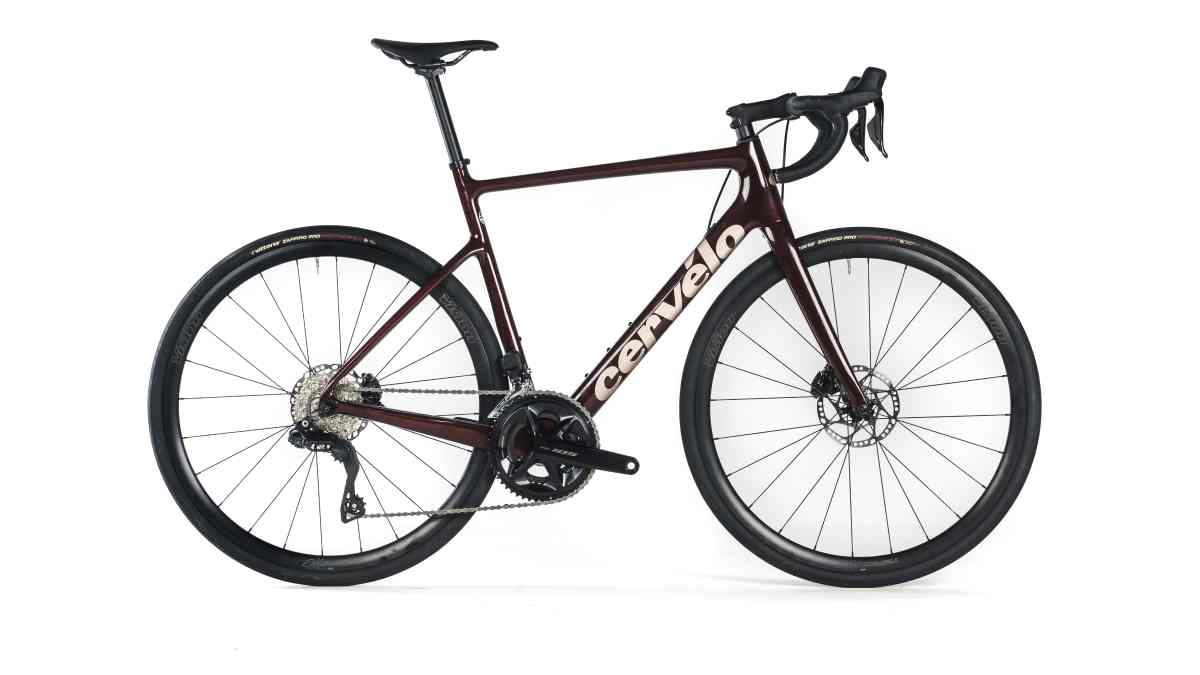
Our test bike with SRAM Force AXS - also the most expensive version in this model range - costs exactly € 1,000 less than the Caledonia-5 with a comparable specification. At first glance, the bike appears to be of a very high quality; with the brand's typical aero shapes, great finish and elegant matt metallic paintwork, it lives up to the brand's premium claim. Compared to the Caledonia-5, however, the bike has to do without some features that cost money to produce: For example, the Caledonia lacks the integrated storage compartment in the down tube, which offers space for a bag with a spare inner tube and tools. Instead of the special comfort seat post with a D-shaped cross-section, a standard round seat post is fitted. The brake lines are also not as elaborately integrated; they run under the stem into the headset cap. Even the eyelets for attaching a top tube bag have been omitted, that the predecessor model still had.

More upright position with identical frame dimensions
Pragmatists may only be bothered by the lack of a storage compartment, as the classic support and the partially integrated cables mean that the effort required for adjustments is limited. Nevertheless, the affordable Caledonia also has clever mounting options for mudguards, which can be permanently installed using special small parts and a bridge for the seat stays. Another difference to the Caledonia-5 is the riding position: While the more expensive version is one of the more sporty representatives of the genre, our test bike is much more comfortable. The frame dimensions of both versions are identical down to the millimetre. However, the other headset cap, which is absolutely necessary for the cable routing, positions the handlebars of the cheaper Caledonia almost two centimetres higher. Apart from the more upright riding position, we feel strongly reminded of the more expensive model when riding, which we tested exactly one year ago.
Functionally hardly worse, but cheaper
The bike follows the track calmly and confidently; the steering is well tuned and the Caledonia runs solidly straight ahead. The low level of comfort on the saddle, which was criticised on the previous model, has only improved slightly; the entry-level model, which is equipped with an aluminium seat post, should ride much more firmly. The frame allows tyres up to 36 millimetres wide, which would make the bike more comfortable. Our test bike comes with 30 millimetre wide Vittoria Corsa N.ext tyres, which run well, but not quite as smoothly as top tyres. Interestingly, there is hardly any difference in weight, the Caledonia-5 with Ultegra groupset weighed almost exactly the same as the current test bike with a comparably heavy Force groupset. The cheaper version is neither better nor worse in the other disciplines, giving the bike the same final score. That sounds like a bargain, but only if you ignore the "soft" criteria that make the Caledonia-5 look even more premium: The carbon handlebars, for example, which are comfortable to grip, the aforementioned storage compartment or the slightly cleaner look in the details. If you can do without these but value the proud lettering of a premium brand, the Caledonia is a reliable companion with no technical weaknesses at a competitive price. The cheapest variant switches with mechanical 105 for 2,999 euros, with electronic shifting from Shimano (105 Di2)* or SRAM (Rival AXS) also costs a fair 3,999 euros.


Jens Klötzer
Editor