


In this article, we use so-called affiliate links. With every purchase through these links, we receive a commission from the merchant. All relevant referral links are marked with . Learn more.
Data and facts about the Cannondale CAAD 14
| Weight | 8.75 kg |
| Drivetrain | SRAM Rival AXS |
| Front brake | SRAM Rival |
| Wheelset | DT-Swiss E 1800 |
| Front tire | Vittoria Rubino Pro Graphene 2.0 28-622 |
Cannondale and aluminium have long been inextricably linked. The US brand, which has been part of the Dutch industry giant Pon (including Cervélo, Focus, Santa Cruz) since 2021, is considered a pioneer of aluminium frame construction: the history of construction with the material dates back to 1983. In the 1990s, the distinctive brand became famous for its high-quality aluminium frames, particularly with mountain bikes, which were welded by hand in the USA and became coveted cult objects. In road racing, Cannondale was still able to make its mark with particularly light and stiff models in the noughties, when the majority of the peloton was already riding on carbon frames. The last professional victory on an aluminium frame was won by Damiano Cunego in 2004 on a stage of the Giro d'Italia on a Cannondale CAAD8. The reputation of the sporty, robust and inexpensive underdog has also been maintained by the later models with an increasingly small but particularly loyal fan base - even when production of the CAAD10 was relocated to Asia in 2010 to save costs.
Back to the roots
With the new CAAD14 Cannondale now wants to pick up at least this small clientele again. Even stoic carbon deniers would no longer claim that aluminium is still a serious technical competitor to carbon. The Cannondale range has long been based predominantly on carbon fibre frames. The CAAD frames - CAAD stands for Cannondale Advanced Aluminium Design - have also become increasingly quiet in recent years. The CAAD13, which was last updated in 2019, took up the silhouette of the SuperSix carbon model, with aero shapes, flowing tube transitions and low-set seat stays. It was also only available with relatively inexpensive equipment, which made the complete bikes comparatively heavy and unattractive.

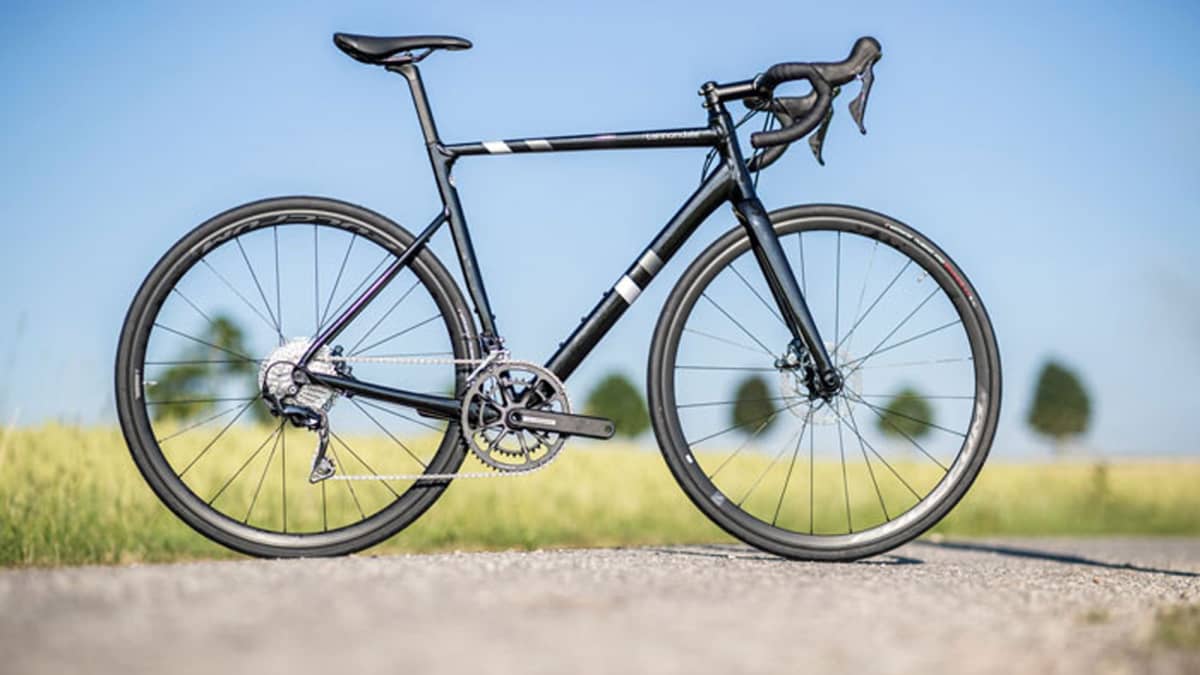
In this respect, the current relaunch seems like a return to old values: with its classic geometry - with a horizontal top tube and seat stays that attach to the saddle nodes - the CAAD14 once again stands out visibly from the carbon monotony. You will also look in vain for modern aerodynamic shapes. The arm-thick down tube signals maximum stiffness with low weight, once the essential virtues of the CAAD models. The workmanship is top-notch: invisible, meticulously polished weld seams at the tube joints are evidence of the high quality standards.
Lighter is hard
In its heyday, a CAAD racer could weigh less than 7.5 kilograms, and the frame weight of the CAAD12 was less than 1,200 grams. Unfortunately, our current test bike can no longer keep up. On the one hand, this has to do with the state of the art: Wider tyres, disc brakes and integrated cables take their toll and make the bike heavier compared to the past. Our mid-range specimen with electronic SRAM Rival AXS also has to make do with heavy add-on parts, which makes it difficult to compare it with earlier, lighter models. Up to one kilogram could be saved on the wheels alone. We can't see any technological leap in the aluminium frame: Cannondale itself states the weight at a good 1,400 grams, which is well above the fabulous value of a CAAD12 Disc. That's still light for an aluminium frame; most of today's competitor bikes are rather cheaply made and significantly heavier.
No miracles
The high total weight of almost nine kilograms is also reflected in the handling. The bike accelerates slowly and feels sluggish when cornering, which we primarily attribute to the heavy wheels. The comparatively elongated riding position and the rather leisurely handling don't really go together. Fitted with a set of lightweight carbon rims for testing, the bike becomes a little livelier, but is still noticeably more sedate than modern carbon racers. The chassis is reassuringly stiff and the bike is exceptionally stable on the road at high speeds, even when the surface becomes uneven. However, the comfort is moderate, with an aluminium seat post and its rather short extension due to the frame shape, there are no miracles to be had. Wider tyres than the 28 mm tyres fitted would be a measure, but would result in even more rotating mass.
Although the bike shifts and brakes excellently and the contact points such as the handlebars and saddle are comfortable, we can't really complain about the equipment. But we have to admit that, apart from the comfortable gears and the much better brakes, the CAAD14 rides almost like a road bike from 15 years ago. While carbon has evolved in many respects - the frames have become significantly lighter, noticeably more comfortable and measurably more aerodynamic - the technical development of aluminium stopped about ten years ago. Even the new edition of a legend cannot change this.
(K)A rational decision
The price difference to comparably equipped carbon bikes is no longer very great, probably due to the low quantities. The simple and easy-to-maintain design and the robust base remain as selling points; experience has shown that even crashes have little effect on aluminium frames. Added to this is the understated feeling of riding something other than the carbon monotony. The top version, the CAAD14 1, promises to be the most fun to ride, with a frame that is said to be 130 grams lighter without coloured paintwork. With a handlebar unit and carbon wheels, it should weigh less than eight kilograms. However, with a SRAM Force 1x13 drivetrain, it is quite specially equipped, 50-tooth chainring and 10-46 cassette require strong calves in the mountains. At just under €7,500, it is also not significantly cheaper than comparably equipped bikes with a carbon frame. The entry-level model with mechanical 105 costs 2,499 euros. If you'd like to go for professional equipment to give the CAAD14 more of a racing feel, you can buy a frame set for 1,799 euros for self-assembly. This is likely to be the most attractive option for many who have lightweight top components in stock, as it would also bring the weight back down to 7.5 kilograms.



Jens Klötzer
Editor