


The question of gravel bikes with or without a motor is polarising. Some see the e-gravel bike as an enrichment, others see it as a betrayal of the idea of sport. It's all a question of perspective. But above all, as is so often the case, it depends on the application.
What an e-gravel bike actually is - and what it isn't
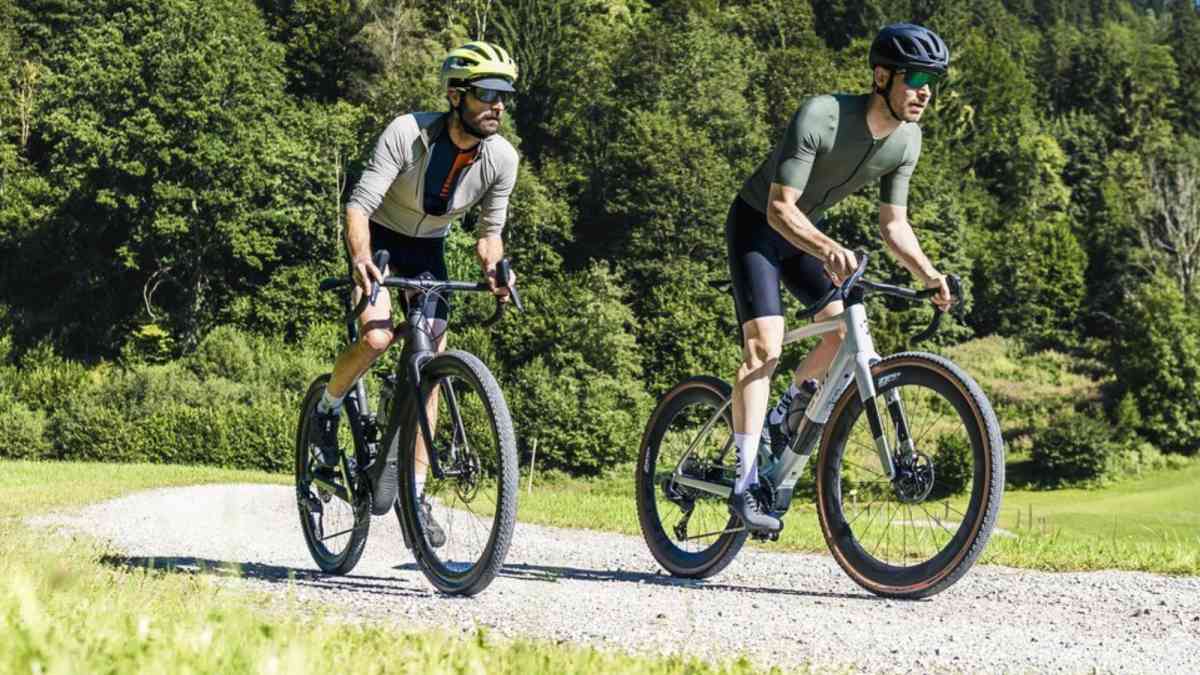
An e-gravel bike should remain as close as possible to a non-motorised gravel bike and hardly differ in terms of handling, appearance and possible terrain. The motor extends the range (prerequisite: e-bike-friendly infrastructure with charging facilities) and offers more options when planning routes. However, you still have to pedal; the assistance level determines how much power your own legs pedal and how much the motor assists. A gravel bike with a motor remains a piece of sports equipment. Despite lighter and more elegantly integrated technology, you can still clearly see the nature of some bikes - and a gravel bike weighing 14 kilos does not ride as naturally as the advertising promises.
The drive and battery are usually fully integrated, so that even experienced cyclists have to look twice to recognise an e-gravel bike as such.
What the engine really delivers
On average, the speed level on gravel bikes is lower than on the road. As the assistance in Germany reaches up to 25 km/h, the motor is more effective on gravel than on a road bike, where you reach the limit of assistance more quickly. The motor can compensate for differences in performance and thus enable people to ride together who would otherwise not have ridden together.

I have experienced it myselfIf our mini bikepacking tour hadn't been on e-bikes, the group would have been completely torn apart within the first few kilometres. The differences in performance were huge. The motor levels out exactly that - uphill. On flat sections, the assistance stops at 25 km/h in Germany. Then the stronger riders have to be considerate.
A motor does not mean that you don't have to exert yourself. If you want to be challenged, switch off the assistance or ride faster. But that's just as common on group rides without a motor.
Also Matthias Borchers from the TOUR editorial team, who rode the Scott Solace Gravel eRIDE for the first time, was surprisedThe silent motor pushes powerfully, but never obtrusively. The transition at 25 km/h is so smooth that you hardly notice it.
For whom is an e-gravel bike useful?
Clear arguments in favour of e-gravel
You want to ride with people who are fitter than you - or, conversely, keep a group together whose performance levels diverge. You want to tackle more metres in altitude or more distance than your current form allows. You are planning bikepacking tours and want to compensate for the weight of your luggage. You've returned to the sport after an accident, illness or a decline in strength as you get older and want to keep up with your cycling mates.
For whom the e-gravel bike is not for
If training is your primary goal - i.e. if you want to pedal watts, build up power, achieve training effects, maybe even race - then the motor is nothing. Especially for races, because you have to be at the start without a motor. The motor helps exactly where it hurts. That's its purpose. But that is also its disadvantage if pain is desired.
What's more, an e-gravel bike weighs between 13 and 19 kilos, depending on the model. You will notice this when carrying it, transporting it in the car or lugging it up to your home. If you regularly have to carry your bike on bikepacking adventures off the beaten track, you should take this into account. And if you like wrenching or want as few workshop appointments as possible: the motor, battery and software updates are more complex than a gravel bike without a motor.
The choice of engine determines the character
Not every e-gravel bike rides the same. The Bosch SX is the right choice for those who want harmonious continuous assistance that also offers plenty of power on the climbs. The other type likes to ride longer flat sections without assistance and treat themselves to an extra boost when their stamina wanes or the going gets steeper. The Bosch battery has a capacity of 400 Wh - enough for long tours, but the system also weighs around 4.5 kilos.
The TQ motor, installed in models from Stevens or Scott, for example, is considered particularly quiet, weighs the least in its class at 1850 grams and delivers up to 300 watts and 50 Nm. The pedals are hardly any further apart than without the motor.
The Mahle X20 is a rear hub motor and therefore the most inconspicuous system: quiet, light, no interference with the bottom bracket. The battery usually only holds 242 Wh - sufficient for short tours and flat terrain, but not enough for long mountain tours.
E-bikepacking and cycle touring: The infrastructure decides
If you go on a multi-day tour with an e-gravel bike, you have to think about the logistics. Without the opportunity to charge the battery, you will quickly become frustrated. As a rough guide: depending on the terrain, luggage and assistance level, most batteries last for 60 to 100 kilometres. In concrete terms, this means: check charging stations along the route, test the range with luggage in advance and the charger is large - it needs space in your pockets. More weight drains the battery more quickly.
The cost of an e-gravel bike
The price range is enormous. Solid models start at around 3,600 euros, while premium models cost 10,000 euros and more.
Conclusion
An e-gravel bike is not a cheat on the sport and not a magic bullet. It is a tool - and like any tool, you should buy it when the intended use is clear. If you want to ride together with others, collect metres in altitude instead of training, or want to get back into gravel life after a break: buy it. If you want to train specifically and pedal every watt yourself: gravel without a motor. And if you're unsure? Take a test ride. This will convince you faster than any purchase advice.
| Pro E-Gravel | Contra E-Gravel |
| Equalise performance differences in the group | Additional weight: An E-Gravel weighs 13 to 19 kg depending on the model |
| More metres in altitude and distance than your own form allows | Carrying passages are much more challenging (in the cellar, in the mountains, over fallen trees) |
| Bikepacking with luggage better compensated | Range depends on infrastructure (charging!) |
| Returning to work after injury or a break | More maintenance work (motor, battery, software) |
| Routes can be planned that would otherwise be too challenging | No training effect where the motor takes over |
| Unobtrusive design, rides almost like a gravel bike without a motor | Higher price: from approx. 3,600 euros, often significantly more |
| Not suitable for racing |


Sandra Schuberth
Editor