Giro d'Italia 2026: Preview stage 6: Explosiveness is the trump card in the changed sprint finale in Naples
Sebastian Lindner
· 13.05.2026

The most important information about stage 6 of the Giro d'Italia 2026
- Thursday, 14 May: Paestum - Naples
- 142 kilometres, 500 vertical metres (flat)
- 1 uphill classification: KM 40.1 (4th category)
- Intermediate sprint KM 92.0
- Red Bull Kilometres: KM 117.2
- Start: 13:50, finish: approx. 17:13
- Live ticker and results
The route of the 6th stage of the Tour of Italy

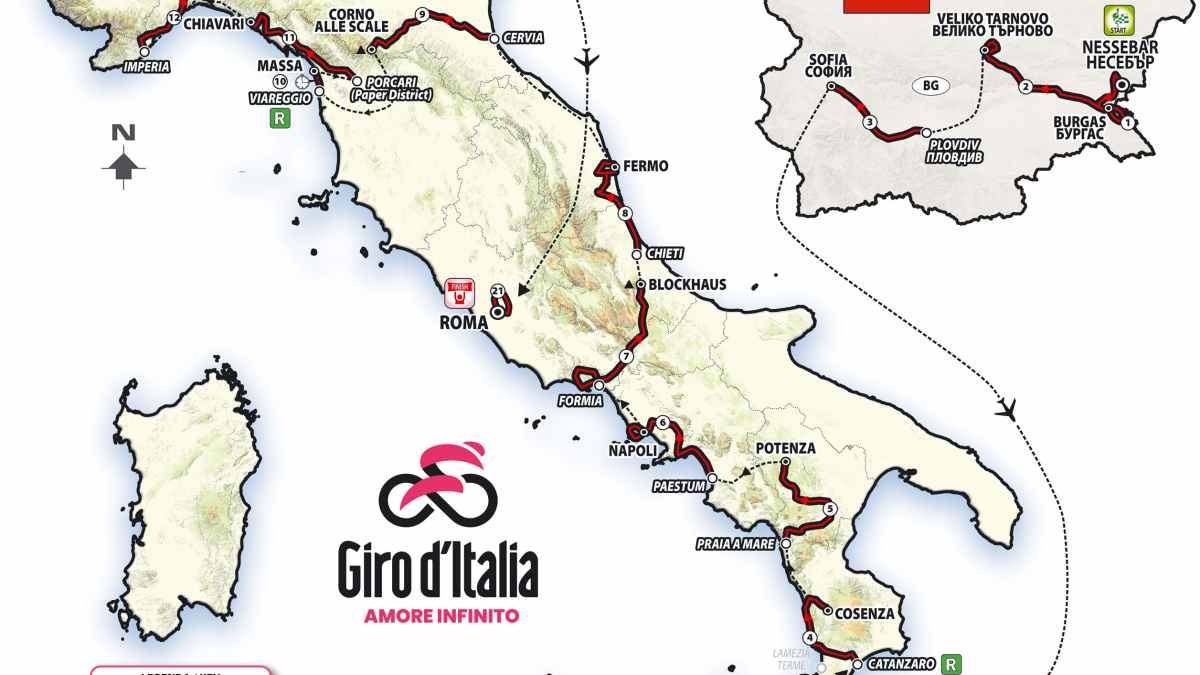
Naples remains - alongside Rome - the most popular stage destination in the Giro in recent years. For the fifth time in a row, the Corsa Rosa stops in the city on Mount Vesuvius. This time it will start from Paestum. The first 30 kilometres again lead directly along the Tyrrhenian coast. This is followed by the only mountain classification of the day, a 4th category.
Once this is crossed, the route continues north-eastwards, but no longer directly along the water, but along the inland side of Mount Vesuvius. With the volcano always in view, the peloton reaches the Neapolitan suburbs after 70 kilometres on what remains flat terrain. The second half of the 141-kilometre stage is therefore almost exclusively in urban areas.
For the finale, the route heads back towards the water. The harbour is reached four kilometres before the finish. But while last year's finish line was right by the water, the race organisers have come up with something special this time. Two sharp bends and cobblestones with a four per cent gradient characterise the last 650 metres. First there is a 90-degree bend to the left, followed 400 metres later by a U-turn in the other direction.

Sporting assessment of the 6th stage of the Giro d'Italia 2026
Mads Pedersen won in 2023, Olav Kooij in 2024 and Kaden Groves last year: Naples has been a paradise for sprinters in the last three years. And there is little doubt that the field will be united for the final 1000 metres this time too.
But what happens next is anyone's guess. A daring manoeuvre to snatch victory from under the noses of the fast men is certainly conceivable. In addition, crashes are a little more likely on the complicated approach than if the stage ended directly in the harbour. After all, the cobbled roads are wide. And: The stage is categorised as a probable mass arrival.
This is why the 5-kilometre rule applies in the event of a crash. Almost more importantly: (non-crash-related) gaps in the peloton are only taken from three seconds. This at least means that the classification riders can stay completely out of the way on the last kilometre and don't have to race at the front in the tight corners.
This means that those interested in winning the stage can remain among themselves. The rider with the highest top speed will probably have the best chances, but the one with the best acceleration. After the first bend, the speed goes way down, then it gets really slow around the U-turn. And then there are only 400 metres left to get back up to speed. Uphill and on cobblestones.