


Back, neck, wrists, buttocks and knees: pain whilst road cycling and gravel biking is common, but it’s not an inevitable fate. This guide explains the reasons behind it and shows you how to ride with fewer aches and pains in the long term by adopting the correct riding position and following a targeted training programme.
The editorial team’s conclusion
Pain experienced whilst road cycling and gravel biking is often the result of a combination of incorrect bike set-up, poor posture, uneven strain and a lack of stability. By checking your handlebars and saddle, improving your riding position and specifically training your core, glutes and shoulder girdle, you can significantly reduce discomfort. It remains important to recognise warning signs and respond to them at an early stage. Persistent numbness, radiating pain, loss of strength or discomfort following a fall, however, should be referred to a doctor. In any case, a professional bike fitting can help to systematically assess your riding position.
The back, shoulders, arms, wrists, neck, buttocks and knees are particularly strained during road cycling and gravel biking. If pain occurs in these areas, it is not necessarily due to weak muscles. It is often a combination of poor ergonomics, incorrect posture, a lack of acclimatisation and excessive strain.
The good news is that many ailments can be significantly reduced by making small adjustments to your bike, adopting a more active riding position and following a targeted training programme. This guide shows you how to recognise common problems and what steps you can take yourself.

The most common areas of pain
| Common symptoms | Common causes | |
| Lower back | Tensile strength, compressive strength, puncture resistance, fatigue | Seating position too stretched out, lack of core stability, rigid pelvis |
| Upper back and shoulders | Tension, a burning sensation, tiredness | Too much weight on the hands, hunched shoulders, incorrect handlebar height |
| Neck | Stiffness, tension-type headache, restricted mobility | Head tilted back, tense shoulders, sitting too far back or too low |
| Arms and elbows | Fatigue, a pulling sensation, pain on the outside | Elbows pushed out, too much weight on the handlebars, a tense grip |
| Wrists and hands | Pain on pressure, tingling, numb fingers | Too much strain on the hands, ergonomically unsuitable handlebars, handlebar tape that’s too thin |
| Buttocks and sit bones | Pain on pressure, tenderness, numbness | An ill-fitting saddle, incorrect saddle height, long periods spent sitting |
| Knee | Pain at the front, inside or outside | Incorrect saddle height, unsuitable gear ratio, excessive load, incorrect cleat position |
Back pain
Typical symptoms
- A dull, aching sensation in the lower back
- A sharp pain when standing up
- Fatigue after long climbs
- Tension between the shoulder blades
- Pain that gradually subsides after dismounting
- Aches and pains that occur particularly after long rides or on uneven gravel routes
In the case of back pain, a distinction must be made between muscular fatigue and more serious conditions. Regular exercise, stretching and mobilisation are considered important measures for preventing non-specific back pain. However, if symptoms are severe or unusual, the cause should be investigated by a doctor.
Common causes
A seating position that is too stretched out
A reach that is too long, a long stem or a saddle that is positioned too far back can stretch the upper body too much. The result is that the back has to remain static, whilst the arms and shoulders take on the additional task of providing support.
Lack of fuselage stability
When road cycling or gravel biking, your upper body should not hang passively over the bike. The core muscles stabilise the pelvis and transfer power between the legs and the upper body. If they are too weak or tire quickly, the lower back often takes over.
Stiff pelvis
Many cyclists tilt their pelvis backwards and sit on the bike with a rounded back. This can put a great deal of strain on the lumbar spine. A neutral, slightly forward-tilted pelvic position allows for a more active posture.
Prolonged, repetitive strain
Even a well-adjusted bike can cause discomfort if the intensity is increased too quickly. Particularly long rides, significant elevation gain or gravel rides lasting several hours can put excessive strain on your back if your muscles are not yet used to sustained exertion.
What helps?
- Check the reach and stem length
- Adjust the saddle position to suit your stride length; adjust the handlebar height
- On long climbs, change your riding position regularly; stand up on the pedals from time to time
- Actively stabilise the pelvis, rather than letting your lower back sag
- Choose a suitable gear ratio for a consistent cadence
- Strengthen your core and glutes twice a week with targeted exercises
- Don’t inflate your tyres unnecessarily hard on gravel routes
- On long journeys, change your hand position on the handlebars regularly
Shoulder and neck pain
Typical symptoms
- A burning sensation between the shoulder blades
- Raised or tense shoulders
- Tension-type headache
- A stiff neck after long journeys
- Pain when looking over my shoulder
- Numbness or tingling in the arm
Common causes
The shoulders are constantly tense
Many cyclists unconsciously hunch their shoulders and grip the handlebars too tightly. This combination prevents the arms and upper body from responding smoothly to the bike’s movements. This effect is often exacerbated on uneven gravel tracks. If you try to absorb every bump with tense arms, you’ll tire more quickly.
The head is raised too high
Anyone who wants to look far ahead whilst driving, on downhill stretches or on gravel tracks often stretches their cervical spine. If the windscreen is set too low or the seating position is too stretched out, this posture can become problematic over a prolonged period.
Too much weight on the handlebars
If your body weight is shifted too far forwards, your shoulder girdle and arms have to work constantly to stabilise you. This often happens when your reach is too long, your stem is too long or your cockpit is too low.
What helps?
- Adjust the handlebar height using spacers; adjust the stem length
- Make a conscious effort to keep your shoulders low and relaxed
- Keep your gaze directed forwards whilst maintaining an active upper-body posture, without overextending your neck
- On long journeys, stretch your hands and shoulders regularly
- Switching between top links, hoods and lower links
- When riding a gravel bike, use handlebar tape that provides sufficient cushioning
Pain in the arms and elbows
Typical symptoms
- Tired or burning forearms
- Pain on the outside of the elbow
- Sore forearms after long descents
- The feeling of having to hold on to the handlebars
- Fatigue after long stretches on coarse gravel
Common causes
Elbows pushed through
On a road bike or gravel bike, your elbows should be slightly bent. If your arms are fully extended, they form a rigid connection between your upper body and the handlebars. This means that movements and vibrations are absorbed less effectively by your arms.
Too tight a grip
Although a firm grip may provide a sense of security in the short term, it tires the forearms and hands. Particularly on fast descents and uneven gravel sections, you should hold the handlebars in a controlled manner, but without tensing up.
Incorrect hand position
If you ride in the same position for a very long time, you put one-sided strain on certain muscles and joints. Top-tabs, hoods and bottom-tabs offer different ways of relieving the strain on your hands and arms.
Basic driving principle
- Bend your elbows slightly
- Keep your shoulders down
- Don’t clench your hands
- Hold the handlebars firmly but loosely
- Absorbing bumps with your arms and legs
- Look a few metres ahead
- Adjust your speed to suit visibility, road surface and your driving ability
- Change your hand position regularly
Your arms should not be completely relaxed whilst doing this. They should be working actively, but with a springy action. The difference lies in whether they allow movement or rigidly support your entire body weight on the handlebars.
Wrist pain and numb hands
Typical symptoms
- Pain when pressure is applied to the palm of the hand
- Numb fingers
- A tingling sensation during or after the journey
- Pain in the wrists
- Strain on the thumb or little finger side
Common causes
Incorrect positioning of the hoods
If the hoods are angled too far downwards or upwards, this results in an ergonomically unfavourable hand position.
Too much pressure on the hands
A reach that is too long, a long stem or handlebars that are too low shift your weight forwards. When your arms are fully extended, this puts a lot of constant pressure on your hands.
Inappropriate handlebar width and shape
Very wide gravel or road bike handlebars can cause some riders to adopt an unnatural position for their arms and wrists. The right width and shape depend, amongst other things, on shoulder width, height, arm length, riding style and bike type. If you experience pain in your wrists, check whether the handlebar geometry matches your body geometry.
Hard contact points
Handlebar tape that is too tight, unsuitable gloves or tyre pressure that is too high can put additional strain on your hands. On gravel routes, vibrations are transmitted directly from the handlebars to your hands and forearms.
What helps?
- Check the position of the bonnet or the angle of the handlebars
- Change your hand position regularly
- Deliberately reduce grip pressure on straights
- Shake your hands regularly on long journeys
- Check the cockpit height and reach
- Choose handlebar tape and gloves that provide sufficient cushioning
- On gravel routes, adjust tyre pressure to suit the surface, tyre width and body weight
- If you experience persistent tingling or numbness, stop what you are doing and seek medical advice
Pain in the buttocks and sit bones
Typical symptoms
- Pain on pressure on the sit bones
- Numbness in the buttocks
- Chafing or skin irritation
- Ailments following long, steady journeys
- Pain when getting back up
Common causes
The saddle doesn't fit
A saddle should support the sit bones without putting unnecessary strain on the soft tissues. Too soft does not automatically mean more comfortable. A very soft saddle can cause the pelvis to sink, making the contact area unstable. Key factors include saddle width, shape, padding and individual anatomy. A saddle that works on a road bike will not necessarily fit just as well on a gravel bike.
Incorrect saddle height
A saddle that is too high can cause the pelvis to tilt sideways with every pedal stroke. A saddle that is too low, on the other hand, often increases pressure on the buttocks and knees and impairs power transfer.
Incorrect saddle angle
A saddle that is tilted too far downwards can cause the body to slide forwards. This increases the pressure on the hands and arms. A saddle that is tilted too far upwards can increase the pressure on the front of the seat.
What helps?
- Measure your sit bones and choose a suitable saddle
- Optimising saddle height with regard to leg movement and pelvic stability
- Adjust the saddle angle in small increments only
- Don’t automatically choose a softer saddle
- Try out cycling shorts with different seat pads
- Change your sitting position regularly on long journeys
- On long climbs, stand out of the saddle from time to time
- If you experience numbness, don’t just carry on driving
Knee pain when road cycling and gravel biking
Typical symptoms
- Pain at the front of the knee
- Symptoms on the inside or outside
- A pulling sensation behind the kneecap
- Pain when setting off or on long climbs
- Symptoms that persist after the journey
Common causes
Incorrect saddle height
A saddle that is too low can increase the angle of flexion in the knee and put greater strain on the front of the knee. A saddle that is too high can lead to hyperextension and increase the likelihood of discomfort when squatting.
The translation is too heavy-handed
If you frequently cycle in gears that are too heavy, you put strain on your knees, particularly on climbs and when pedalling hard. A lighter gear ratio and a more consistent cadence can help reduce this strain.
Incorrect cleat position
When cycling with clipless pedals, an unfavourable position of the cleats can affect the leg axis and foot position.
Increasing the workload too quickly
More kilometres, more elevation gain and more intense intervals should be incorporated into the training plan gradually. The knee is particularly sensitive to a sudden increase in intensity, especially after long breaks.
What helps?
- Check the saddle height and saddle setback
- Drive with a lower gear ratio
- Do not set your cadence too low for prolonged periods
- Check your cleat position and foot position
- Gradually increase the amount of training
- If you experience recurring knee pain, consider having a bike fitting and a medical examination
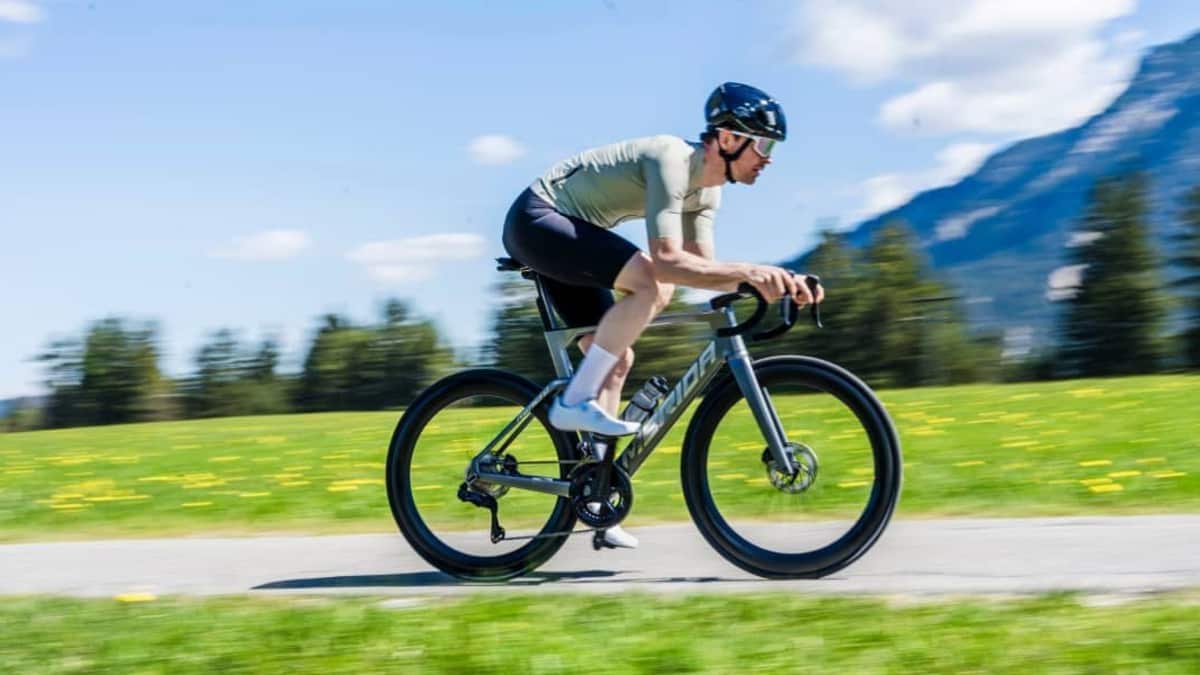
The correct riding position on a road bike and gravel bike
A good riding position is not a fixed posture. It changes depending on the surface, speed, gradient and distance travelled. Cycling not only helps to prevent pain; it also improves control, comfort and efficiency.
On the plain
- Keep your pelvis in a neutral position
- Stretching the back
- Bend your elbows slightly
- Keep your shoulders down
- Hands loosely on the handlebars
- Change your hand position regularly
- Look several metres ahead
- Step evenly
On the uphill
- Lean your upper body slightly forwards
- Keep your pelvis stable
- Don’t lean over the handlebars with a rounded back
- Keep your cadence as steady as possible
- If necessary, stand up briefly from the saddle
- Loosen up your shoulders and hands regularly
On the descent
- Don’t tense your upper body unnecessarily
- Use your arms and legs as active suspension
- Bend your elbows and knees slightly
- Keep your hands firmly but loosely on the handlebars
The combination of tyres, tyre pressure, handlebar tape and saddle should be suited to the intended use. On gravel tracks, tyre pressure that is too high can put unnecessary strain on your hands and back. Conversely, pressure that is too low can compromise riding stability and increase the risk of punctures.
Six exercises to ease discomfort
The following exercises do not require a gym. They are designed to strengthen and improve the flexibility of the key areas that provide stability and absorb impact during road cycling and gravel biking.
1. Dead Bug for core stability
The dead bug exercise works the core muscles. As you do the exercise on the floor, you don’t need any special equipment, apart from, ideally, a fitness mat.
Description:
- Lie on your back.
- Keep your hips and knees at a 90-degree angle.
- Stretch your arms straight up.
- Slowly lower one arm and the opposite leg.
- Return to the starting position and change sides.
Scope: 2 to 3 sets of 6 to 10 repetitions per side.
Important: Keep your lower back as still as possible on the floor. Do not arch your back.
2. Side plank for the lateral core muscles
The side plank is a bodyweight exercise designed to strengthen the oblique abdominal muscles as well as the deep core and pelvic stabilisers.
Description:
- Rest your weight on the side of your forearm.
- Stretch your legs out, or start by resting your knees on the floor.
- Lift your pelvis.
- The shoulders, hips and knees – or feet – form a straight line.
- Maintain a controlled position.
Scope: 2 to 3 rounds of 20 to 40 seconds per side.
3. Glute bridge for the glutes and posterior chain
This floor exercise is one of the most effective ways of engaging the gluteus maximus.
Description:
- Lie on your back.
- Stand with your feet hip-width apart.
- Slowly lift your pelvis upwards.
- Tighten your buttocks at the top.
- Lower it vertebra by vertebra.
Scope: 2 to 3 sets of 10 to 15 repetitions.
Do not lift from your back. The movement should come mainly from your hips and buttocks.
4. Shoulder blade push-up
The shoulder blade push-up trains active control of the shoulder girdle and strengthens the muscles around the shoulder blades. This helps to maintain a relaxed and stable posture on road or gravel bike handlebars.
Description:
- Get down on all fours or into a high push-up position.
- Keep your arms almost fully extended.
- Control the movement of your shoulder blades as you bring them together and pull them apart.
- The upper body remains stable.
Scope: 2 sets of 8 to 12 repetitions.
5. Thoracic spine rotation
This exercise works the upper back. The lower back should remain as stable as possible whilst doing it.
Description:
- Get down on all fours.
- Place one hand behind your head.
- Bring your elbow towards the opposite knee.
- Then turn your upper body to the side.
- Let your gaze follow the movement.
Scope: 8 to 10 repetitions per side.
6. Wrist and forearm mobilisation
Description:
- Stretch one arm out in front of you.
- Turn your palm upwards.
- With your other hand, gently pull your fingers downwards.
- Then turn your palm downwards and gently move your fingers backwards.
- Do not stretch with sudden movements.
Scope: 20 to 30 seconds per position and side.
A simple training plan for road cyclists and gravel cyclists
For most amateur cyclists, the following structure is sufficient to start with:
Two strength training sessions a week
- Dead Bug
- Side support
- Glute Bridge
- Shoulder Blade Push-ups
- Squats or lunges
Two to three sets per exercise. The final repetitions may be challenging, but should remain technically sound.
Before every journey: spend ten minutes
- 10 shoulder circles in each direction
- 10 controlled trunk rotations
- 10 glute bridges
- 20 seconds of side plank on each side
- 5 deep breaths, keeping your shoulders consciously relaxed
- A quick check of the brake levers, saddle, handlebars and tyre pressure
Whilst driving
- Relax your hands every 30 minutes or as and when required
- Change your hand position regularly
- On long climbs, stand out of the saddle from time to time
- Actively lower your shoulders
- Don’t grip the handlebars and brake levers too tightly
- Keep your cadence as steady as possible
- If you start to feel pain, don’t simply increase the intensity
- On gravel routes, adjust your speed and tyre pressure to suit the surface
When you should see a doctor
Not every complaint is a sign of a serious injury. However, there are certain symptoms you should not ignore:
- Pain following a fall
- Persistent numbness or tingling
- Loss of strength in an arm or leg
- Pain that radiates into the arm or leg
- Pain at night or pain that is steadily getting worse
- Significant restriction of movement
- Swelling or instability of a joint
Ultimately, the following applies
Pain experienced whilst road cycling and gravel biking is often not caused by a single mistake. The key factor is the interplay between the bike, riding position and how you manage the physical strain.
The most important first steps are:
- Check the handlebars, saddle and, if applicable, the cleats.
- Keep your hands, shoulders and elbows relaxed whilst driving.
- Actively direct your gaze, rather than overextending your neck.
- Strengthen your core and glutes regularly.
- Change your hand and seating positions regularly on long journeys.
- Select the appropriate gear ratio, pedalling cadence and tyre pressure for the terrain.
- Gradually increase the intensity and duration of your runs.
- Take numbness, tingling and radiating pain seriously.
By focusing not only on your body but also on your bike, your riding position and how you manage the physical strain, you can reduce many common aches and pains whilst gaining greater comfort, control and endurance on both road and gravel surfaces.

Josh Welz
Editor-in-Chief