


The outdoor effect: Why the cold burns calories
Anyone who trains outdoors for hours on end in late autumn and winter will be familiar with this phenomenon: even at a moderate base pace (Zone 2), your stomach makes itself felt more quickly and more strongly than it does at the same wattage levels in summer. The reason lies in human thermoregulation – and in the fact that the cold boosts calorie expenditure on several levels simultaneously.
Shivering and non-shivering thermogenesis
As soon as the body has to expend energy to keep the hands, feet and torso warm, the autonomic nervous system switches to thermogenesis. Even unconscious micro-contractions of the muscles – even before any visible shivering begins – significantly increase the basal metabolic rate.
Increased carbohydrate requirements in cold conditions
In cold environments, absolute carbohydrate oxidation increases measurably – particularly at moderate to higher intensities. This is due to the increased sympathetic tone (adrenaline release) caused by exposure to the cold, which stimulates glycogen metabolism. Important: This does not mean that fat burning decreases – fat oxidation also remains the same or increases. However, someone cycling at 2 °C at 200 watts will burn significantly more carbohydrates overall than when cycling at 20 °C at the same power output.

Mechanical overtime
The extra mechanical effort also contributes to calorie expenditure. Thick winter clothing, the increased rolling resistance of colder tyres and the higher air density in winter all mean that, on balance, more effort is required to maintain the same speed.
Practical implications for outdoor training
Even during basic endurance training, carbohydrate intake should not be neglected in winter. An hourly intake of 40 to 60 grams of carbohydrates – combined with warm drinks in a thermos flask to ease the strain on the gastrointestinal tract – helps prevent a drop in performance.
The indoor paradox: Appearances can be deceiving
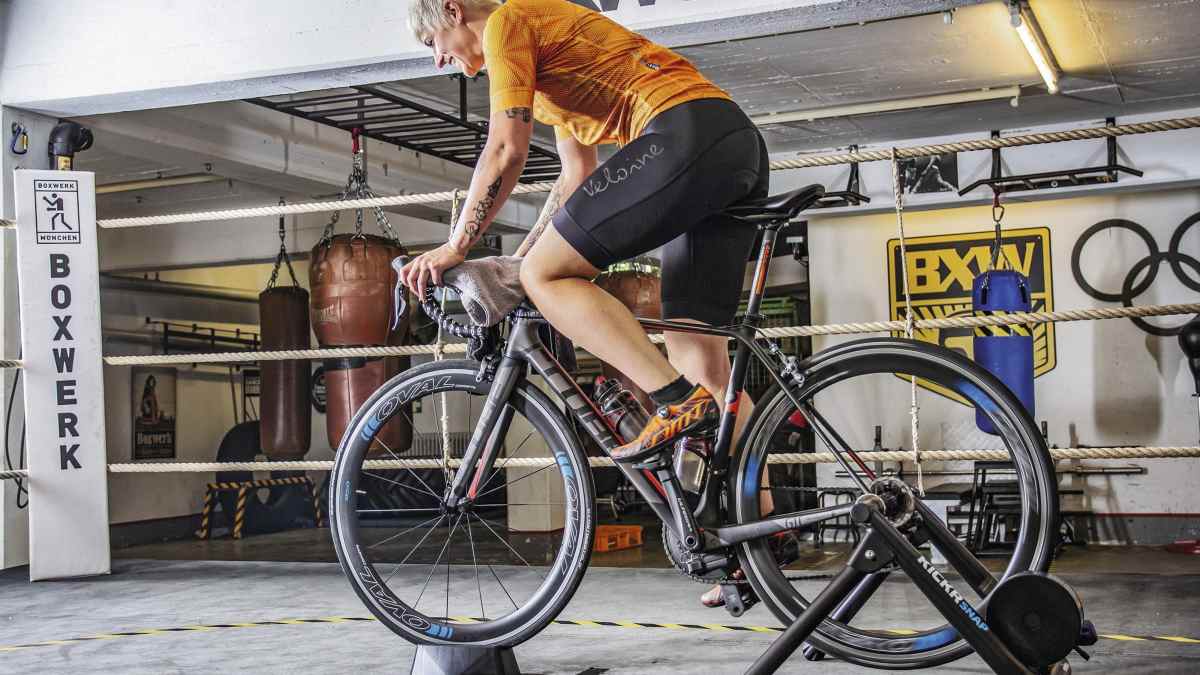
On the roller, the problem is exactly the opposite. Many athletes massively overestimate their calorie expenditure on indoor trainers – and confuse physiological stress with pure energy expenditure.
Shorter training sessions, high perceived exertion
In terms of sustained mechanical exertion, one hour of indoor training is roughly equivalent to 75 to 90 minutes of outdoor cycling (approximate value), as there are no stops at traffic lights, descents or periods of coasting in the slipstream. Nevertheless, the actual duration of the training session is usually shorter. A 60-minute workout rarely burns more than 600 to 800 kcal, despite a high heart rate – depending on the actual wattage output.
The heat build-up effect
As there is no natural airflow, core body temperature rises rapidly on the trainer. The heart rate climbs due to what is known as ‘cardiovascular drift’ – that is, the continuous rise in heart rate at a constant power output, triggered by dehydration and rising core temperature. Athletes experience an extreme perception of exertion, which is primarily attributable to the body’s cooling mechanisms (sweating, vasodilation). Whilst this cooling process also requires energy, it usually does not live up to the subjective expectation of being a ‘mega calorie-burner’.
Fluids before calories
On the treadmill, the primary limiting factor is usually not glycogen, but the risk of dehydration and electrolyte loss. Consuming too many high-calorie gels during short, intense indoor sessions often leads to stomach problems – because at high training intensity and with an increased core temperature, gastric emptying slows down measurably.
Consistency in practice (indoor)
For sessions lasting less than 75 minutes, targeted fluid and electrolyte intake is usually sufficient. It is only during high-intensity interval training or long indoor sessions (> 90 mins) that targeted carbohydrate intake (30–60 g/h) is advisable – preferably in liquid form.
A comparison of energy consumption
The chart compares calorie expenditure and carbohydrate requirements for indoor and outdoor training.
- Z1 compensation: Very low intensity for active recovery
- Z2 Core module: Traditional endurance training (fat metabolism & moderate carbohydrate utilisation)
- Z3 Development Area: Brisk pace/intervals with increased glycogen requirements
- Z4 Threshold Zone (FTP): Maximum sustained power output at the anaerobic threshold (almost 100 per cent carbohydrate utilisation)
- CHO: Carbohydrates (in grams per hour)
- kcal/h: Total calorie expenditure per hour

Conclusion: A periodised nutrition strategy
The formula ‘1 hour of cycling = 1 gel + 1 bar’ has long been outdated. A modern nutritional strategy in cycling takes into account both the physical environment and the physiological objectives.
Power metres as a benchmark – but not as the sole criterion
The power meter measures mechanical work in kilojoules. Bear in mind, however, that the cold can increase this basal calorie expenditure by a further 10–20 per cent.
Periodised carbohydrate intake
Short, intense indoor interval sessions require, above all, hydration and electrolytes; long, cold outdoor endurance rides require a steady supply of easily digestible carbohydrates – despite moderate wattage levels.
Don’t neglect your gastrointestinal training
Anyone who neglects their nutrition whilst training outdoors in the cold during winter will lose the ability to absorb nutrients whilst under stress. This is a disadvantage that will come back to haunt them by the time the first spring classic rolls around, at the very latest.


Josh Welz
Editor-in-Chief