


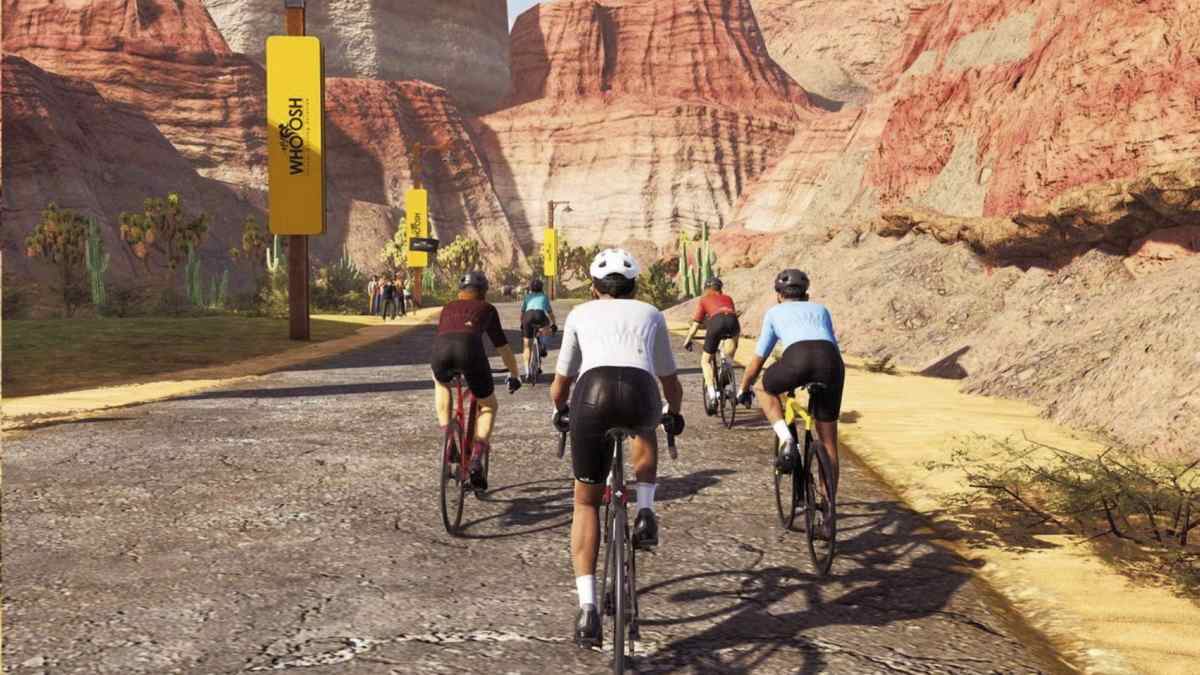
One million dollars being paid out - that sounds more like the lottery than sport. But that's exactly how much money was in the pot at the MyWhoosh Championships 2025. At the second edition of the MyWhoosh Championships e-sports event, an athlete from New Zealand won 12,000 US dollars for first place, which increased with additional prizes won. In comparison: Tadej Pogačar only received 8,000 euros for his world championship title in the road race. The fourth-placed rider in the women's Esports race exemplifies the dream of earning money on a road bike on the side: Mary Kate McCarthy works as a full-time police officer in Hamilton, New Zealand, and only rides indoor cycling races in her spare time. She specialises in races with prize money and takes part in competitions all year round. Her victory at the UCI Cycling Esports World Championships a few months later earned her 15,000 US dollars, in addition to 13,000 US dollars from Zwift races and 148,000 US dollars from MyWhoosh. This brought her earnings from prize money for the year 2025 to 176,000 US dollars, or around 153,000 euros. An impressive sum when you consider that the minimum salary in the Women's World Tour is 31,768 euros in the first year. No wonder McCarthy explains in interviews that she no longer dreams of a career in professional cycling: "E-cycling allows me to compete at the highest level while being at home with my family - and very few sports offer that balance. I consider myself incredibly lucky to be able to race at such a high level in a way that suits my life," she told Escape Collective. The cycling website calculated that the New Zealand policewoman earned an hourly wage of 3,000 US dollars if you offset the races she rode against the prize money.
Prize money MyWhoosh Championships
That sounds tempting, but the global comparison of performance is tough - extreme performances are delivered in the highest category. This becomes clear at the MyWhoosh Championships 2025, where Michael Vink, former rider for UAE Team Emirates, came out on top. The fact that a former World Tour pro won gives an idea of how difficult it is for real amateurs. The German Jason Osborne came out on top at the UCI Cycling Esports World Championships in 2025. This is his third e-cycling world title and Osborne has been winning e-cycling races for years as a proven specialist. He owes a regular income to the platform - he earns 2,170 US dollars just for winning the weekly Sunday Race Club race. 400 watts average power, 5.7 W/kg and an average heart rate of 161 show that Osborne delivers brutal performance in indoor cycling. Other prize money hunters also enjoy the Sunday Race Club - here you can regularly collect race experience and prize money in various performance categories. German triathlete Eleisa Haag describes her motivation for taking part in the race: "Especially in winter, it's a great way for me with a full-time job to train for competition - and all from the comfort of my own home, with no extra travelling time. The prize money on offer, which depends on the category, is of course an incentive that provides extra motivation." Haag starts in the second-highest category and benefits from the fact that not only the winner receives a prize, but also other places are honoured. A clever move by MyWhoosh is to organise the races in six different performance categories. The model is based on the performance system in Australian amateur cycling, which offers races in different age and performance categories. An initial categorisation into a group is based on a power passport test with video recording. Even a beginner can work their way up in their class and receive a bonus for 10th place. "No matter what level you are at, you can take part," says Smithson. "We hear a lot of stories where people have said: I bought a new car as a result of the race, I went on holiday with my family."

Lots of prize money from the Gulf States
MyWhoosh is a private company, but is closely linked to the ruling family: Matar Suhail Ali Al Yabhouni Al Dhaheri, board member of the Abu Dhabi Sports Council, sits on the board of MyWhoosh. Within the UAE, MyWhoosh is integrated into government-run sports programmes and sponsorship funds come from the IHC Group, a subsidiary of the Royal Group. The Abu Dhabi Sports Council (ADSC) has stated that "Abu Dhabi's position as a global centre for cycling championships" is to be strengthened. On the road, the Abu Dhabi Gran Fondo has set new standards in terms of prize money. Around 470,000 euros were awarded in the 2025 road race. Not only the overall winners received a cheque, but also many of the winners in the age categories. With around 1,000 starters, it sounds better statistically than the global showdown in e-cycling. But there should be no illusions. There are strong teams competing for victory, which are specifically lined up for the race - e.g. Team Dubai Police, Shabab Al Ahli Dubai or the Al Wathba Team. The prize money is the same for men and women and goes up to 10th place in the age group. Around €4,700 was awarded for winning the age group in 2024. The exact information is difficult to find and the rules on the exclusion of professionals do not appear to have been implemented consistently when looking at the results list. In any case, Lothar Färber was the winner of the Abu Dhabi Gran Fondo: he was the only person to compete in the 75+ age group. The 77-year-old was therefore able to budget his prize money - as long as he made it to the finish line without crashing. Because with such big prize money, the ambitions of the participants are also big - many crashes are part of the race.
High premiums in the USA
The USA seems to be another paradise for prize money hunters - there are several races and racing series on the road and off-road where the safe is well filled. Last year, a total of 156,000 US dollars (approx. 136,000 euros) was paid out at the Levi's Granfondo. There is also a lot of money in gravel racing, where the boundaries between professional and amateur are not as clearly defined as in road cycling. Private race organisers decide on application who is allowed to start in the "Pro" category and many gravel bikers see themselves as professionals as soon as they have sponsors. Financially, the gravel racing scene is definitely professional. The Gravel Worlds race in Lincoln, Nebraska, is setting new standards for 2026: with prize money of 150,000 US dollars (approx. 125,000 euros), which is split equally between men and women, it is establishing itself as the event with the highest prize money in the gravel sector for a one-day race. Sponsor Goodlife Nutrition, a Lincoln-based company, makes this sum possible. The prize money will be distributed to the top ten male and female riders. The men's and women's winners will each receive 25,000 US dollars. Second place receives 17,000 US dollars and third place 10,000 US dollars - with an additional 500 euros for 10th place. The event should not be confused with the UCI Gravel World Championships, which are organised by the International Cycling Union.
Prize money in gravel cycling
The high prize money in gravel cycling is attractive for road cyclists. Former professionals from the World Tour and even current professional cyclists can often be found on the podium. The new gravel stage race Gravel Burn 2025, for example, attracted a total prize fund of 150,000 euros. The women's race was won by Axelle Dubau-Prevot from France, who now competes in the Women's World Tour with the EF Education-Oatly team. There are also events with higher prize money. The Life Time Grand Prix is a race series (including Unbound Gravel) that pays out 350,000 US dollars (approx. 300,000 euros). By comparison, the Tour de Suisse stage race only paid out around 131,000 euros.
Contrast with cycling criteria in Germany
In Germany, cycling criteria are the basis of organised amateur cycling. In nostalgic anecdotes, amateur cyclists talk about the golden age when large starting fields also provided attractive prizes. Those with talent saw the prizes as motivation to travel long distances. The bonus sprints were particularly popular with local criteria, as you could try your luck again and again during the race. Nowadays, many cycling clubs are happy if they can cover the organisational costs - there is not much leeway when it comes to prize money. 30 euros for the classification sprint in the criterium is a realistic incentive. There is also less in the pot due to the reduced number of participants. The competition regulations of German Cycling stipulate that at least 30 per cent of the income from entry fees must be distributed as prize money. With the small starting fields and low entry fees, there is inevitably little left over. The situation is completely different in the USA: In the USA Crits race series, the men's and women's winners each receive 100,000 US dollars per victory. There is also prize money for placings and teams. The series consists of eight races on short circuits in the city centre and therefore attracts thousands of spectators. All riders must have a valid licence from USA Cycling (USAC) or the UCI and the highest level of the series consists of permanently registered "D1 teams" that compete in the entire series. Registration as a D1 team costs around €3,000 for six riders. Seven men's and four women's teams took part in 2025. However, the crits in the USA have nothing to do with amateur sport - even in terms of performance. This is perfectly illustrated by the German World Tour rider Maurice Ballerstedt, who took a professional break in 2025 and rode crits in the USA. He rarely finished on the podium, although he has been racing for Alpecin-Premier Tech against the best professional cyclists in the world since 2022.
Prize money as an investment
Why do organisers or governments spend so much on prize money? Over 650 riders from 47 countries took part in the seven stages of the MyWhoosh Championships 2025 in Abu Dhabi, which were spread over eight days. Assuming that many of the athletes travelled with a companion, the event could generate an estimated two million euros in revenue for local tourism. If you look at it from this perspective, the event and the prize money are an investment.
Abu Dhabi also organises a marathon, a World Triathlon Championship Series event, the Spartan World Championship and the Abu Dhabi Sail Grand Prix. The investments in Abu Dhabi certainly also have a political dimension. Like Saudi Arabia, the country uses professional and amateur cycling to gain political influence and improve the country's image. However, there are also purely economic reasons for high prize money: it increases the relevance of the event, boosts media coverage and therefore visibility for sponsors.
Prize money as a marketing driver can also be seen in the example of MyWhoosh: "We were faced with the question: How can we draw attention to ourselves from a marketing perspective? And so we decided that e-sports should be our entry point. In the early years of our company, we didn't actually do any marketing at all. It was our marketing tool. That's how the news spread: "Oh, there's this new platform that offers paid races", and that's how we started to grow." Reaching a global customer group with advertising is expensive - all the better if a large prize money gets the message across all by itself.
Equal prize money for women
MyWhoosh 2025 has awarded more than six million dollars in prize money - half of it to women, who are still a minority in cycling. The platform could therefore also be described as a small support programme for women's cycling. The best example of this is the women's cycling team "Champ Bullies Philippines", which is led by multiple Philippine champion Jermyn Parado. The team competes every week in the Sunday Race Club (SRC), usually in categories 2 to 4, and competes both individually and collectively for the highest possible prize money. All prize money earned on MyWhoosh is collected and invested back into the team to fund travel, accommodation, entry fees and equipment. This has enabled the team to compete throughout Asia and pave the way for professional cycling. Riders from the team have already won national championship titles. In a sport where financial barriers - especially in women's cycling - are high, Champ Bullies has created a self-sustaining model that is entirely funded by indoor cycling races. In a nutshell, the riders of Champ Bullies Philippines have used the MyWhoosh platform as a sponsor and the amount of sponsorship depends on their performance.
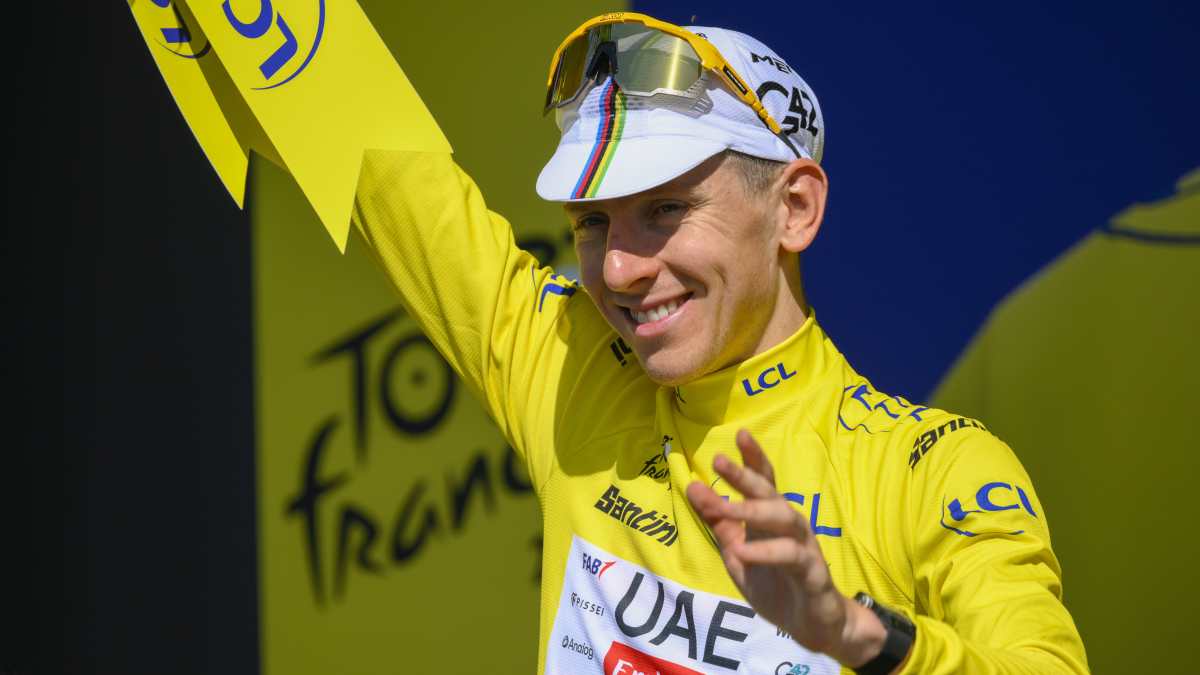
However, Tadej Pogačar shows that prize money is not everything. He only received 8,000 euros for his World Championship victory - but his annual income is estimated at around 12 million euros. The World Cup prize money is nothing more than pocket money for him.
Transparency notice: An earlier version stated that "MyWhoosh is significantly supported and financed by the government of Abu Dhabi". At MyWhoosh's request, we have amended this wording. The support is undisputed - there are numerous connections of an organisational and personal nature. Matar Suhail Ali Al Yabhouni Al Dhaheri sits on the board of MyWhoosh. Board member of the Abu Dhabi Sports Council and Chairman of the Abu Dhabi Cycling Club. Within the UAE, MyWhoosh is firmly integrated into government-led sports programmes. The financial support is also clear - but the government does not own any shares in MyWhoosh. On the other hand, MyWhoosh receives sponsorship money from the IHC Group (International Holding Company), e.g. to finance the premiums for the Sunday Race Club. The IHC Group is a subsidiary of the Royal Group, a conglomerate chaired by Sheikh Tahnoon bin Zayed Al Nahyan, the UAE's National Security Advisor and brother of the President.


Kristian Bauer
Editor