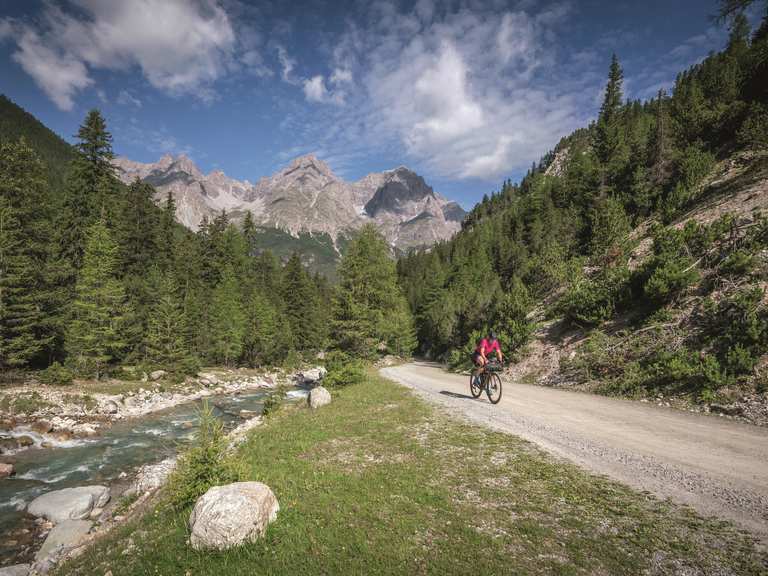
My kick feels kind of doughy. What's going on? I look down. Crap! A flat tyre has slowly crept up on me - at the wrong time. Well, there's never a good time for a flat tyre, but here, on this remote, gravelled descent south of Madonna di Campiglio, the puncture is particularly annoying. I'm already rumbling on the rim and feeling every little stone. I can't continue like this. So I get off the bike to pump up the tyre, but the air pump doesn't work. 'If you don't test everything at home first,' I think.
Fortunately, there are also a few other cyclists out and about on this warm, sunny May day. And so I ask the first two people I come across. I don't speak Italian, but I manage somehow with English or Spanish. Unfortunately, they don't have a pump with them. So I push on downhill. At the bottom, at the end of the descent, the forest opens up. There seems to be some kind of bike festival going on in the meadow in front of it. What luck! I push the bike to a mechanic's stand, in front of which two men in their mid-forties are squatting on folding chairs in their underarm shirts. They look up and I try my luck in Spanish and ask if they have a pump. One of them says yes in Italian. The tyre is pumped up. I thank them and cycle on. I still have 33 kilometres to go today, including a stretch with 200 metres of climbing and a gradient of more than 30 percent - even the lowest gear won't help. It didn't start out quite this steep four days ago ...

The adventure begins at Lake Reschen
My journey across the Alps on a gravel bike starts at a lake, Lake Reschen in South Tyrol, less than three kilometres south of the Austrian border. It will end in six days, after around 400 kilometres and 11,000 metres in altitude, back at a lake on the northern shore of Lake Garda. Even though I love company, I'm travelling alone this time. This way I am less distracted and can savour and enjoy everything around me even more intensely. The route leads mainly through Switzerland for the first two days, then only through Italy. That was my plan because I hadn't travelled much by bike in Trentino-Alto Adige - even less on a gravel bike - and wanted to get to know the region. I had already heard a lot about Lake Reschen and how beautiful the sunset is there. So it was clear to me that my adventure should start there!
On the first morning, my route immediately climbs from the 1,500 metre high lake through sparse forest to 2,000 metres. Even with my eyes closed, I could feel the mountain air; it is much fresher, drier and more invigorating than in the lowlands. After the 500 metre climb, I am above the tree line, where horses graze on the mountain pastures, and enjoy the view of Lake Reschen. I feel free, any thoughts of everyday stress have vanished. This happens faster on gravel terrain than on the road, where traffic is often annoying and distracting. Off-road, I can concentrate completely on the here and now, for example on crossing the border from South Tyrol to Tyrol, from Italy to Austria. It's spectacular high up on the mountain, because sharp mountain pillars separate the countries. Then it's downhill to Nauders in Austria, where I look for the nearest supermarket. Instead of gels and bars, I buy the ingredients for a wrap with cheese and salad. I eat a wrapped tortilla straight away and pack everything else, as I don't want to start the next climb on a full stomach.
Meander over gravel paths
After the Austrian detour, my route turns south-west into the Inn Valley, and thus into Switzerland. I didn't want to head south directly from Lake Reschen on tarmac roads - hence the detour on gravel roads through Austria and Switzerland. I cross the border to Switzerland off-road high above the Inn. Down in the valley, in the Lower Engadine, many people still speak Rhaeto-Romanic, one of Switzerland's four national languages. As a Swiss by choice, I am always fascinated by how diverse the country is. Scuol, the destination of my first stage, lies in the valley. The hotel offers a fantastic view to the south, to where the following day's ascent disappears between the rock faces. I had booked all the hotels in advance as I didn't want to risk arriving somewhere and finding everything full. I'm pretty exhausted from the first day because I didn't sleep much the night before due to the excitement. And although the simple bed squeaks with every movement, I'm so tired that I quickly sink into a deep sleep.
My first thought the next morning is: coffee. Nothing works without it. With heavy legs and a sluggish body, I drag myself to breakfast. Two or three cups of coffee chase away the sluggishness, and after a bowl of muesli I'm off. It's eight o'clock, still a bit chilly, but I'm looking forward to starting the day. A short descent to the Inn, followed immediately by an ascent, first through forest, soon through a rocky landscape. A moment ago I was still in the village, now I feel very far away from civilisation. The climb doesn't want to end, not even when I leave the small summer village of S-charl at 1,800 metres above sea level behind me and there is only a gravel path and a long horizon ahead of me. I love the feeling of being far away from everything, just on my own. Everyday life is left behind behind the mountains - like a piece of luggage left behind.
Lonely royal stage
The ride doesn't want to end today. By the evening of my longest stage, my legs will have covered 90 kilometres and 2,770 metres in altitude. That's why I save myself longer stops and prefer to enjoy the scenery from my bike. I know myself all too well: the longer a break lasts, the harder it is for me to continue. I only stop briefly in Fuldera in Val Müstair to top up my water bottles at the fountain. So far, this day has revealed wonderful gravel passages and little traffic. I hardly see a soul on the next climb either. It's long and steep, the path rutted by streams that seem to plunge down into the valley during heavy rainfall. I am fully focussed on finding the best route.
The view is worth every bead of sweat. I wind my way across a plateau where horses and cows graze; every now and then a marmot whistles to warn its fellow marmots of the strange intruder. Again, I feel far away from everything and, surrounded by mighty mountains, very small. At first, the route leads over good gravel, then it becomes so narrow and difficult that the singletrack forces me to dismount. I doubt that I will reach my destination of Livigno in daylight if the pushing continues like this. But luckily I can soon get back on the bike.
In bikepacking rhythm
The next two days also take me through beautiful landscapes and varied terrain. I've found my rhythm: packing, eating, riding - everything has settled into place. The loss of air and defective pump was the only serious problem so far. I'm still thinking about the Italians and their air pump as I shoulder the bike and pile 200 metres up the 30 per cent climb. At the top, a magnificent finish awaits after the slog: 25 kilometres downhill to Ponte Arche, my destination for the day, before I reach Lake Garda tomorrow.
Ponte Arche, the small main town in the municipality of Comano Terme, lies at an altitude of 400 metres. Accommodation is scarce and I have booked a simple hotel. The hotelier hands me the room key and I march up to the first floor. Without air conditioning, it is so hot in the room that I take a cold shower to cool down, otherwise I won't be able to sleep. I get hungry and go back downstairs to ask the hotelier: "Where's the best pizza?" He says: "25 kilometres from here, a few places further on." I look at him questioningly. We're in Italy - and he's sending me 25 kilometres away for a pizza? "Where are you from?" he asks. Me: "From Switzerland." He: "Oh, then 400 metres from here." I have to laugh. The quality of a pizza apparently changes depending on where the person asking is from. I decide to go to the supermarket round the corner and buy some wraps, cheese and salad.
The night was uncomfortable, stuffy, I felt every spring in the mattress. But the coffee in the morning soothed me. My last stage. I get on my bike, a little sad. I don't have any extremely hard days behind me, but that's not what I wanted. I wanted to find time and leisure on this Transalp, experience landscapes and people - and over a relatively short distance. A trip like this, away from civilisation, into the mountains and into lonely nature, always opens up a new perspective on life. But it's not over yet - today I'm going to celebrate every single kilometre to Lake Garda!
Info about the Gravel-Transalp
Journey
Railway: Landeck can be reached several times a day from Frankfurt/Main via Munich/Innsbruck or via Lindau/Bregenz and Feldkirch in six and a half to seven hours. Bike transport is subject to reservation, the ticket costs nine euros (to be booked at DB travel centres, agencies or by calling 030/2970) including parking space reservation. From Landeck-Zams, take the 210 bus (which takes bikes free of charge if there are free spaces on the rear rack) to Nauders in just over an hour. From there, it is eight kilometres and 120 metres in altitude to the starting point in Reschen.
Car: From Munich via Innsbruck: Inntal motorway 12, exit Zams. From Stuttgart via Ulm, Füssen and Fernpass to Imst. From there take the country road to Landeck (without motorway toll sticker Austria). From Frankfurt/Main around 550 kilometres.
Back to the car (by bus and train/bus): From Torbole to Rovereto with bus lines B 301 or B 332 (bikes in the luggage compartment), then by train - change in Bolzano and Merano - to Malles/Mals in Val Venosta/Vinschgau. From Malles to Resia/Reschen by bus 273. Information and tickets: www.trenitalia.com/de.html and www. suedtirolmobil.info/en. Important: Due to construction work, the railway line between Merano and Tel is expected to be closed until autumn 2023 (from summer 2023 the entire railway line). During the summer season, a bus for cyclists departs from Merano four to six times a day, which must be booked at weekends; phone 0039/0473/201550 - where you can also get information on departure times. Online information (not yet available at the time of going to press) at www.suedtirolmobil.info/de.
Accommodation
Start, Reschen: Hotel Schwarzer Adler, Double room with breakfast from 67 euros, www.adler-reschen.it
Day 1, Scoul: Hotel Quellenhof, Double room with breakfast from 142 euros, www. quellenhofscoul.ch
Day 2 Livigno: Alpen Village Hotel, Double room with breakfast from 115 euros, www.biviolifelivigno.it
Day 3, Santa Caterina: Valfurva Hotel 3 Signori, Double room with breakfast from 69 euros, www.3signori.it/de
Day 4, Marilleva: Marilleva 900 Hotel Sporting Ravelli, Double room with breakfast from 89 euros, www.ravellihotels.com/de
Day 5, Ponte Arche (Comano Terme): Hotel Comano Cattoni Holiday, Double room with breakfast from 128 euros, www.comanocattoniholiday.it/de
Day 6, Torbole: Bike Hotel Caravel, Double room with breakfast from 121 euros, www.caravelbikehotel.com
Food & Drink
Breakfast TOUR author Monika Sattler fuelled up for the day in the morning with oatmeal, chocolate protein powder and fruit. She also had a few cups of coffee.
On the road Sattler usually had snacks with her: wraps, cheese, avocado, bananas and anything that could be easily wrapped in aluminium foil and wouldn't leak in her jersey. She also stopped at petrol stations to buy whatever she was hungry for at the time - that could be something salty or sweet - and sometimes both. To avoid hunger pangs, especially on remote sections of the route without any catering options, she always took an emergency bar with her.
Best time to travel
End of May, beginning of June - before that the high passes are still closed or the gravel crossings are not yet free of snow - until October. For the province of Bolzano, the traffic report transport.province.bz.it This allows you to assess the snow conditions in neighbouring regions. If you start early in midsummer, you reduce the risk of getting caught in a thunderstorm in the afternoon. Weekends during the summer holidays, especially in August, should be avoided due to the holiday traffic; this is also when many cycle tour operators are on the road with their groups and it could get crowded in the accommodation and on the route. The number of thunderstorms decreases in September, as does the number of cars on the roads.
Book tip

If you would like to read more about Monika Sattler's Gravel-Transalp, she has written a book about this tour. In it, she provides detailed information on the right preparation, gives lots of tips on equipment and presents two somewhat easier routes: one with 290 kilometres and 8,000 metres of altitude and one 373 kilometres long with just over 10,000 metres of altitude.
"Gravel transalp adventure - from easy to heavy" Monika Sattler, Delius Klasing 2023, 144 pages; 29.90 euros.
Maps
Michelin regional map, volume 553, "Switzerland Southeast", 1:200,000, 2021; 9 euros. Michelin road and tourism map, volume 354, "Trentino, South Tyrol", 1:200,000, 2023; 9.95 euros.
Equipment
To decide what to take with her, Monika Sattler asked herself the following questions: How heavy and big are the items? How likely is it that I will need them? How long and how often will I need them? Things like a chain lock, which weighs almost nothing, came along, even though a chain rarely breaks. Sattler prefers to save on the clothing that takes up the most space. She recommends lightweight, multifunctional clothing that dries quickly because you can wash it on a multi-day tour. During the day, short cycling shorts, a short-sleeved jersey, leg and arm warmers, two pairs of socks and a headband were enough for her. For long descents and bad weather, Sattler took a water-repellent, lined cycling jacket with her. For the evening, she had a long-sleeved and a short-sleeved top with her, as well as leggings with a roughened fleece inside. She also had a toothbrush, travel-sized toothpaste, sun and lip cream, liquid soap in a mini tube and a small first aid kit. For the bike: mini air pump, multi-tool, chain oil, lights.
The author packed everything in a saddle bag (14 litres), handlebar bag (14 litres), top tube bag (0.8 litres) and stem bag (1 litre). Food and clothes for the day went in the saddle bag - clothes for the evening in the handlebar bag. The top tube bag contained gels, sun cream, inner tube, air pump and multitool. The bag next to the stem held another water bottle.
The stages
Our route leads in six stages with around 400 kilometres and 11,000 metres in altitude from Reschen to Torbole at the northern end of Lake Garda - from north to south with a slight curve to the west. After a tiny detour to Nauders in Tyrol and a longer one to the Engadin and the Swiss canton of Graubünden, the route takes a detour to the west, into Lombardy to Livigno. On the fourth day, it leads over the Passo Tonale back to Trentino-Alto Adige, which also includes Torbole.
Tour character
Stage lengths of between 50 and 90 kilometres may not sound like much - but gravel roads, single trails, short push sections, luggage on the bike and many metres in altitude require time and energy, and the short single trails also require good riding technique. Nevertheless, our route is also manageable for those with average training - only the 90-kilometre royal stage on the second day requires special climbing skills with almost 2,800 metres of altitude. However, if the last two climbs (800 metres in altitude) on this day are too much for you, you can descend to Bormio instead of climbing to Livigno. All stages have their own charm and something special to offer: great views, sparse forests, quaint mountain villages, famous passes, lonely paths. Some of the gravel sections in particular lead into remote valleys, from where the high mountains appear even more imposing.

Day 1: Reschen - Scuol
48 kilometres, 1,320 metres in altitude

The Gravel-Transalp starts in South Tyrol in Reschen in the Vinschger Oberland. Although the start is at an altitude of 1,500 metres, the route immediately heads towards Austria/Tyrol through the forest at an altitude of over 2,000 metres - including a magnificent view of Lake Reschen and the surrounding mountains. From there, descend and cross the border to Austria and Nauders. This is followed by a short road section to Nobertshöhe, then - after crossing the border into Rhaeto-Romanic Switzerland - forest paths and trails on the light, panoramic south-east side of the Inn Valley. After a six-kilometre forest path - and an unlit tunnel (bring your lights!) - to the Inn, the route follows the river for 18 kilometres, moderately uphill to Scuol.
Day 2: Scuol - Livigno
90 kilometres, 2,770 metres in altitude

The queen's stage leaves no time for rolling in: Shortly after Scuol (from the Inn), the route climbs, this time on gravel through the Val Clemgia, with a total of a thousand metres in altitude to the Pass da Costainas (2,250 m). The first section climbs at up to 14 per cent. The lonely, rocky mountain world and the view of waterfalls and the valley are a reward for the effort. The top of the pass: no one around, surrounded by high mountains. Gravel paths and a single trail lead downhill through the rough, rocky landscape into Val Müstair, where the next long gravel ascent climbs 700 metres in altitude into the barren, stony mountain solitude - to the south-west, across the border into Italy. There you reach Lago di Giacomo and soon afterwards the tarmac road that leads over Passo di Foscagno (2,291 m) and Passo d'Eira (2,210 m) to the day's destination of Livigno.
Day 3: Livigno - Santa Caterina
58 kilometres, 1,640 metres in altitude

LivignoThe first 30 tarmac kilometres largely follow the final section of the previous day (Passo d'Eira and Passo di Foscagno). At the Lago di Cancano reservoir (tip: there is a lovely café on the left before the dam wall, de.cancano.com) at an altitude of almost 1,900 metres, new gravel terrain begins: eight kilometres through a secluded, fragrant pine forest. The gravel route then turns onto the road that leads down from the Stelvio Pass to Bormio, but follows forest paths for six kilometres above Bormio, finally following the road towards the Passo di Gavia, 400 metres uphill.
Day 4: Santa Caterina - Marilleva 900
73 kilometres, 1,940 metres in altitude

Glaciers, three thousand metre peaks, alpine meadows, larch and stone pine forests: a wonderfully scenic 800 metres of asphalt climb await you in the morning up to the Passo di Gavia (2,618 m). At a small lake, you know that the top of the pass is not far away. At the top, be sure to stop off at the Rifugio Bonetta, where photos from 5 June 1988 hang: Giro d'Italia, natural road, snowstorm. We also follow the narrow tarmac road downhill - with a view of the panorama of the Adamello group. Shortly before Ponte di Legno, a gravel road leads along the eastern side of the valley for almost ten kilometres, after which the main road to Passo Tonale (1,882 m) awaits. We follow the Val di Sole downhill largely on easy gravel terrain to Ossana, where a final 300 metre altitude hurdle awaits on easy gravel.
Day 5: Marilleva 900 - Ponte Arche
59 kilometres, 1,810 metres in altitude

After just under six kilometres of rolling into Val di Sole, the first long climb of the day begins with the turn-off to the south: 13 kilometres with almost 900 metres of altitude difference lead towards Madonna di Campiglio over an unnamed hill at an altitude of almost 1,670 metres. The beautiful gravel road strains the legs and tests the tyre tread: 18 per cent gradient at times. After Madonna di Campiglio, the route leads onto a short, technically demanding singletrail (possibly a stretch of road). The route then continues on a wide gravel track. The second long climb follows: almost 700 metres in altitude over eight kilometres. It begins with a moderate ascent in the forest and increases to an unrideable 30 per cent at Lago di Valàgola - 200 metres in altitude to push. The view of the mountains is worth the effort. On the 35 kilometres to Ponte Arche, almost 1,500 metres in altitude are lost, first on gravel, then on asphalt.
Day 6: Ponte Arche - Torbole

Today, the route no longer leads over 1,000 metres in altitude. Even the 1,420 metres of altitude difference are not scary: Half of it is spread over the first 18 kilometres. On gravel paths and over cobblestones, the route leads through villages to the highest point of the climb at just over 900 metres. This is followed by a panoramic road along a rock face. The view is spectacular, looking 700 metres down - and across the valley to Lake Garda. Downhill to Fraveggio, then between vineyards on narrow roads towards Lake Garda, past Lago di Cavedine and through the Marocche di Dro - a scree landscape created by landslides.