


Verdict on the Radon Regard 7.0 test
Das Regard ist wie gemacht fürs klassische Gravelbiken. Sprich: Feldwege und zahmes Gelände. Hier glänzt das Rad mit spritziger Beschleunigung. Mit knapp über neun Kilo muss es sich beim Gewicht nur dem Cube geschlagen geben.
Data and facts about the Radon Regard 7.0
| Weight | 9.07 kg |
| Drivetrain | Shimano GRX RD-RX822 SGS |
| Front brake | Shimano GRX 820 |
| Wheelset | Newmen Evolution SL.X.R.25 |
| Front tire | Continental Terra Speed TR 700x45c |
Sporty look, impressive cockpit
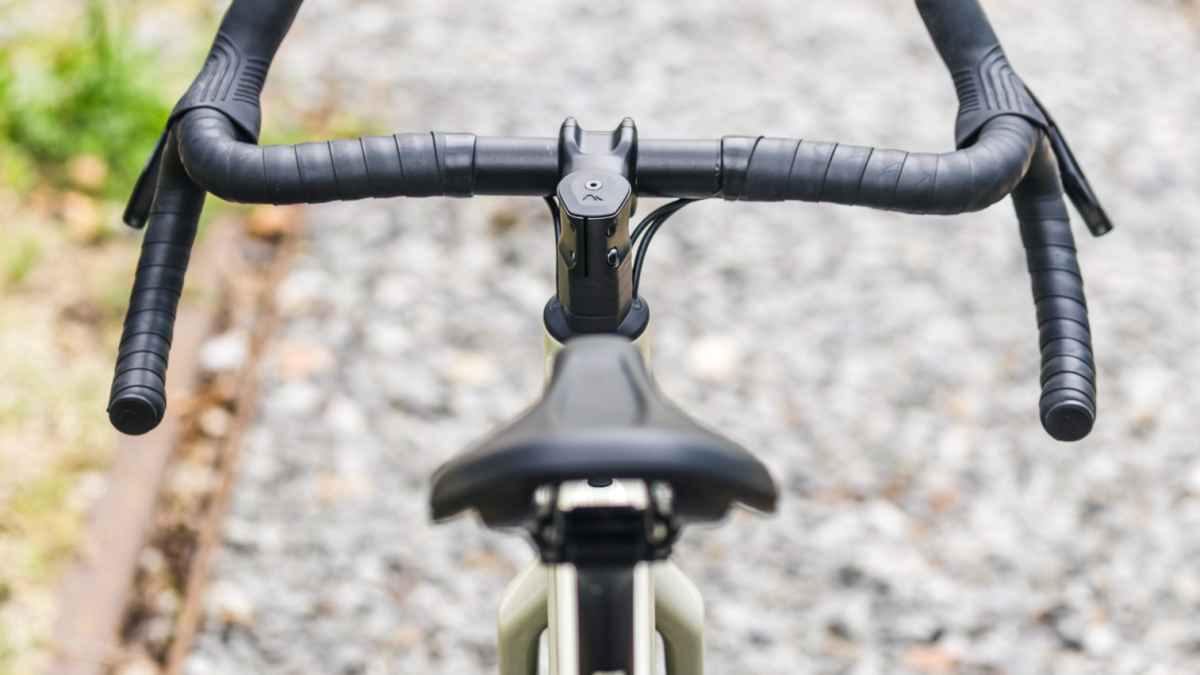
The Rhinelanders are known for their aggressive pricing policy. When we requested the bike for testing, the Regard 7.0 still cost 2,599 euros. Radon has now reduced the price to 2,199 euros, making the bike a real bargain. Had the manufacturer slashed the price a little sooner, even the higher-spec Regard 8.0 would have made it into the test – featuring SRAM’s Rival XPLR AXS wireless groupset, 13 speeds and Newmen carbon wheels. Our verdict: You should definitely consider this model. It’s even lighter and better at sprinting – a cracking deal! But the Regard 7.0 also cuts a fine figure. Particularly striking: it’s the only bike in the test line-up to feature a one-piece carbon cockpit, where the handlebars and stem merge into a single unit. This gives the bike a sleek, uncluttered look – some might even call it sexy. Thanks to its flattened profile, the handlebars feel comfortable in the hands. At 400 millimetres, it is the narrowest in the test field, yet still offers sufficient leverage when accelerating. It also has a shallow drop, making it easy to switch to the lower part of the handlebars, and enough flare to ensure the brake levers remain particularly ergonomically accessible there.
An all-rounder with plenty of climbing potential
Radon describes the only carbon gravel bike in its range as a “sporty all-rounder” – and that sums up the bike’s character rather well. The range comprises four models, with prices ranging from 2,199 to 3,999 euros for the top-of-the-range model. All share the same clean look, with fully integrated cable routing and a single-chainring drivetrain. On the test bike, the 12-speed derailleur is mechanically operated. Although the cassette, with 10 to 51 teeth, results in slightly larger gear steps, it also offers particularly low gears to ensure you don’t get stuck even on steep inclines. However, anyone who mainly rides in the flat north won’t be entirely happy with the gear ratio. The 45-millimetre-wide Continental tyres seemed perfectly adequate to us. According to the manufacturer, however, the Regard can also accommodate tyres up to 50 millimetres wide. That would further enhance riding comfort on rough terrain.
Lively on classic gravel routes
The Regard is tailor-made for classic gravel biking. In other words: dirt tracks and gentle terrain. This is where the bike really shines, with lively acceleration. Weighing just over nine kilos, it’s second only to the Cube in terms of weight. Great: the Regard rides beautifully quietly, and the forest dwellers will thank you if, during a rapid downhill ride, the freewheel doesn’t roar like a chainsaw. Because the moderate comfort ratings drag down the overall score, the Regard was penalised slightly by our testing system. That’s a shame, as the testers’ subjective riding impressions don’t quite match this assessment. The sporty Radon was great fun to ride and really spurred us on to stand out of the saddle and sprint.
Conclusion by Dimitri Lehner, BIKE test editor
The Radon fits my definition of gravel biking to a tee. The bike feels light, accelerates briskly and impresses with its agile handling. The cockpit is particularly stylish. For me, it’s the bike with the highest fun factor.
| Category | Data |
| Price | 2,199 euros |
| Weight | 9,070 g |
| Frame sizes | XS, S, M, L, XL |
| Frame | Carbon, integrated cable routing |
| Drive/Gearbox | Shimano GRX 820, 1x12, 40 teeth / 10–51 teeth |
| Brakes | Shimano GRX 820, 160/160 mm |
| Bicycle wheels | Newmen Evolution SL.X.R.25 |
| Tyres | Continental Terra Speed TR, 45 mm |
| Maximum tyre width | 50 mm, according to the manufacturer |
| Impeller weight | 1507 g at the front / 2228 g at the rear |
| Shape, size M | Seat tube 500 mm, top tube 560 mm, head tube 150 mm |
| Wheelbase/steering angle | 1040 mm / 71.5° |
| Driving stability | 7.9 N/mm |
| Comfort (rear/front) | 198 N/mm / 116 N/mm |
| Bottom bracket stiffness | 62 N/mm |
| Advantages | One-piece cockpit, price, acceleration, well-balanced overall design |
| Drawbacks | Less smoothness and comfort on rough terrain |
What’s good, and what isn’t?
+ stylish one-piece cockpit design, price, acceleration
- lack of smoothness when driving off-road

Dimitri Lehner
Editor
