


Cervélo Áspero: The bike and I – a marriage of convenience or a whirlwind romance?
Dimitri Lehner
· 12.09.2026


The sentence that changed everything
I didn’t know anything about gravel bikes. Absolutely nothing. I’ve been testing mountain bikes for 26 years; I’ve had about a thousand of them pass through my hands. Gravel was uncharted territory for me – same family of bikes, but a different approach.
TOUR mechanic Matthias Fischer then had this to say about the new Cervélo Áspero: "That's brilliant!"
That was enough.
In the road cycling magazine TOUR, the tone was later somewhat more restrained:
2024 – five years after the original Áspero, Cervélo is launching the second generation of its sporty gravel bike. Slimmer tubes and partially integrated cables are designed to make it more aerodynamic, whilst comfort has also been improved. The riding position remains sporty without being extreme.
As a guide: Pure-bred race gravel bikes have an STR+ value of 1.10 (Giant Revolt), 1.11 (Wilier Rave) or 1.13 (Rose Backroad FF). In other words, a more stretched riding position. The Cervélo Áspero has an STR+ value of 1.14
The Cervélo Áspero carbon frame is exceptionally stiff, whilst 40-millimetre tyres and the round carbon seatpost ensure a comfortable ride. Depending on the build, tyres up to 45 millimetres wide are possible. The ‘Trail Mixer’ also allows you to adjust the handling: in the long position, the Áspero rides smoothly and stably without feeling sluggish.

Weighing in at 8,490 grams, the Áspero is lightweight and clearly designed for speed. At the same time, the gear ratio for steep climbs, the UDH derailleur hanger, the top tube bag and additional mounting options ensure it’s perfectly suited to everyday use. Overall, the new Áspero combines the comfort of an adventure gravel bike with the responsiveness of a race model
In the summer of 2024, I cycled my first 50 kilometres through the woods. Then 500 kilometres from Munich through the Allgäu to Freiburg. Later, through the Black Forest and the Upper Bavarian countryside. At some point, it became clear: the Áspero is here to stay.
Road bike with gravel licence
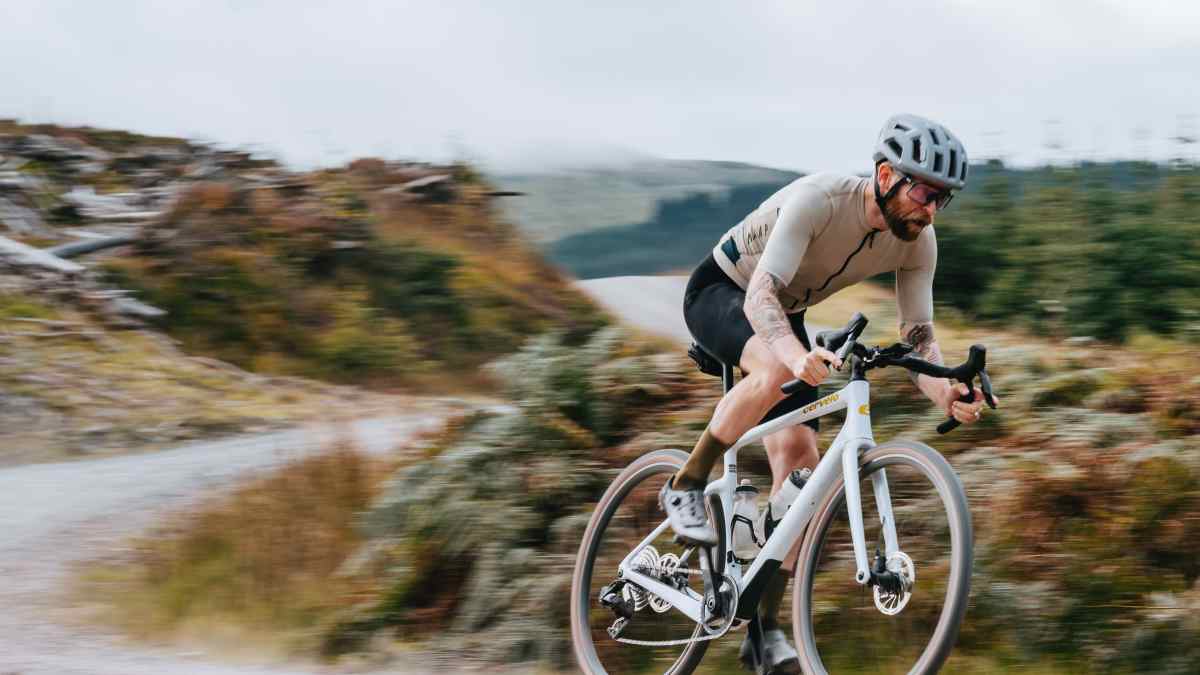
The Áspero is a race gravel bike. An extended riding position, few eyelets, and minimal expedition kit. Designed for speed rather than as a packhorse. Yet you still sit in a surprisingly relaxed position.
The carbon frame is lightweight and looks as though Cervélo had a wind tunnel rather than a campsite in mind when designing it. No wonder: aerodynamics are in the brand’s DNA. The second generation is said to be three watts faster, with some of the cables hidden away in the cockpit. But what matters much more to me is what happens when I’m sitting on it: Press the pedal – and off it goes.
8.5 kilos without pedals is absolutely fine. The bike feels light, partly thanks to the high-profile carbon wheels. The acceleration is still one of its best features. Out of the saddle, pedal, and off you go. Brilliant.
At the same time, it remains comfortable. The round carbon seatpost and the 40-millimetre tyres smooth out a fair bit of the ride. Cervélo now even allows for 45-millimetre tyre widths and is fitting them to the latest models, but I’m sticking with 40 for the time being. Perhaps I’ll switch to fast 45s at some point. I don’t need any wider than that.
What I don’t need
The Áspero also taught me what I need to know when riding on gravel not need.
No suspension fork. I don’t ride on terrain that would justify one. That’s what mountain bikes are for. But everyone should decide that for themselves. Besides, a suspension fork would ruin the frame’s beautiful, clean lines. I’m a bit fussy about that sort of thing.
No Vario support. I’ll just have to be a bit more careful going downhill.
The riding position can be adjusted quite comfortably using spacers. My stack under the stem certainly won’t win any design awards, but it’s invisible from the saddle. I’m still thinking about a one-piece cockpit, though – ideally with the same flare but less drop. The handlebars have a 16-degree flare.
The Áspero is, quite simply, a race-oriented gravel bike with a bit of comfort to spare. It’s not an expedition bike. And that’s exactly what I like about it.
Tubeless tyres, radio issues and other minor mishaps
Of course, after nearly two years, the relationship has had its ups and downs.
The tyres have already had a taste of two nails. The sealant held the puncture at first, but eventually it stopped working. Then we had to resort to tyre plugs. Tubeless: no advantage without a downside.
The SRAM Rival wireless gear system forced me to ride in single-speed mode a few times. The battery was flat. A classic. On another occasion, the button cells in the shift levers had run out. Two minutes later, the problem was sorted. Those are the downsides.
Less amusing: the brake pads. At the front, I’ve worn them right down to the backing plate. In 26 years of mountain biking, that’s never happened to me before.
Removing the rear wheel is a real pain. On one occasion, I suddenly found myself holding the cassette in my hand – complete with tiny metal parts that subsequently went missing amongst the leaves. I’ve put this miniature mechanism back together twice. Once without success. I had to get hold of some replacement pawls. Whoever came up with this design probably doesn’t ride gravel bikes themselves.
Then the bottom bracket made a cracking sound. Diagnosis: loose. Off to the workshop, tightened up, problem sorted. That’s the advantage of bolted bottom brackets. Since then, the Áspero has been gliding silently through the woods again. Almost like a submarine.
Two years on: still in love
I’ve ridden quite a few decent bikes over the years: the S-Works Crux 5, the Giant Revolt, the Factor Aluto and the Storck Fascenario.5. Even so, I still love getting on the Áspero time and again.
Not because it can do everything better. But because it for me gets quite a lot right: it’s fast without being jarring. Comfortable without being mushy. Sporty without reminding me of my age at every kilometre.
Above all, it fits in with what I’ve learnt about gravel riding so far: I don’t need bumpy tracks or carpets of roots. I don’t need MTB tyres or a bike that’s half an Everest expedition in itself. I want to ride through the woods, feel the gravel beneath my tyres, power up a ramp – and sometimes just get home quicker than planned.
After almost two years, my verdict is therefore rather unspectacular: The Áspero was a good buy. In fact, a very good one.
Cervélo Áspero Rival XPLR AXS 1 – Review score and details
- TOUR rating: 1.7
- Price: 5,799 euros (2024), now: 5,499
- Weight of complete bike: 8.5 kilos
- Frame sizes 48, 51, 54, 56, 58, 61 (test size in bold)
Geometry
- Seat tube / top tube / head tube: 471/575/159 millimetres
- Stack/Reach/STR: 596/390 millimetres/1.53
- Stack+/Reach+/STR+: 647/566 millimetres/1.14
- Wheelbase/caster: 1030/70 millimetres
Facilities
- Drive/Gearbox: SRAM Rival XPLR AXS (1x12; 40, 10–44 t.) | Grade: 2.0
- Brakes: SRAM Rival (160/160 mm) | Mark: 1.5
- Tyres: WTB Vulpine TCS Light 40 mm (effective: 42 mm) | Grade: 2.0
- Wheels: Reserve 40/44
- Impeller weights: 1410/1959 grams (left to right)
Measurements
- Driving stability: 8.72 N/mm | Grade: 1.3
- Rear comfort: 94 N/mm | Grade: 1.3
- Comfort Front: 84 N/mm | Grade: 2.3
- Acceleration/bottom bracket stiffness: 62 N/mm | Mark: 1.0
Pros and cons of the Cervélo Áspero Rival XPLR AXS 1
Plus: very comfortable, relatively light, with adjustable handling characteristics
Minus: relatively expensive

Dimitri Lehner
Editor