


World’s fastest road bike: Baldiso breaks the Zenith Aero record and the TOUR record
Jens Klötzer
· 01.10.2026


Data and facts about the Baldiso Zenith
| Weight | 6.19 kg |
| Drivetrain | Shimano Dura Ace Di2 |
| Front brake | Shimano Dura Ace |
| Wheelset | Scope Artech |
| Front tire | Pirelli P Zero Race SLR TLR 28-622 |
Just six years after founding his company, Sebastian Baldauf is launching a major offensive. He aims to have his brand, Baldiso, produce nothing less than the best road bike in the world, as he promises in the press release that recently landed in cycling journalists’ inboxes. When asked what he bases this claim on, Baldauf refers to the TOUR Test. This test measures aerodynamics, frame stiffness and riding comfort on test benches, weights the criteria appropriately and summarises them in a comparable overall score. It is this TOUR Test score that Baldauf has his sights set on – and he is certain that with his model, the Zenith, he will be in with a chance of taking the crown. At least, that is what he has calculated based on the available data, says Baldauf. And now he is keen to prove it.
He’s taking on some big names here: Specialized S-Works Tarmac SL9 and Giant Propel Advanced SL are currently tied for top spot with an overall score of 1.4 – flagship racing models from global market leaders, well-established in professional racing, with decades of experience and substantial development budgets. Baldauf’s company consists of twelve people, yet he is determined to beat the record. This is not based on vague hope: he has backed it up with commissioned tests carried out by established partners. Wind tunnel tests with Robert Kühnen and mechanical tests at Dirk Zedler’s institute preceded the market launch. Both played a key role in developing the TOUR test protocols, which are still in use today.

A bike shop with a vision
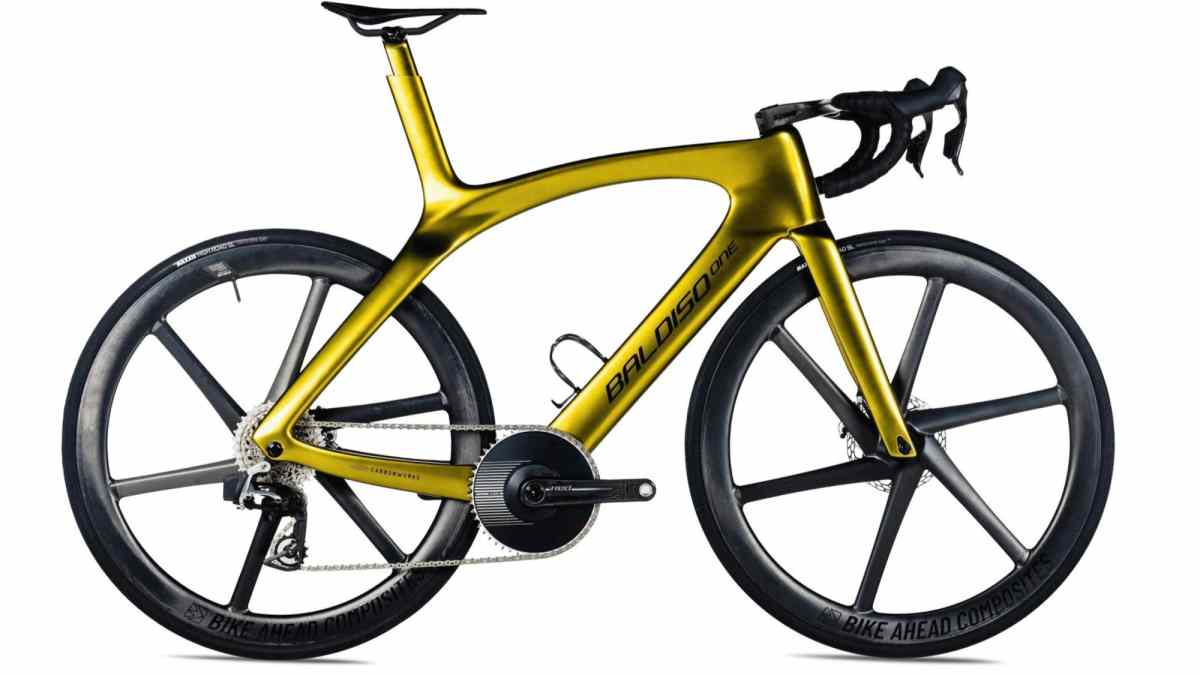
Sebastian Baldauf was a professional cyclist for ten years, before deciding to launch the Baldiso cycling brand. He soon realised, however, that nobody had been waiting for a new brand featuring Far Eastern frames, such as those he initially offered in his shop in the Allgäu. But he stuck with it. With the its first in-house-developed bike, the Baldiso One (or B1), the brand caused quite a stir: an unconventionally designed road bike frame without a seat tube – more sculpture than piece of sports equipment – which nevertheless proved technically impressive. This designer piece, limited to 1,500 units, at least brought Baldauf’s company to national attention. Following the visually radical ‘One’, the brand from the Allgäu region is taking a more understated approach to design with the ‘Zenith’, whilst still making a big splash when it comes to the specs.
Renowned partners
For this project, Sebastian Baldauf once again brought Simon Bühler from CarbonWorks on board – the aerodynamics and carbon fibre expert who had previously been jointly responsible for the B1. He also secured another high-calibre partner for production: the frame set is manufactured entirely by Bike Ahead Composites GmbH in Würzburg, a company renowned in the industry for the high precision and exceptional surface quality of its carbon production. The same expertise that Bike Ahead CEO Christian Gemperlein applies, for example, to BMC’s premium Masterpiece range, is also incorporated into the Zenith frame.
Like varnish, only better
On the one hand, this contributes to the technical characteristics – in other words, the balance between weight and stiffness. The frame is said to weigh just 860 grams, which would be remarkably light given its sweeping lines. The appearance benefits too: many bikes feature visible carbon fibre – but not like this. On the Zenith, the fibre structure lies exposed and perfectly flat, without the usual cosmetic touch-ups of filler and paint that other manufacturers need to make a carbon frame presentable. The result has a sense of depth that makes you want to touch it – smooth as paint, yet with the honesty of the raw material itself. Anyone who still wants colour on the frame can have it in any shade they wish for an additional charge.
First shot, first hit
At first glance, the shape is also distinctive: it is not a designer bike like the B1, but it is, once again, unmistakable. Any similarities to other brands are limited to the details at most. The flowing head tube and the strikingly shaped seat tube create a unique, highly technical-looking silhouette. The design is clearly guided by measurable objectives: aerodynamics, comfort, weight – constrained only by the regulations of the International Cycling Union (UCI). Even the very first prototype produced by the 3D printer achieved an outstanding result in the wind tunnel. Baldauf himself describes the result as a ‘stroke of luck’ – though a second attempt, i.e. a completely new design, would not have been possible anyway for financial reasons. With just a few optimisations and carefully selected components, the production-ready Zenith has thus achieved the best result to date in our wind tunnel tests – at 194 watts, it is just ahead of the Storck Aerfast, which came as a surprise even to the developers.
Tuned to the max
However, the configuration tested leaves no room for further improvements: tall carbon rims from Scope and Aero tyres from Pirelli form part of the highly refined aerodynamics; as is a 3D-printed bottle cage adapted to the frame’s shape – though one could certainly debate whether this is still a bottle cage or an aerodynamic fairing no longer permitted under the racing regulations. The front derailleur has also been omitted in favour of a single, flat carbon chainring, which should save a further two or three watts. The latter remains the biggest compromise in terms of practicality – though anyone who wants a double chainring can fit the Zenith with a derailleur. With the tuning parts fitted, the Zenith weighs in at 6.2 kilograms. That’s not a record, but it’s light enough to score 1.0 in this category – and racing requires a minimum weight anyway.
This means the Baldiso lays the foundations for top marks in its two core disciplines: aerodynamics and weight. The other test results are also impressive. Riding stability is excellent, and the bottom bracket is exceptionally torsionally rigid. The only area with some room for improvement is seating comfort, though even this is good for a race bike: the trick lies in an aero seatpost, which is significantly slimmer at the bottom than the seat tube into which it fits. The rear section of the seat tube is fitted with a rubber sleeve.
New top mark in the TOUR test
All in all, the Zenith narrowly sets a new benchmark on our rating scale with a score of 1.3. And how does such an exclusive racing machine with outstanding lab figures actually ride? The answer may be somewhat sobering, but in a way it’s also reassuring: astonishingly simple and predictable – exactly as you’d want a road bike to be, whatever your requirements. The responsiveness when accelerating is a real experience: The featherweight frame, combined with the extremely stiff bottom bracket, means that the bike shoots forward during sprints like Schmidt’s much-quoted cat. The riding position is modern and race-oriented, and feels just right straight away; it practically tempts you to do acceleration intervals. Once you’ve picked up speed, you’ll want to rest your forearms on the flat handlebars and simply enjoy the speed; even at high speeds, the bike still responds brilliantly to the throttle and lies on the road like a plank. The steering is agile yet predictable; the narrow handlebars make the bike compact and manoeuvrable, whilst the suspension comfort is certainly suitable for long distances on such a sporty road bike – provided you can cope with the upright riding position.
It also features tyres that inspire confidence, comfortable handlebar tape and sturdy brake discs. Apart from the gear ratio – which isn’t suited to hills, though this can be adjusted – a slightly slippery carbon saddle and a bottle cage that takes some getting used to, we can’t find anything on the Zenith that could even begin to detract from the riding experience. However, as the bike is built exclusively to order, you can have your own priorities and ideas incorporated.
Expensive, but there are good reasons for it
Of course, the thrill of speed comes with a price. The test bike costs 15,700 euros – which isn’t quite out of this world, but it is at the very top end of the price range for road bikes. That said, 3D-printed titanium hub bodies, brake discs with carbon spiders, ceramic bearings in all rotating parts and the full-carbon saddle can scarcely be replaced by even more exclusive materials. Whether the technical advantages are worth the premium of around 20 per cent compared to top-of-the-range models from better-known brands is something every buyer must decide for themselves. However, at Baldiso, customers get something the market can hardly offer elsewhere: every bike is manufactured entirely in Germany and assembled to order following in-depth consultation. Top-of-the-range bikes from other premium brands such as Pinarello or Colnago are in a similar price bracket – but are significantly less exclusive. For the most affluent road bike enthusiasts, these can be compelling arguments.
It becomes more difficult to sell the bike on a limited budget: the frame set alone costs 6,900 euros – a reflection of the complex manufacturing process and limited production runs. From €13,200, the Zenith is available as a complete bike with Ultegra Di2 and DT Swiss wheels. However, it is hard to imagine that there might be customers who would prefer an Ultegra Baldiso to a professional-spec Specialized. Another concession to production constraints: Baldiso is initially offering the Zenith in just three sizes: S, M and L. Most prospective buyers should be fine with this, but certainly not all. Despite these drawbacks, the Zenith has become more than just a marketing promise on two wheels. It raises the bar yet another small notch in the race for the title of best designer. It also proves that world-class excellence is not necessarily a question of company size.

Jens Klötzer
Editor